The Diencephalon: The Brain's Relay and Regulatory Hub
Explore the diencephalon, a crucial part of the brain located between the brainstem and cerebrum. This section details the functions of its four main components: the thalamus (sensory relay), hypothalamus (homeostasis), epithalamus (biological rhythms), and subthalamus (motor coordination).
Located between the brainstem and the cerebrum, the diencephalon serves as the central processing and regulatory hub of the brain. While the cerebral cortex is responsible for high-level cognition, the diencephalon manages the critical "middle management" tasks: routing sensory information, maintaining internal stability (homeostasis), and coordinating motor control.
To understand how the brain integrates the external world with internal needs, we must examine its four primary components: the thalamus, hypothalamus, epithalamus, and subthalamus.
The Thalamus: The Sensory Gateway
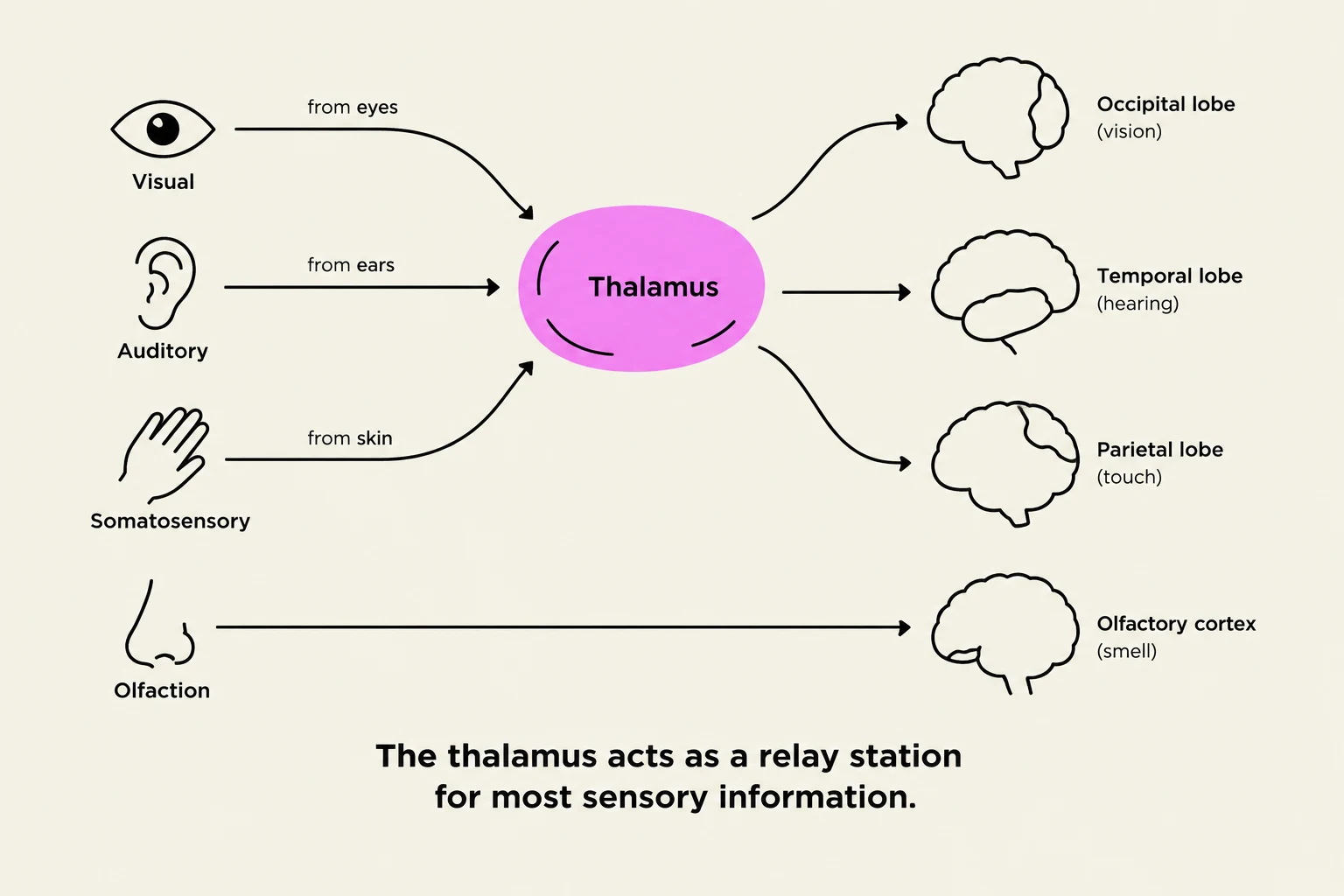
The diagram illustrates how the thalamus functions as a central relay station for sensory information from various parts of the body, including vision, hearing, somatosensory input, and olfaction, before it is processed by different lobes of the brain.
The thalamus is often described as the "relay station" of the brain. Almost all sensory information—with one notable exception—must pass through the thalamus before it can reach the cerebral cortex for conscious perception.
Sensory Routing
The thalamus is not merely a passive cable; it is an active filter. It receives incoming sensory signals, processes them, and directs them to the appropriate specialized areas of the cortex. For example:
Visual information is routed to the occipital lobe.
Auditory information is routed to the temporal lobe.
Somatosensory information (touch, pressure, pain) is routed to the parietal lobe.
Exam Tip: The Olfactory Exception
Remember that the sense of smell (olfaction) is the only sensory modality that bypasses the thalamus and travels directly to the olfactory cortex. This is a common high-yield question in neuroanatomy exams!
The Hypothalamus: The Master of Homeostasis
Diagram illustrating the feedback loop of homeostasis, involving the hypothalamus, temperature regulation, endocrine system, autonomic nervous system, and thirst/hydration.
If the thalamus is the gateway, the hypothalamus is the thermostat and control center. It is a small but incredibly powerful structure responsible for maintaining homeostasis—the stable internal environment required for survival.
The hypothalamus regulates several vital systems:
Autonomic Nervous System (ANS): It influences heart rate, blood pressure, and digestion.
Endocrine System: It acts as the bridge between the nervous and endocrine systems by controlling the pituitary gland.
Temperature Regulation: It senses blood temperature and triggers responses like sweating or shivering.
Hunger and Thirst: It monitors nutrient levels and hydration status to drive feeding and drinking behaviors.
Circadian Rhythms: It helps regulate sleep-wake cycles.
The Epithalamus: Biological Rhythms
The epithalamus is a smaller, dorsal portion of the diencephalon. Its most significant component is the pineal gland.
The pineal gland is responsible for the secretion of melatonin, a hormone that regulates sleep patterns in response to light and darkness. When light levels drop, the pineal gland increases melatonin production, signaling to the body that it is time to prepare for sleep.
The Subthalamus: Motor Coordination
While the other parts of the diencephalon focus on sensation and homeostasis, the subthalamus plays a specialized role in movement.
The subthalamus is part of the complex circuitry that includes the basal ganglia. It helps regulate motor output, ensuring that movements are smooth, coordinated, and purposeful. Damage to the subthalamus can lead to involuntary movements, such as those seen in certain movement disorders.
Summary Table of Diencephalon Components
To help consolidate your learning, use the following table to review the primary functions of each region:
Structure
Primary Role
Key Function/Mechanism
Thalamus
Sensory Relay
Routes sensory data (except smell) to the cortex
Hypothalamus
Homeostasis
Regulates ANS, endocrine system, and body temp
Epithalamus
Biological Rhythms
Pineal gland secretes melatonin for sleep
Subthalamus
Motor Control
Coordinates with basal ganglia for smooth movement
Worked Example: A Physiological Response
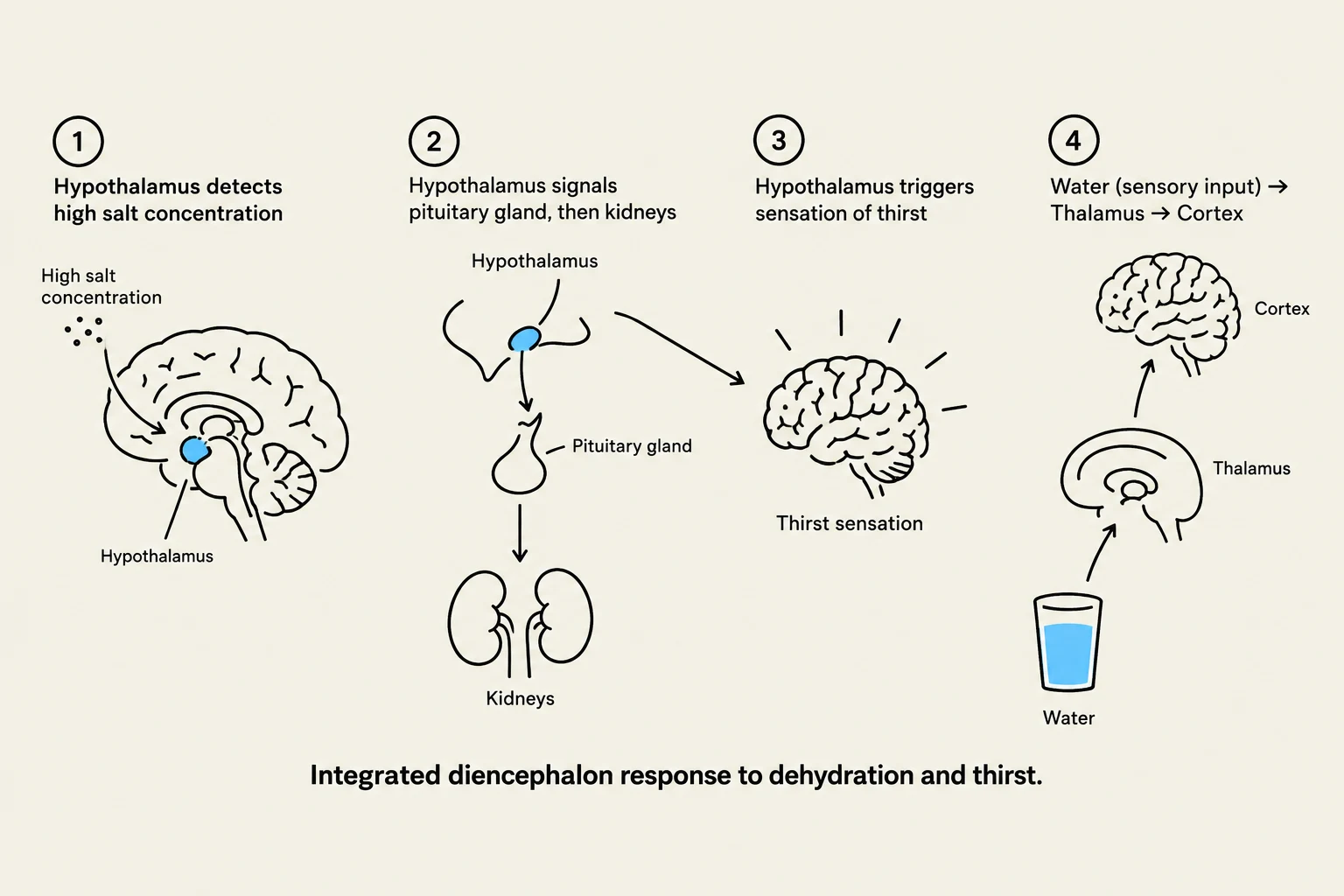
This diagram illustrates the integrated diencephalon response to dehydration and thirst, detailing how the hypothalamus detects high salt concentration, signals the pituitary gland and kidneys, triggers the sensation of thirst, and processes sensory input related to water intake.
To see how these structures work together, consider the scenario of dehydration:
Detection: Osmoreceptors in the hypothalamus detect that your blood is too concentrated (high salt/low water).
Endocrine Response: The hypothalamus signals the posterior pituitary to release Antidiuretic Hormone (ADH), which tells the kidneys to conserve water.
Behavioral Response: The hypothalamus triggers the sensation of thirst, driving you to seek water.
Sensory Integration: Once you find a glass of water, the thalamus relays the visual and tactile information about the glass to your cortex so you can interact with it.
Through this integrated effort, the diencephalon ensures that your internal state remains balanced despite the changing environment.
Keep reading for free.
Create an account to finish this reading and make it part of your study routine.