The Declaration of the Rights of Woman and the Paradoxes of the French Revolution
Examines the exclusion of women from the rights proclaimed during the French Revolution and how women used revolutionary language to demand inclusion, highlighting the paradoxes of liberty and the struggle for citizenship.
The French Revolution is often celebrated as the dawn of modern democracy, a period defined by the pursuit of "Liberty, Equality, and Fraternity." However, this era was also defined by a profound and glaring contradiction: the systematic exclusion of women from the very rights being championed by the new revolutionary government. While the Declaration of the Rights of Man and of the Citizen reshaped the political landscape, it simultaneously codified a gendered hierarchy that relegated women to the private sphere, denying them legal personhood and political agency. This article examines the literary and political responses to this exclusion, focusing on how women utilized the language of the Revolution to demand their own inclusion in the social contract.
The Paradox of Revolutionary Liberty
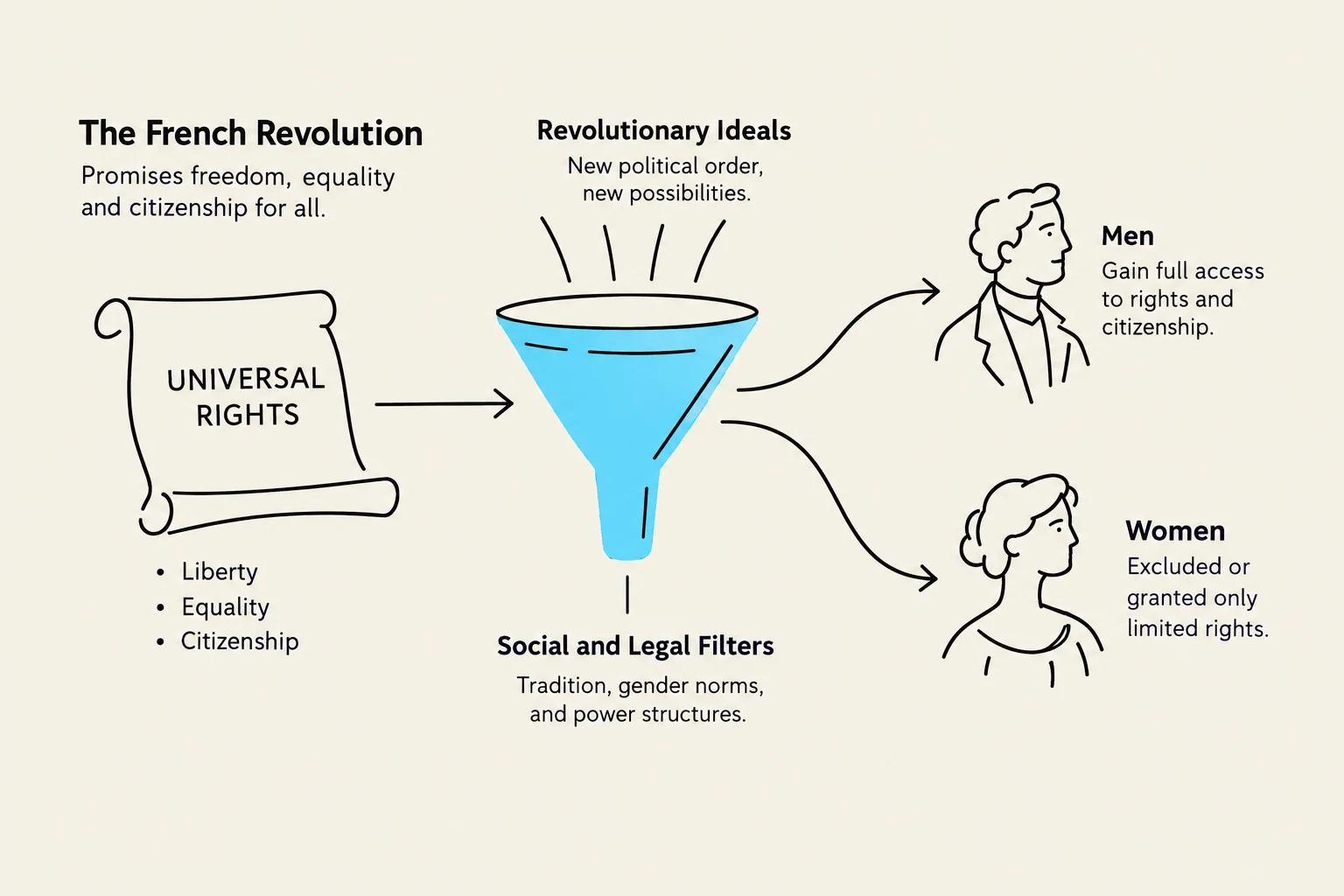
At the heart of the French Revolution lay a tension between universal ideals and restrictive applications. The revolutionary leaders sought to dismantle the privileges of the aristocracy and the clergy, replacing them with a system based on merit and natural rights. Yet, the definition of "citizen" was almost exclusively male. This created a political paradox: a movement dedicated to breaking chains was simultaneously constructing new legal barriers based on sex.
This exclusion was not merely a social oversight; it was a structural component of the new legal order. By defining rights through the lens of masculinity, the state effectively categorized women as dependents rather than autonomous actors.
This diagram illustrates how the ideals of the French Revolution, aiming for universal rights like liberty, equality, and citizenship, were filtered through social and legal structures, resulting in differential access to rights for men and women.
Exam Tip: When analyzing revolutionary documents, always look for who is not mentioned. The "silences" in a text—such as the absence of the word "woman" in a declaration of rights—are often as politically significant as the words that are present.
The Literary Response: Reclaiming the Language of Rights
In response to this exclusion, women writers and activists did not simply ask for permission; they used the Revolution's own logic to argue for their inclusion. The most significant literary and political response was the drafting of documents like the Declaration of the Rights of Woman and of the Female Citizen.
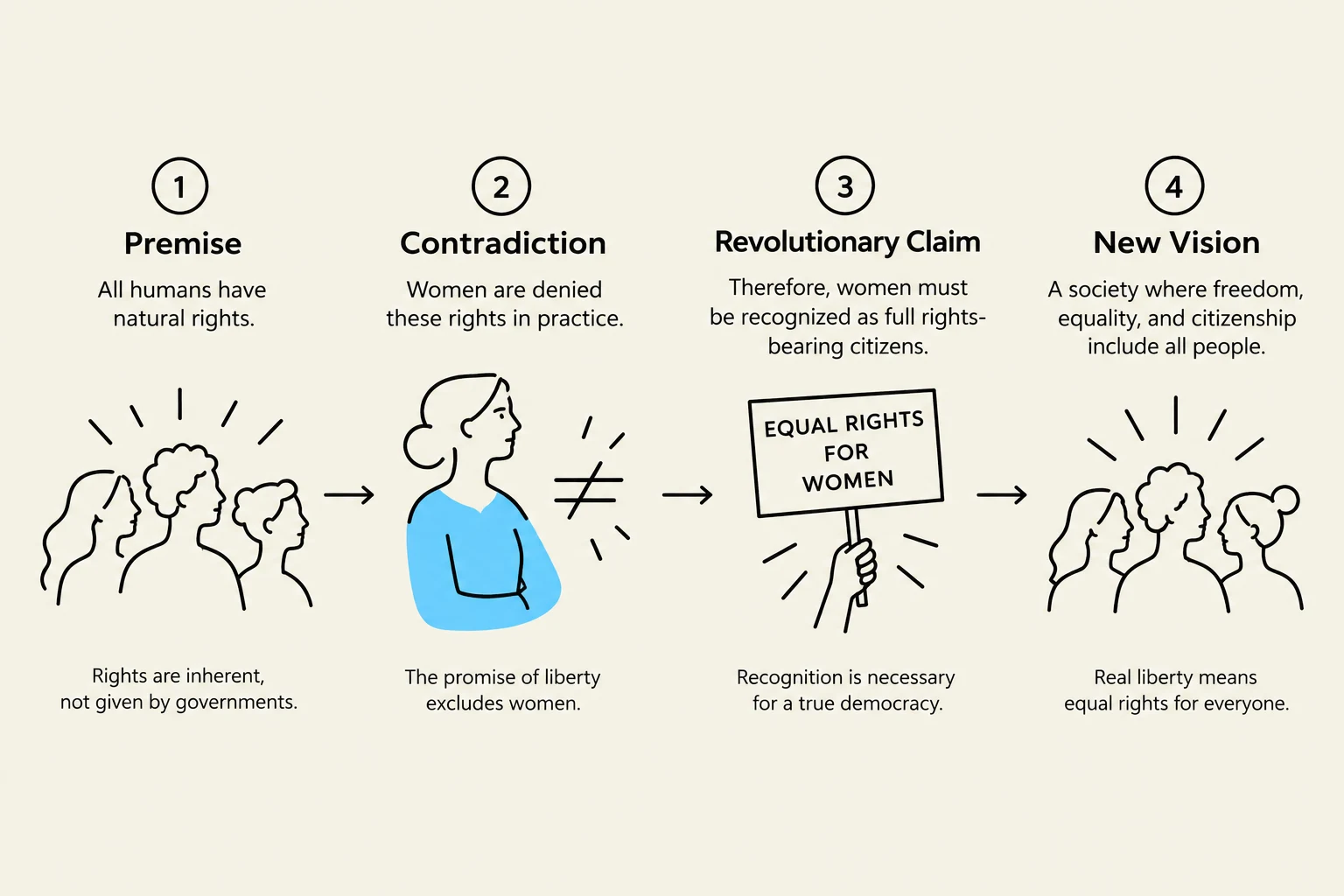
These responses were characterized by a sophisticated use of rhetoric. If the Revolution was based on the principle that "natural rights" are inherent to all human beings, then it followed logically that women, as human beings, must also possess these rights. Activists pointed out the hypocrisy of a government that spoke of "universal" liberty while maintaining "particular" restrictions.
The literary response served several functions:
Critique: Highlighting the contradictions in revolutionary law.
Legitimation: Using the Enlightenment's own philosophical framework to justify female suffrage and legal equality.
Visibility: Moving the "woman question" from the domestic kitchen to the public political stage.
This diagram illustrates a logical progression of arguments for equal rights, starting from the premise of natural human rights and leading to a vision of a society with freedom, equality, and citizenship for all people.
Political Agency and the Struggle for Citizenship
The struggle for women's rights was not confined to the pages of pamphlets; it manifested in the streets and in the halls of power. Women participated in the bread riots, the March on Versailles, and various political clubs. However, as the Revolution progressed and moved toward more radical and eventually conservative phases, the space for female political expression was increasingly constricted.
The political response can be understood through the tension between the Public Sphere (politics, law, war) and the Private Sphere (family, home, child-rearing). The revolutionary government attempted to solidify the boundary between these two, arguing that a woman's contribution to the state was best realized through her role as a mother and wife.
To visualize this tension, consider the following relationship between political participation and legal status:
Political Agency∝Social ConstraintsLegal Recognition
In this conceptual model, as social constraints regarding gender roles increased, the perceived political agency of women was mathematically diminished in the eyes of the law.
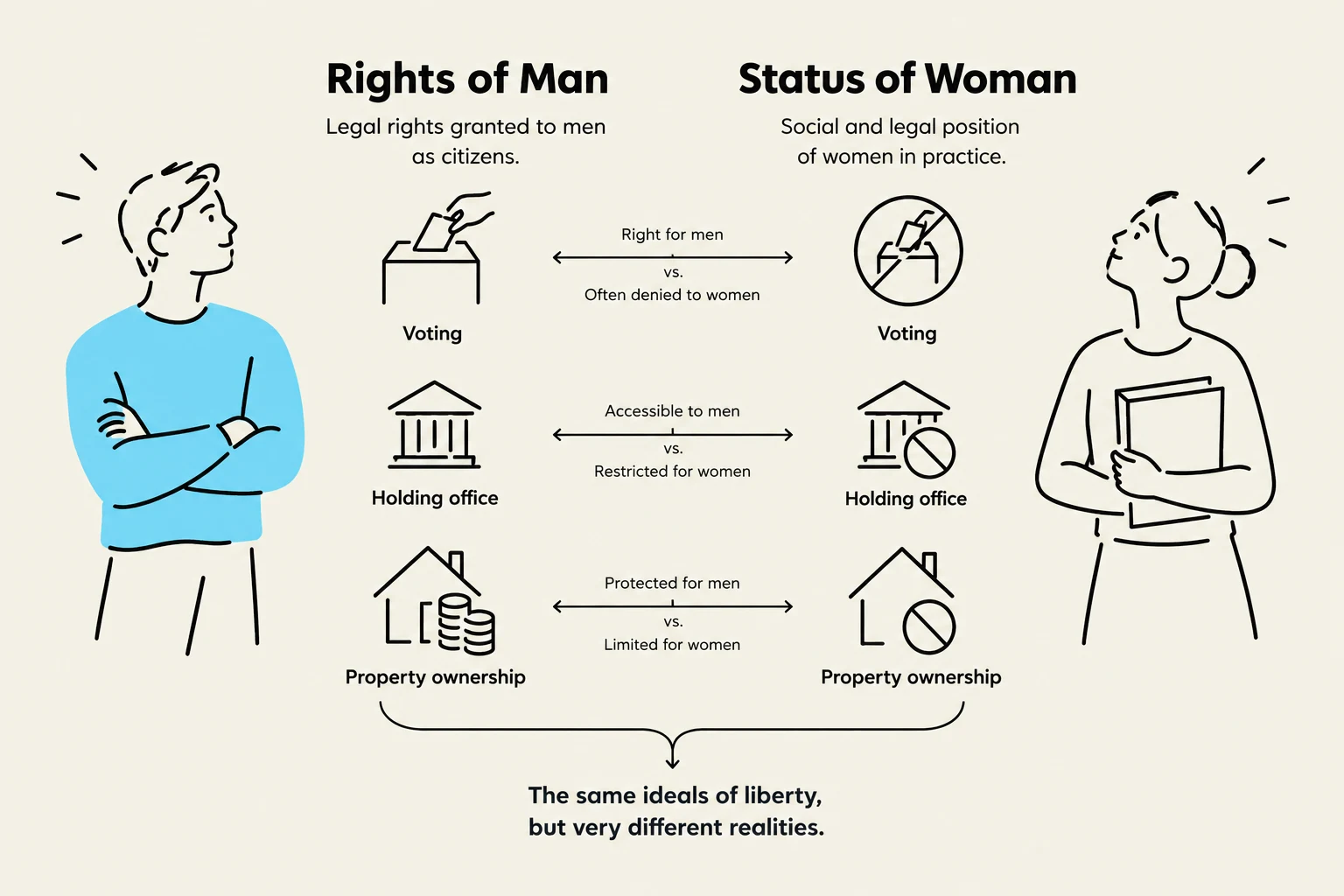
This illustration contrasts the legal rights granted to men as citizens with the social and legal position of women in practice, highlighting differences in voting, holding office, and property ownership, despite shared ideals of liberty.
Conclusion: The Legacy of the Declaration
The Declaration of the Rights of Woman and the various literary responses of the era did not achieve immediate legal equality. In many ways, the post-revolutionary period saw a hardening of gender roles. However, the intellectual groundwork laid during this period was transformative.
By framing gender equality as a fundamental requirement of Enlightenment logic, these early activists ensured that the "woman question" could never be fully silenced. They turned the Revolution's own tools against its limitations, creating a precedent for the feminist movements that would follow in the 19th and 20th centuries.
Keep reading for free.
Create an account to finish this reading and make it part of your study routine.