The Cultural and Historical Significance of Constellations
Explore how constellations have been used across cultures for mythology, navigation, religion, and record-keeping, bridging ancient traditions with modern science.
To the modern observer, the night sky is often seen as a vast, silent expanse of gas and light. However, for most of human history, the sky was far from empty. It was a canvas, a map, a clock, and a sacred text. While modern astronomy defines the field as the scientific study of celestial objects and the laws governing the universe, a more human perspective views astronomy as an investigation into the human condition. By looking upward, our ancestors sought to answer fundamental questions: Where are we? How do we exist? Why do we exist?.
Constellations: Mapping Mythology to the Sky
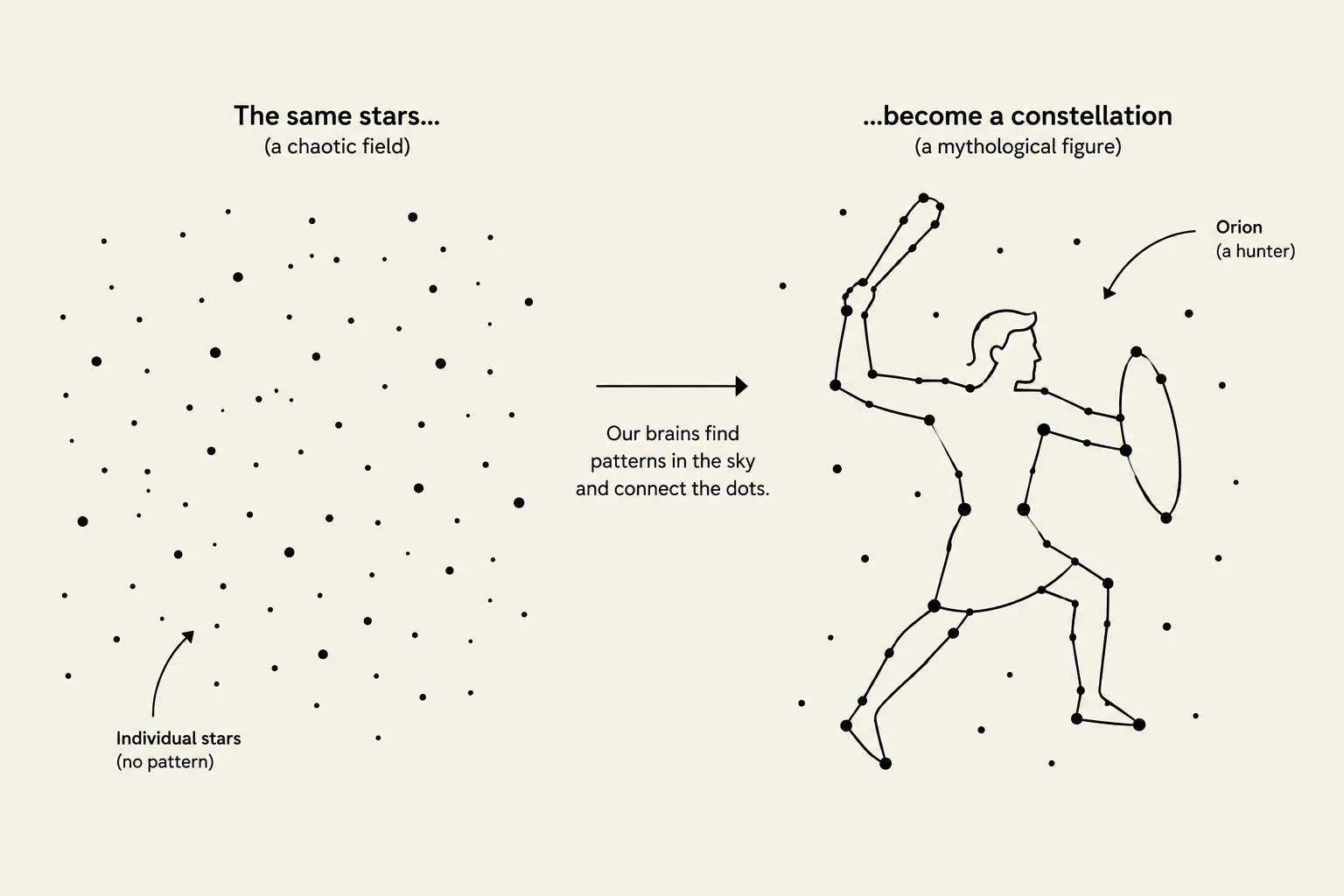
The image illustrates how humans perceive patterns in random star distributions, forming constellations like Orion, the hunter, from what initially appears as a chaotic field of individual stars.
The concept of a constellation is essentially a way for humans to organize the chaos of the stars into recognizable patterns. This process is deeply rooted in storytelling and cultural preservation.
The Ancient Greeks were instrumental in this organization, using 88 constellations derived from their own mythology to divide the sky. This framework provided a systematic way to navigate both the physical world and the mythological one. Similarly, the indigenous peoples of North America utilized the stars to weave and communicate their own cultural narratives. Specific astronomical objects, such as the Pleiades star cluster, have served as central figures in these oral traditions, acting as focal points for storytelling across different generations.
The Evolution of Astrology
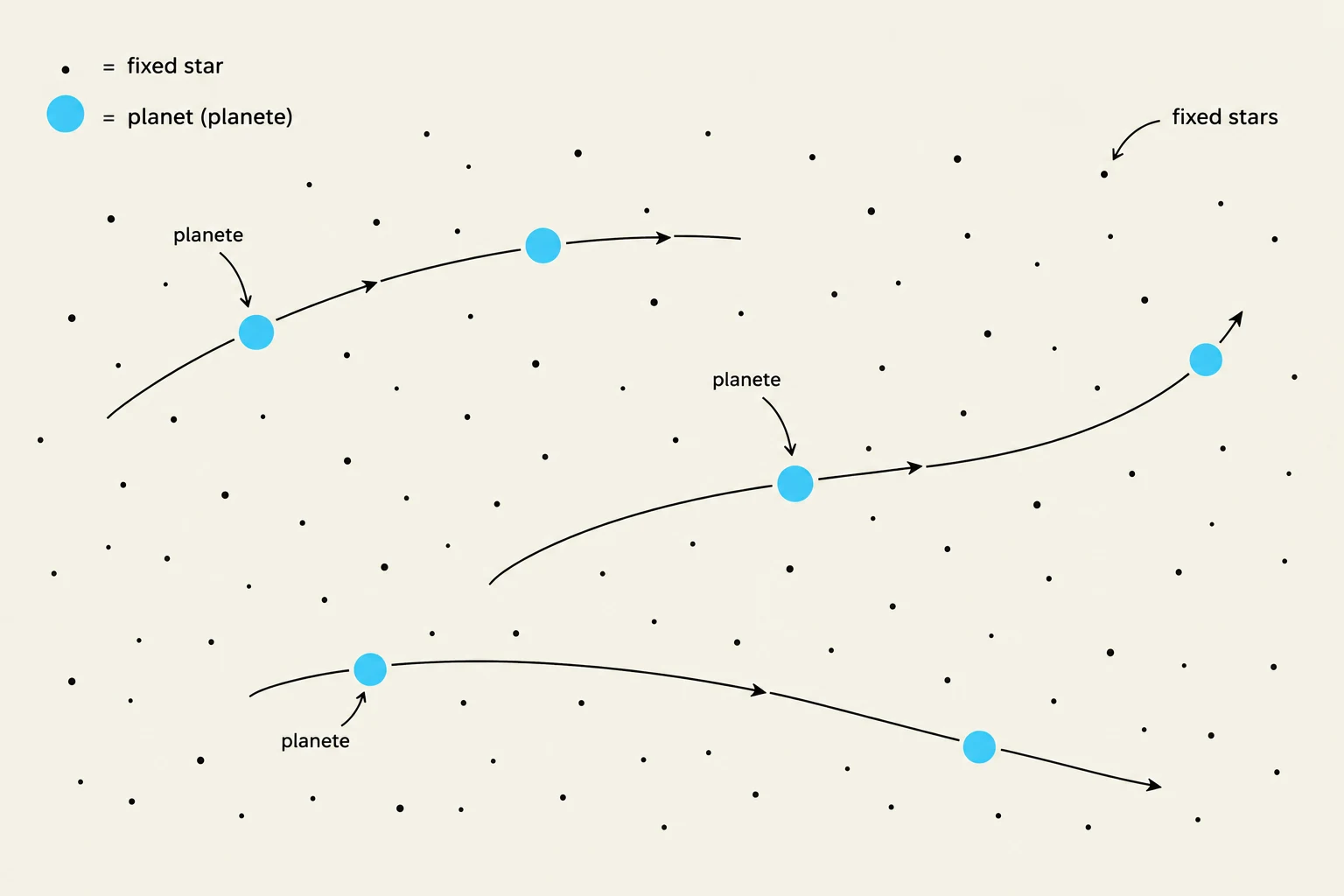
This diagram illustrates the concept of planets orbiting fixed stars in space. The blue circles represent planets, and the black dots represent fixed stars. Arrows indicate the direction of planetary motion.
The relationship between the movement of celestial bodies and human life led to the development of astrology—a discipline born from the perceived connection between the heavens and supernatural forces.
One of the most enduring legacies of this era is the naming of the planets. In Greek, the word for planets is planetes, which translates to "wanderers". This term reflects the observation that, unlike the "fixed" stars, these bodies moved across the background of the constellations. Historically, different civilizations used this knowledge for various purposes:
Babylonians: Used celestial observations to provide guidance and advice to their rulers.
Ancient Greeks: Established the foundational principles of astrology that would eventually shape the Western world.
Study Tip: If you are studying the history of science, remember that astrology and astronomy were once deeply intertwined. It wasn't until much later that they were treated as distinct disciplines.
One figure whose influence remains remarkably potent is Ptolemy. His ancient treatises on astrology were so comprehensive that they continue to be used in astrological studies to this very day.
Stars as Beacons for Navigation
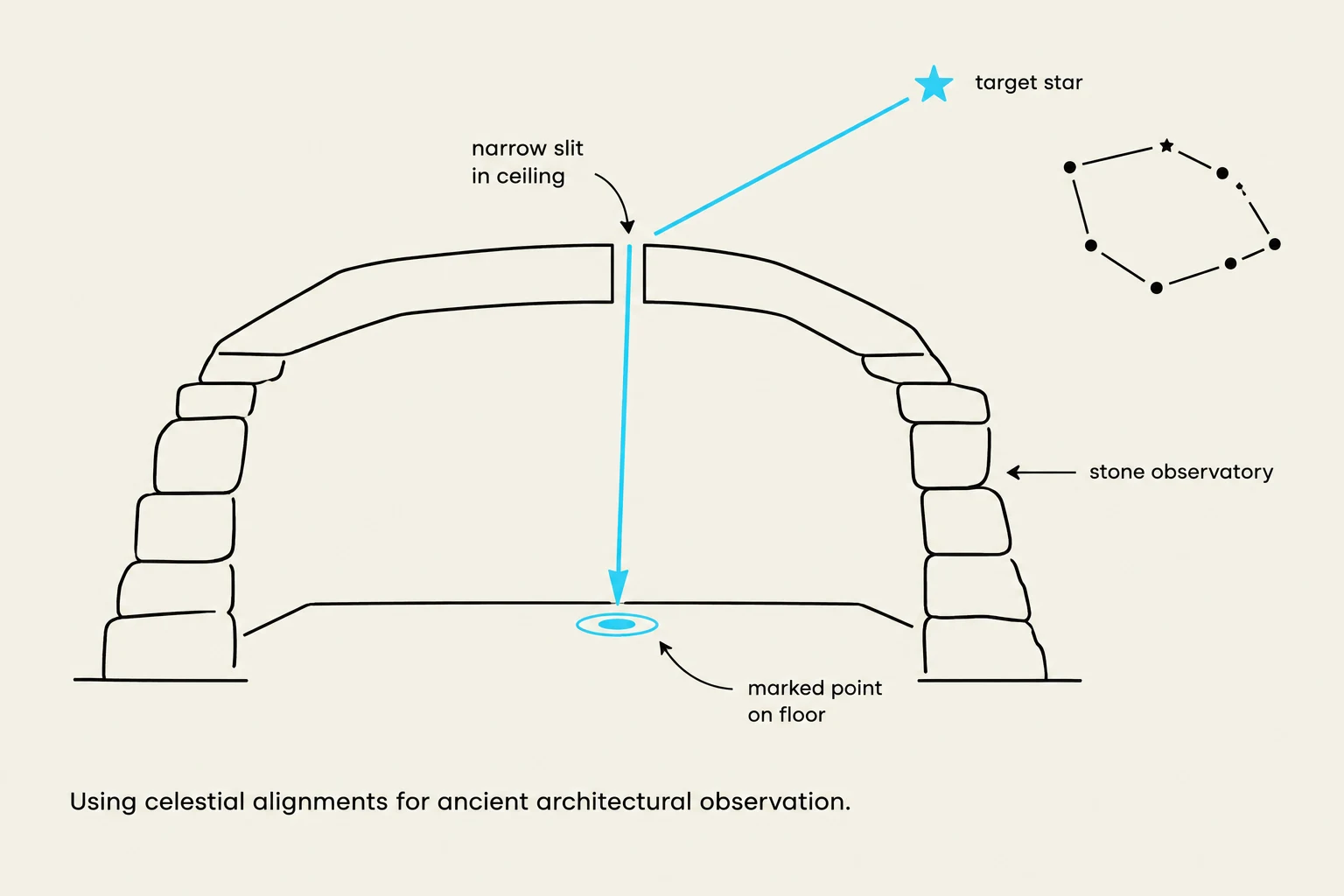
Diagram illustrating how ancient observatories used narrow ceiling slits to align with celestial bodies, casting a light spot on a floor marker.
Beyond the realm of myth and fate, the stars served a practical, life-saving function: they were the primary tools for long-distance travel.
In the Pacific Ocean, navigators mastered the art of wayfinding. By utilizing star charts and understanding the positions of specific stars, they were able to traverse the vast distances of the Polynesian triangle. This allowed for the settlement and connection of isolated island chains across thousands of miles of open water.
Archaeological evidence further proves the importance of celestial observation in ancient engineering. For example, the Rapa Nui observatory was constructed specifically to observe celestial patterns. The design of such structures—often featuring narrow openings in the ceiling—allowed ancient people to track the movement of specific stars with high precision.
Pillars of Religion and Global Record-Keeping
For many cultures, the stars were not just tools, but pillars of spiritual life. This is perhaps most evident in the history of Islamic astronomy.
Islamic astronomers relied heavily on the stars for several critical religious and practical functions:
Timekeeping: Determining the precise time for daily activities.
Location: Finding one's position on Earth.
Prayer: Coordinating specific prayer times according to celestial movements.
This deep historical connection explains why many stars in our modern catalogs still retain their Arabic names.
Finally, the drive to understand the heavens led to a global tradition of meticulous bookkeeping. From the Chinese to the Europeans, civilizations maintained detailed records of astronomical observations. This collective effort to document the sky helped organize societal, religious, and scientific life, creating a bridge between the ancient world and modern science.
Summary Table: Celestial Uses Across Cultures
Culture
Primary Use of Stars/Constellations
Key Legacy
Ancient Greeks
Mythology & Astrology
88 Constellations; Ptolemy's treatises
Indigenous N. Americans
Storytelling & Cultural Narratives
Oral traditions (e.g., Pleiades)
Polynesians
Long-distance Navigation
Star charts; Polynesian triangle
Islamic Astronomers
Religion & Timekeeping
Arabic star names
Babylonians
Political Guidance
Advising rulers
Keep reading for free.
Create an account to finish this reading and make it part of your study routine.