This document explains the principles and methods for controlling microbial growth, including terminology, physical and chemical control methods, and mechanisms of action. It covers sterilization, disinfection, antisepsis, and the dynamics of microbial death, as well as resistance hierarchies and common antimicrobial a
In microbiology, controlling the growth of microorganisms is essential for preventing disease, ensuring food safety, and maintaining sterile laboratory environments. Depending on the goal, we may aim to completely destroy all life forms or simply slow down their multiplication to prevent spoilage or infection. Understanding the distinction between killing a microbe and merely inhibiting its growth is the first step in mastering microbial control.
Terminology of Control
To communicate effectively in clinical and laboratory settings, it is vital to use precise terminology. A helpful rule of thumb is to look at the suffixes of the words used:
-cide: This suffix denotes destruction or killing. For example, a biocide or germicide kills microorganisms, a fungicide kills fungi, and a viricide inactivates viruses.
-stat: This suffix indicates that growth and multiplication have been stopped or held steady. An example is bacteriostasis, which inhibits bacterial growth without necessarily killing the cells.
Beyond these suffixes, we categorize treatments based on their application and intensity:
Sterilization: The complete destruction or removal of all microbial life, including highly resistant endospores.
Disinfection: The removal of pathogens from inanimate objects.
Antisepsis: The removal of pathogens from living tissue.
Sanitization: The process of reducing microbial counts to safe levels, typically on eating utensils.
Degerming: The removal of microbes from a limited area, such as cleaning skin before an injection.
Exam Tip: Remember that "asepsis" refers to the absence of significant contamination, meaning an object or area is pathogen-free.
The Dynamics of Microbial Death
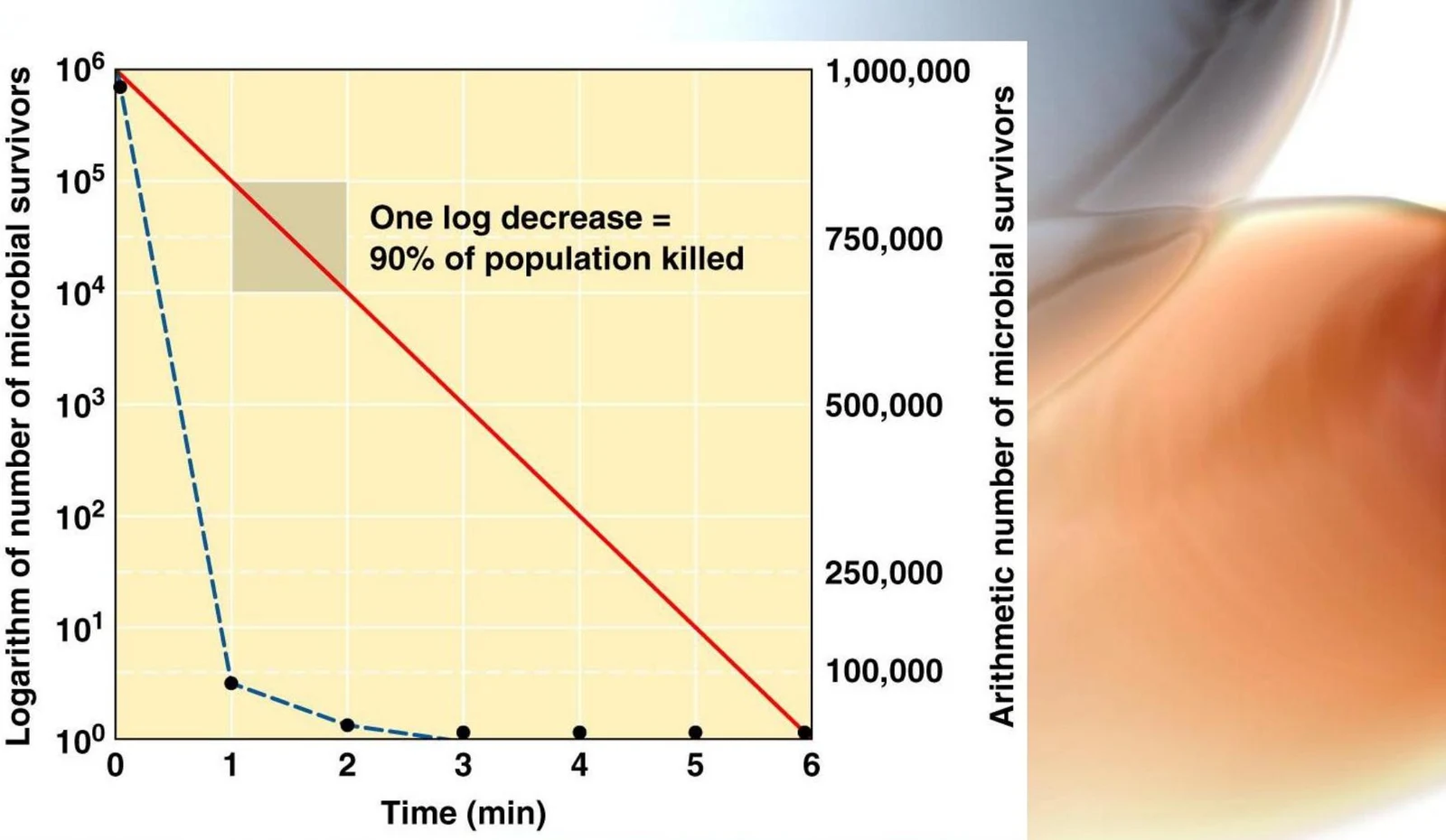
Microbial populations do not die off randomly; they typically die at a constant logarithmic rate. This means that as time progresses, the number of survivors decreases by a consistent percentage rather than a consistent number.
This graph illustrates the logarithmic decrease in microbial survivors over time, indicating that one log decrease corresponds to 90% of the population being killed.
Figure 7.1a
The effectiveness of any antimicrobial treatment is not universal; it depends on several critical factors: the initial number of microbes, the environment (such as the presence of organic matter or biofilms), the time of exposure, and the specific characteristics of the microbes being targeted.
This graph illustrates the logarithmic decrease in microbial survivors over time for both high and low population loads, indicating the rate of microbial reduction.
Figure 7.1b
To quantify how long it takes to kill a population, scientists use the Decimal Reduction Time (DRT), also known as the D Value. This is the number of minutes required to kill $90%$ of a microbial population at a specific temperature.
Time (min)
Deaths per Minute
Number of Survivors
0
0
1,000,000
1
900,000
100,000
2
90,000
10,000
3
9,000
1,000
4
900
100
5
90
10
6
9
1
Table 7.2: Example of DRT calculation
Mechanisms of Action
How do these agents actually work? Most control agents target one of three vital cellular components:
Membrane Permeability: Agents can damage lipids or proteins in the plasma membrane, causing cellular contents to leak out and interfering with growth.
Proteins and Enzymes: Agents can denature the 3-D structure of proteins by breaking hydrogen and covalent bonds, rendering them non-functional.
Nucleic Acids: Damage to DNA and RNA prevents the cell from replicating or performing essential metabolic functions, such as enzyme synthesis.
Physical Methods of Control
Heat
Heat is the most common method of microbial control. It is categorized into two main types:
Moist Heat: This is the preferred method for sterilization because it denatures proteins via coagulation. The autoclave is the gold standard, using steam under pressure. At 15 psi, the temperature reaches 121∘C, which is sufficient to kill all organisms and endospores, except for prions.
Diagram illustrating the operation of a steam sterilizer, showing the flow of steam and air during the sterilization cycle.
Figure 7.2
Dry Heat: This method kills microbes through oxidation. It includes methods like flaming, incineration, and hot-air sterilization. Note that dry heat is less efficient than moist heat; for example, 170∘C for 2 hours is required for dry heat, whereas an autoclave achieves sterilization at 121∘C in only 15 minutes.
Pasteurization is a specialized use of heat designed to reduce pathogenic microbes and lower microbial numbers in food without significantly altering the food's quality. It follows the concept of equivalent treatments: as temperature increases, the time required to kill the same number of microbes decreases.
Filtration
When materials are heat-sensitive (such as enzymes, vaccines, or certain culture media), filtration is used to physically remove microbes. In medical settings, HEPA (High Efficiency Particulate Air) filters are used to remove microbes from the air in operating rooms and burn units.
Temperature and Pressure
Low Temperatures: Refrigeration slows metabolic rates, while deep freezing can disrupt cellular structures with ice crystals. Lyophilization (freeze-drying) stops metabolism entirely until liquid nutrients are added.
High Pressure and Desiccation: High pressure can denature proteins, while desiccation (drying) prevents cell metabolism.
Osmotic Pressure: High osmotic pressure can cause plasmolysis, where the cell membrane pulls away from the cell wall.
Radiation
Radiation damages DNA through different mechanisms:
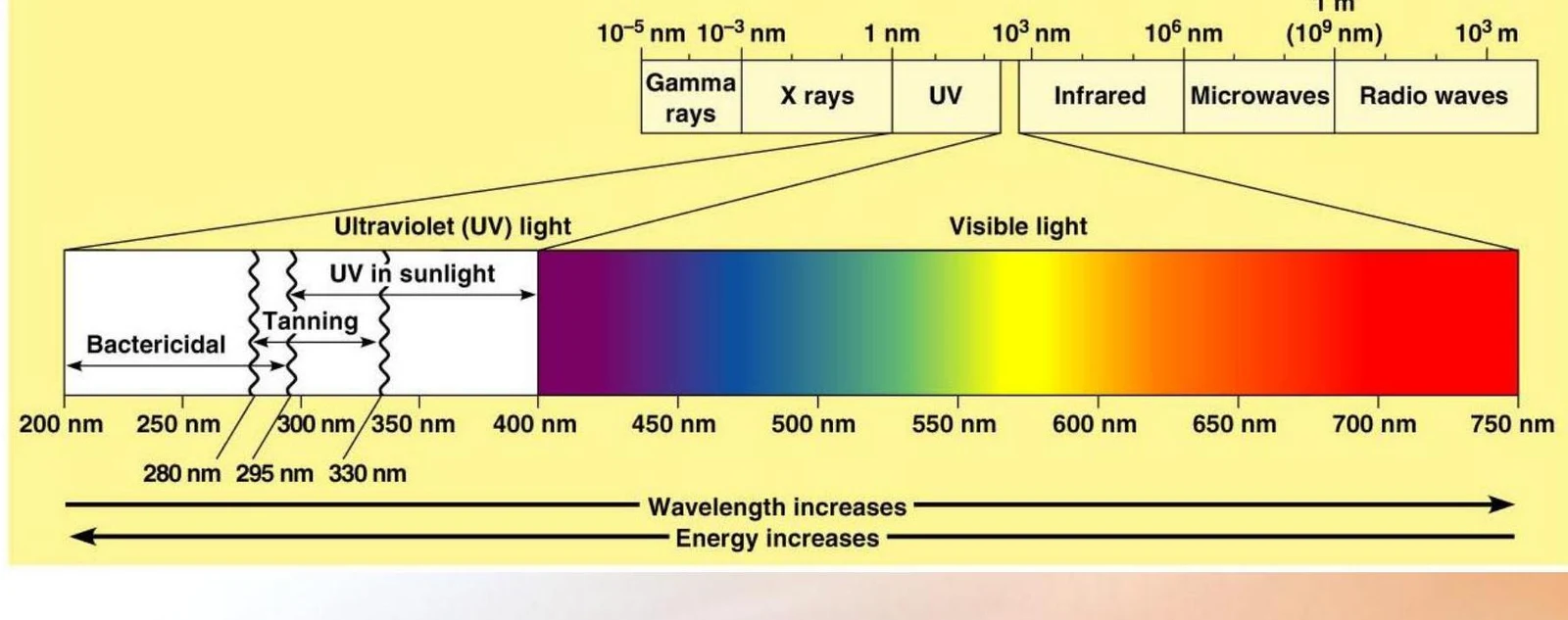
Ionizing Radiation: Includes X-rays and gamma rays. These have short wavelengths (λ<1 nm) and are used to sterilize medical and dental supplies.
Nonionizing Radiation: Includes UV light. These have longer wavelengths (λ>1 nm) and are used for surface and air disinfection, such as germicidal lamps in hospitals.
This diagram illustrates the electromagnetic spectrum, highlighting the ranges of ultraviolet (UV) light and visible light, along with their respective wavelengths and applications such as bactericidal effects and tanning. It also shows the relationship between wavelength and energy increase across the spectrum.
Figure 7.5
Resistance Hierarchy
Not all microbes are created equal. Some are naturally more resistant to control methods than others.
Most Resistant
Least Resistant
Prions
Viruses with lipid envelopes
Bacterial Endospores
Gram-positive bacteria
Mycobacteria
Non-enveloped viruses
Protozoan Cysts
Chemical Methods of Control
Chemical agents are used when physical methods are impractical. Their effectiveness depends on concentration, organic matter presence, pH, and contact time.
Common Chemical Agents
Phenols and Derivatives: Phenols disrupt plasma membranes. Bisphenols like Triclosan (used in soaps) and Hexachlorophene (used in hospitals) are common derivatives.
Biguanides: Chlorhexidine is a broad-spectrum agent used for surgical hand scrubs.
Halogens: Iodine (often as Betadine) impairs protein synthesis, while Chlorine (used in water treatment) is highly effective, particularly in the form of hypochlorous acid (HOCl).
Alcohols: Ethanol and isopropanol denature proteins and dissolve lipids. They are effective against bacteria and fungi but not against endospores or non-enveloped viruses.
Heavy Metals: Metals like Silver (Ag), Mercury (Hg), and Copper (Cu) exert oligodynamic action, meaning even small amounts can be antimicrobial by denaturing proteins.
Surfactants: These include soaps (for degerming) and Quaternary Ammonium Compounds (Quats), which are cationic detergents that disrupt plasma membranes.
Food Preservatives
To prevent spoilage, various chemicals are added to food:
Organic Acids: Sorbic and benzoic acids inhibit metabolism.
Nitrites: Sodium nitrate and nitrite are added to meats (like bacon) to prevent the germination of C. botulinum endospores.
Summary Table: Chemical Effectiveness against Endospores
No activity: Mercury, Bisphenols, Quats, Chlorhexidine.
Poor activity: Phenolics, Iodine, Alcohols.
Fair activity: Chlorines, Glutaraldehyde.
Keep reading for free.
Create an account to finish this reading and make it part of your study routine.