An explanation of Canada's federal system, focusing on the division of powers between the federal and provincial governments as outlined in the Constitution Acts of 1867 and 1982, and the role of the Charter of Rights and Freedoms.
To understand how Canada functions as a nation, one must look beyond the daily news and into the foundational legal architecture that dictates who has the power to make laws. Unlike a unitary system where a central government holds most authority, Canada is a federation. This means power is constitutionally divided between a central federal government and various provincial governments. This division is not merely a matter of administrative convenience; it is a fundamental legal principle enshrined in the country's founding documents.
The Foundations: The Constitution Acts of 1867 and 1982
The Canadian constitutional framework is primarily built upon two monumental pillars: the Constitution Act, 1867 and the Constitution Act, 1982.
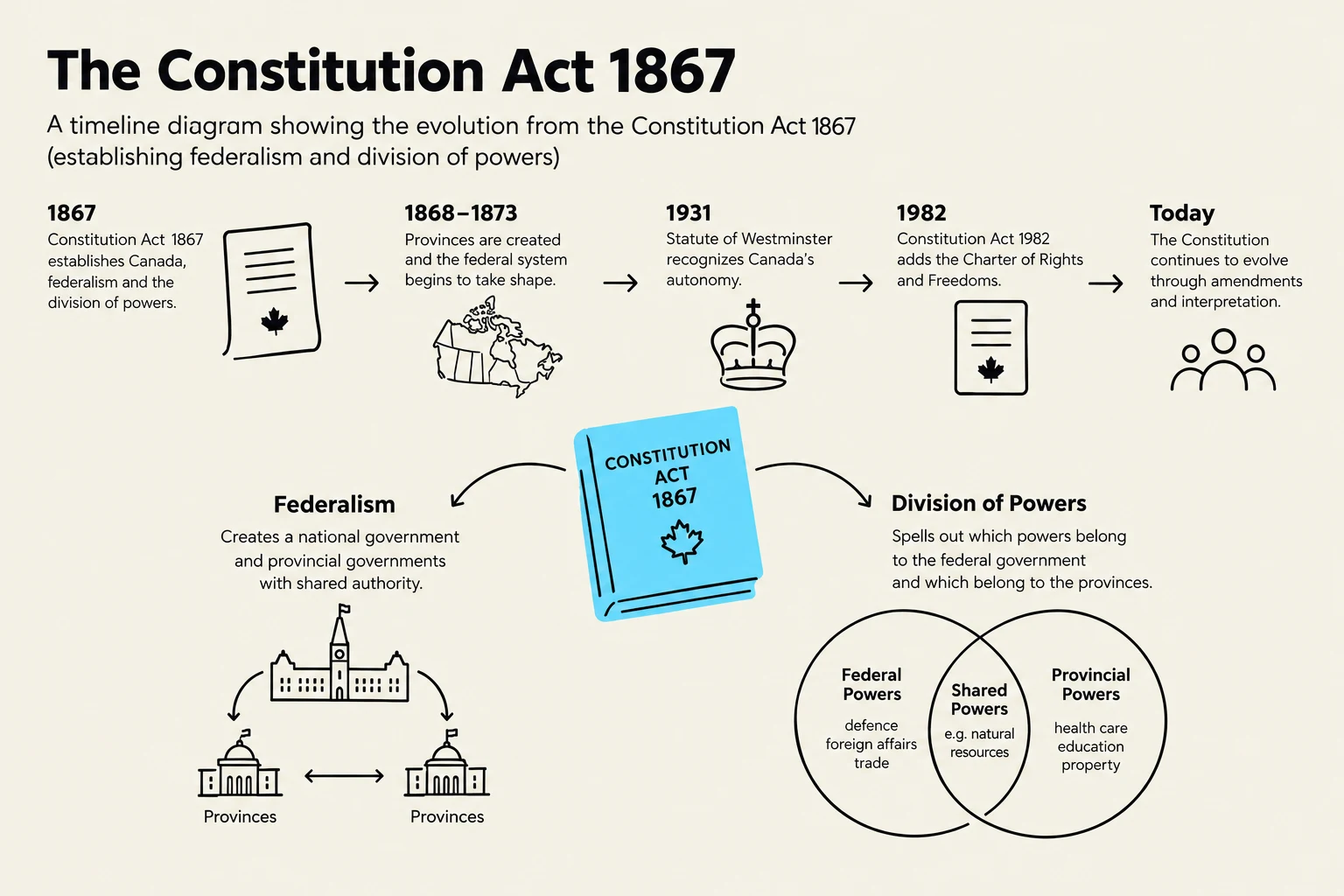
The Constitution Act, 1867 (originally known as the British North America Act) is the blueprint for the Canadian state. It established the structure of the government, the monarchy, and, most importantly, the division of legislative powers between the federal Parliament and the provincial Legislatures.
The Constitution Act, 1982 represented a massive evolution in Canadian law. It did two transformative things: it "patriated" the Constitution (meaning Canada could now amend its own laws without the approval of the British Parliament) and it introduced the Canadian Charter of Rights and Freedoms. While the 1867 Act focuses on who has the power to govern, the 1982 Act focuses on how that power must respect the fundamental rights of individuals.
A timeline illustrating the evolution of the Constitution Act 1867, detailing the establishment of federalism and the division of powers in Canada.
Exam Tip: If a question asks about the "division of powers," focus on the 1867 Act. If it asks about "individual rights" or "the ability to amend the constitution," focus on the 1982 Act.
The Division of Powers: Sections 91 and 92
The core of Canadian federalism lies in the distribution of legislative competence. The Constitution Act, 1867 uses specific sections to delineate which level of government can pass laws regarding specific subject matters.
Federal Powers (Section 91)
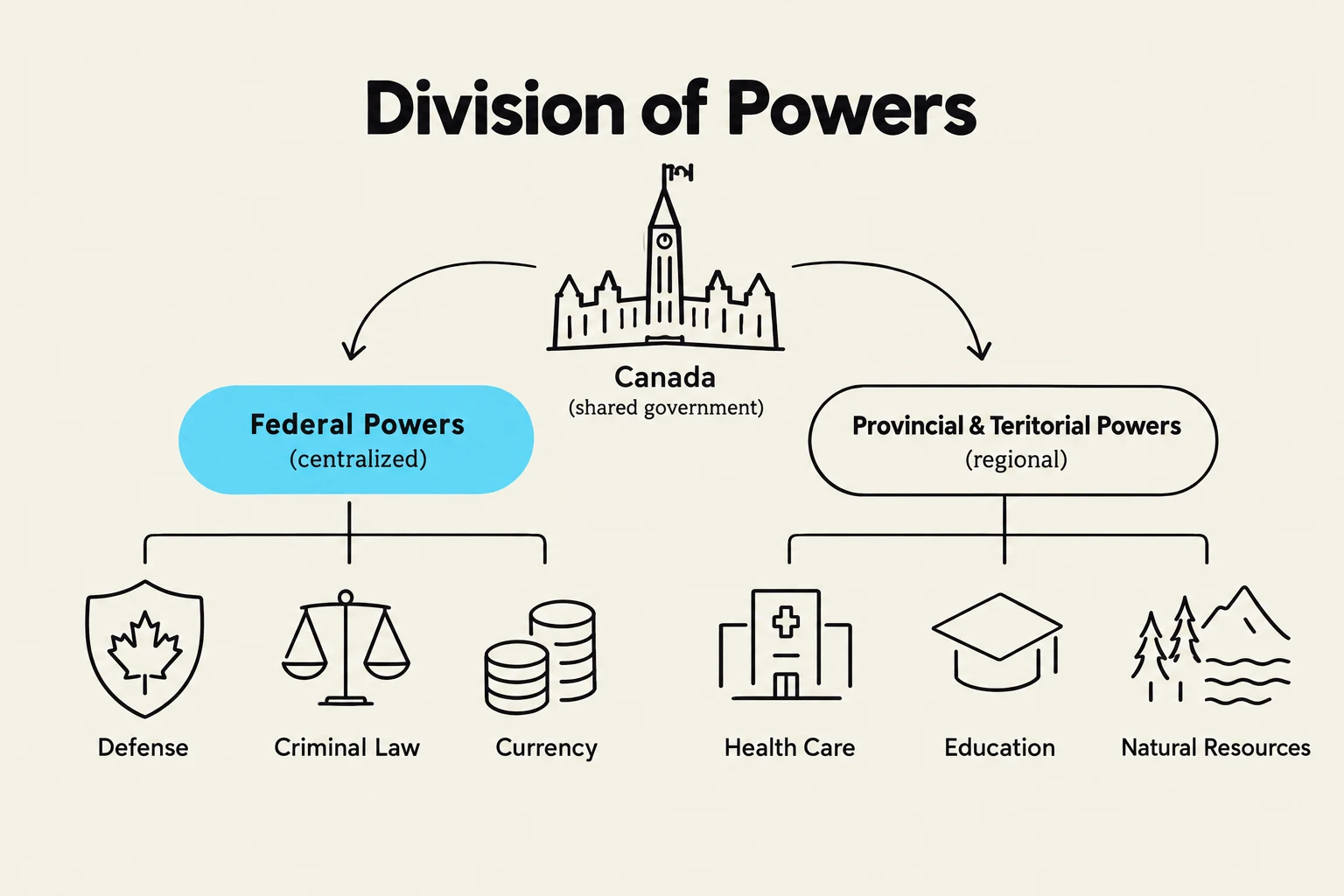
The federal government is granted authority over matters that affect the country as a whole or require national uniformity. These include:
National defense and the military.
Criminal law.
Currency and banking.
Trade and commerce with other countries and provinces.
Postal services.
Provincial Powers (Section 92)
The provinces are granted authority over matters of a "local or private nature." This allows provinces to tailor laws to the specific needs of their regional populations. Key areas include:
Healthcare delivery.
Education.
Property and civil rights.
Municipal institutions.
This diagram illustrates the division of powers between the federal and provincial/territorial governments in Canada, categorizing responsibilities such as defense, criminal law, currency, health care, education, and natural resources.
Resolving Conflicts: Paramountcy and Residual Powers
Because the lists of powers are not exhaustive and can sometimes overlap, the legal system requires mechanisms to resolve disputes.
The Doctrine of Paramountcy
In cases where both the federal and provincial governments have the authority to legislate on a specific matter (known as "concurrent jurisdiction") and their laws conflict, the doctrine of federal paramountcy applies. If it is impossible to obey both laws simultaneously, the federal law prevails, and the provincial law is rendered inoperative to the extent of the conflict.
Residual Powers
A critical distinction between the Canadian system and others (like the United States) is the concept of "residual powers." In Canada, any area of lawmaking not specifically assigned to the provinces in Section 92 is granted to the federal government under the "Peace, Order, and Good Government" (POGG) clause of Section 91.
Worked Example: The Internet and New Technology
Imagine a new technology emerges that was unknown in 1867, such as satellite communications. Since "satellite regulation" is not explicitly listed under provincial powers in Section 92, the federal government would likely claim jurisdiction over it using its residual powers (POGG) to ensure national consistency.
The Impact of the Charter of Rights and Freedoms
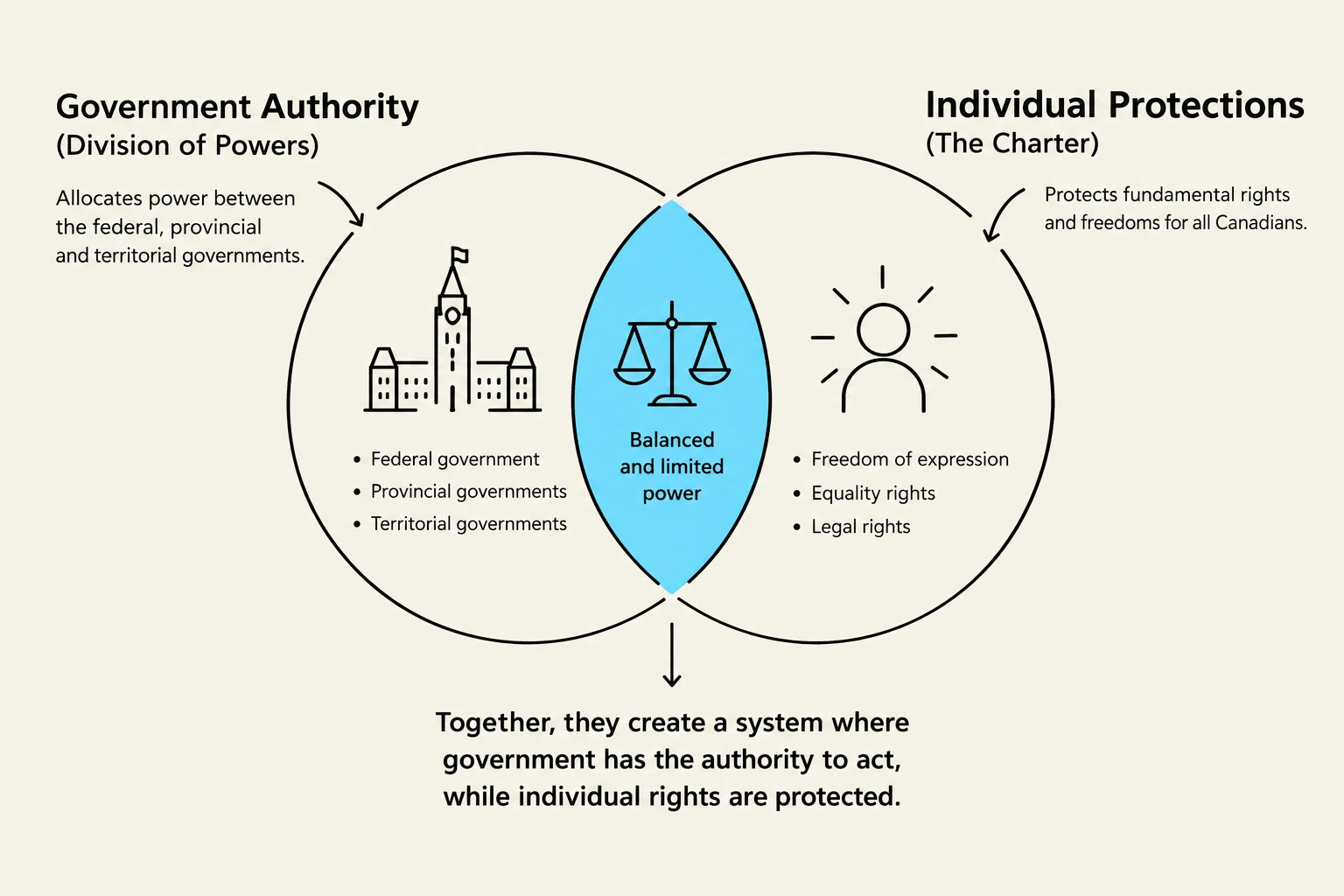
While the division of powers dictates who can make a law, the Canadian Charter of Rights and Freedoms (part of the 1982 Act) dictates whether that law is valid in a democratic society.
Before 1982, the courts primarily focused on whether a government had the authority to pass a law (the division of powers). After 1982, the courts also examine whether the content of that law violates protected rights, such as freedom of expression, equality rights, or legal rights. This means even if the federal government has the power to pass a criminal law, that law can be struck down if it violates the Charter.
This diagram illustrates the division of powers within a government, showing how authority is allocated between federal, provincial, and territorial governments, and how this balances with individual protections such as freedom of expression, equality rights, and legal rights, as outlined in The Charter.
Summary Table: Quick Reference
Feature
Constitution Act, 1867
Constitution Act, 1982
Primary Focus
Structure of government and division of powers.
Rights of citizens and constitutional independence.
Key Mechanism
Sections 91 (Federal) and 92 (Provincial).
The Canadian Charter of Rights and Freedoms.
Jurisdiction
Defines who makes the law.
Defines the limits of what laws can do.
By balancing the autonomy of the provinces with the necessity of a strong central government, and tempering both with the protection of individual rights, the Canadian constitutional framework creates a complex but stable system of governance.
Keep reading for free.
Create an account to finish this reading and make it part of your study routine.