An overview of the U.S. Constitution's creation, focusing on the compromises made by the Framers to balance government power, state sovereignty, individual liberty, and representation.
When the delegates gathered in Philadelphia in 1787, they were not merely tasked with fixing a broken system; they were tasked with inventing a new one. The previous governing document, the Articles of Confederation, had created a national government so weak that it could not tax, regulate commerce, or even raise an army to quell domestic rebellions like Shays’ Rebellion. The Framers sought to replace this instability with a system that could effectively manage a growing nation while simultaneously preventing the rise of tyranny.
To achieve this, they balanced four primary objectives: creating a strong government for defense and commerce, establishing a federal government that respected state sovereignty, ensuring a limited government to protect individual liberty, and building a representative government based on the consent of the governed.
The Great Compromises: Balancing Power and People
The drafting of the Constitution was defined by intense debate and the necessity of compromise. One of the most fundamental conflicts involved how states would be represented in the new national legislature.
The Battle for Representation
Large states favored the Virginia Plan, which proposed that representation in Congress should be proportional to a state's population. This would give more political weight to more populous states. Conversely, small states advocated for the New Jersey Plan, which argued for equal representation, giving every state one vote regardless of size.
The resolution was the Great Compromise, which created a bicameral Congress. Under this system, the House of Representatives provides proportional representation based on population, while the Senate provides equal representation for every state.
A diagram illustrating the structure of a bicameral Congress, showing the House of Representatives based on population and the Senate based on states with equal representation.
Slavery and the Three-Fifths Compromise
A darker and more contentious compromise involved the issue of slavery and political power. Southern states wanted enslaved people to be counted toward their population totals to increase their number of seats in the House of Representatives, even though enslaved people were denied legal rights. Northern states opposed this, arguing that if enslaved people were considered property and lacked rights, they should not count toward political apportionment.
The resulting Three-Fifths Compromise dictated that each enslaved person would be counted as three-fifths of a person for the purposes of both taxation and political representation.
Defining the Presidency
The delegates also struggled to define the executive branch. While they agreed on a single executive, they disagreed on how that person should be chosen. The final decision was to implement the Electoral College, a system where each state is assigned a number of electors equal to its total number of members in Congress.
The Ratification Debate: Federalists vs. Anti-Federalists
Once the Constitution was drafted, it had to be approved by at least nine of the thirteen states. This sparked a fierce national debate between two primary factions.
Federalists: Supporters of the new Constitution who argued that a strong central government was essential for national stability. They published The Federalist Papers to persuade the public of the Constitution's merits.
Anti-Federalists: Opponents who feared that a powerful national government would inevitably trample on state sovereignty and personal liberties.
Exam Tip: If a question asks what was required to secure the support of the Anti-Federalists, the answer is the Bill of Rights. The promise to add these first ten amendments—protecting freedoms like speech, religion, and trial by jury—was essential to the ratification process.
Mechanisms of Limited Government
The Framers were deeply suspicious of "unrestricted majority rule," fearing it could lead to a "tyranny of the majority" where an irrational mob might trample the rights of the minority. To prevent this, they designed a system of limited government—a government subject to strict legal limits on its use of power.
Separation of Powers and Checks and Balances
To ensure no single entity could seize absolute control, the Framers implemented the separation of powers, dividing national authority among the legislative, executive, and judicial branches. However, they went a step further by creating an interlocking system of checks and balances.
In this system, each branch has the capacity to restrict the others. For example:
The President can veto legislation passed by Congress.
Congress can impeach the President or override a presidential veto.
The Supreme Court can declare acts of Congress or executive actions unconstitutional.
This diagram illustrates the checks and balances between the three branches of the U.S. government: the President, Congress, and the Supreme Court.
Grants and Denials of Power
The Constitution also limits government through the explicit use of grants and denials of power.
Grants of Power: The Constitution lists specific powers given to the national government (such as the power to regulate commerce or raise an army).
Denials of Power: The Constitution expressly prohibits certain actions, ensuring that neither the national nor the state governments can overstep their bounds.
Representative Government and the Republic
Finally, the Framers sought to establish a representative government based on popular consent. However, they distinguished between a "direct democracy"—where people vote on every policy—and a republic. They viewed direct democracy as impractical and dangerous at a national level, preferring a republic: a system where elected delegates make decisions, but within a framework of constitutional limits that protect minority rights.
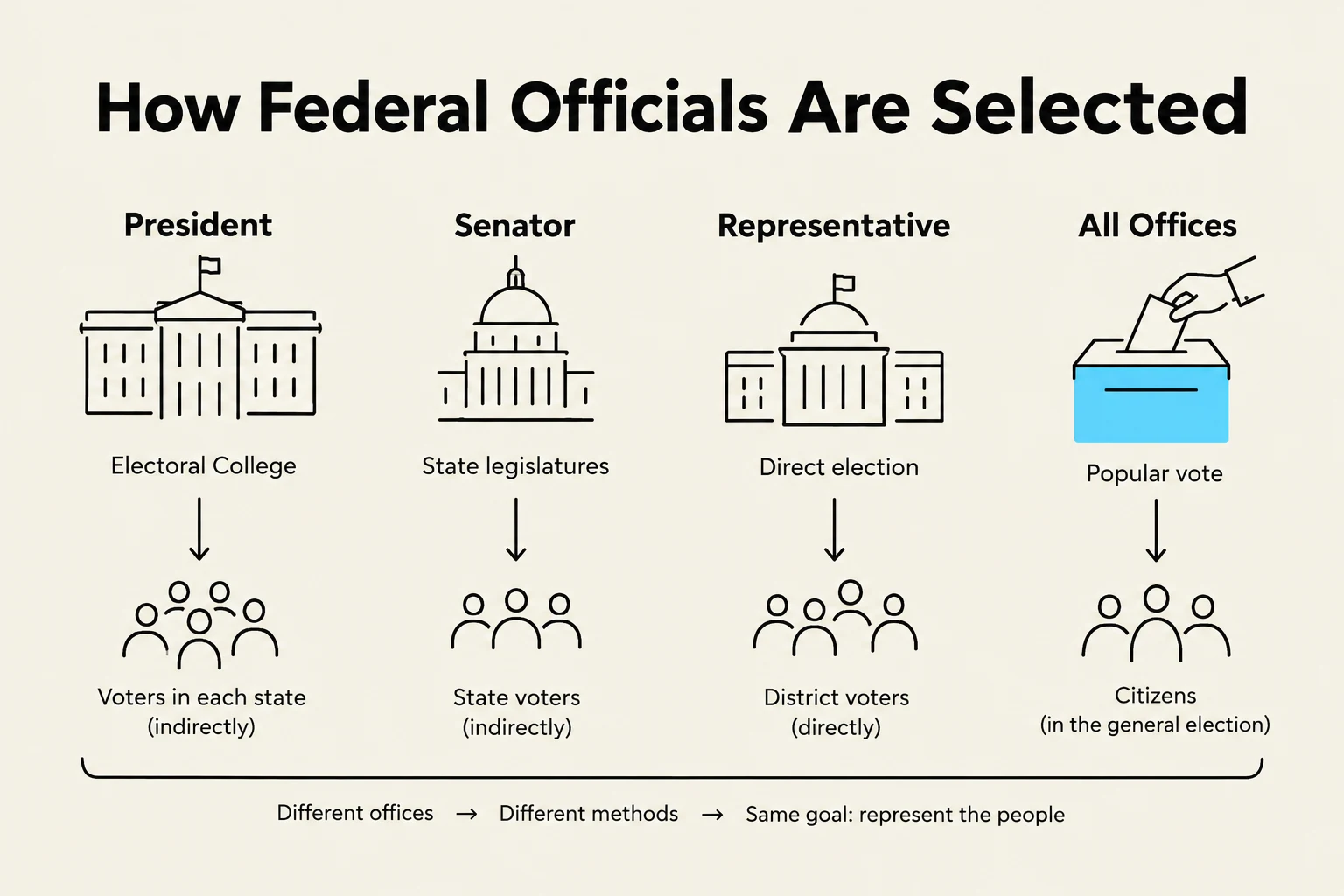
To ensure the government remained accountable to the people, the Framers included provisions for elections. While the original system was designed to be somewhat indirect—for instance, Senators were originally chosen by state legislatures rather than by popular vote—the system provided a mechanism for voters to eventually remove officials from office.
This diagram illustrates how federal officials in the United States are selected, outlining the different methods for electing the President, Senators, and Representatives, as well as the general process for all offices.
Today, the United States is described as a constitutional democratic republic. It is constitutional because power is exercised lawfully with respect to individual rights; democratic because it allows for majority influence through elections; and a republic because it utilizes separated institutions to moderate power.
Keep reading for free.
Create an account to finish this reading and make it part of your study routine.