The Cognitive Science of Religion: An Interdisciplinary Approach
Explore the Cognitive Science of Religion (CSR), an interdisciplinary field that uses evolutionary biology, cognitive psychology, and neuroscience to understand how religious beliefs, rituals, and behaviors emerge and persist in the human mind and society. It examines cognitive mechanisms like agency detection and theo
What is the Cognitive Science of Religion (CSR)? At first glance, the term might seem paradoxical. How can one apply "science"—a discipline rooted in empirical observation and natural laws—to "religion," a domain often associated with the supernatural, faith, and the intangible? CSR seeks to bridge this gap by moving away from asking whether religious claims are true, and instead asking how religious ideas are possible within the human mind and social structures.
By integrating evolutionary biology, cognitive psychology, and neuroscience, CSR explores the mechanisms that allow religious beliefs, rituals, and behaviors to emerge, persist, and spread throughout human history.
The Core Mission of CSR
The fundamental goal of CSR is to understand the cognitive architecture that makes religious thought a natural byproduct of human intelligence. Rather than treating religion as an external force that "infects" the mind, CSR views it as a phenomenon arising from the way our brains are wired to process information.
To achieve this, the field focuses on several key pillars:
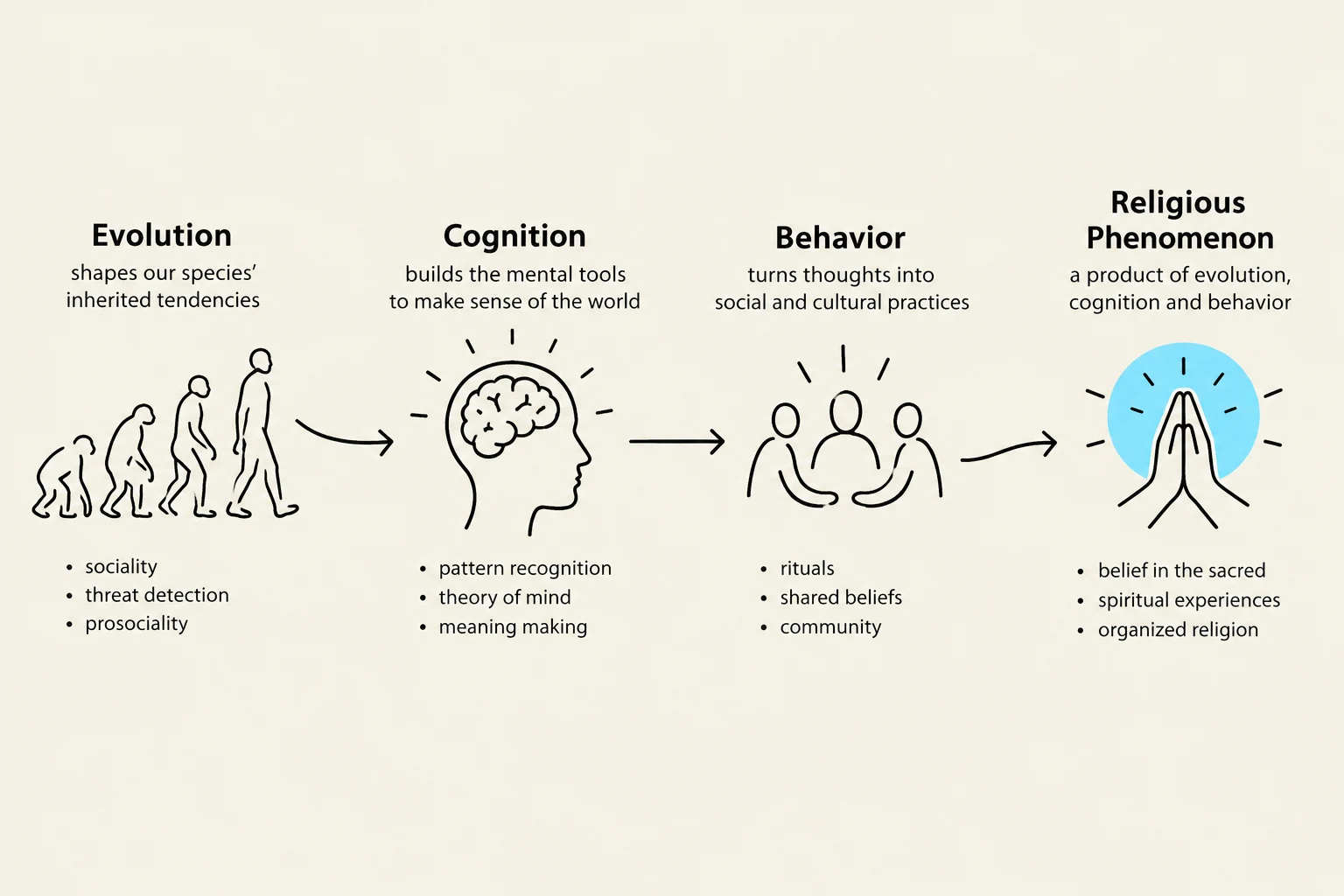
Evolutionary Perspectives: Why did religious tendencies survive natural selection?
Cognitive Mechanisms: Which specific mental processes (like agency detection) facilitate religious belief?
Behavioral Patterns: How do these mental processes translate into social rituals and group cohesion?
Study Tip: When approaching CSR, remember the "Naturalistic Assumption." CSR does not attempt to prove or disprove the existence of gods. It treats religious phenomena as natural data points to be explained through biological and psychological processes.
This diagram illustrates the evolutionary progression from basic inherited tendencies to complex religious phenomena, encompassing cognition and behavior as intermediate stages.
The Evolutionary Foundation
To understand why religion exists, CSR researchers look to our evolutionary past. One major area of inquiry is whether religious behaviors provided an adaptive advantage to our ancestors. This is often explored through the lens of group selection and social cohesion.
If a shared belief system encourages individuals to cooperate, sacrifice for the group, and follow common rules, then groups with high religious engagement may outcompete groups without such cohesion. In this view, religion acts as a "social glue" that facilitates large-scale cooperation among non-kin members.
Cognitive Mechanisms: The "How" of Belief
While evolution explains why religion might persist, cognitive science explains how it is generated. The human brain did not evolve specifically to believe in gods; rather, it evolved to solve specific survival problems. Religious ideas are often "byproducts" of these specialized cognitive systems.
1. Hyperactive Agency Detection Device (HADD)
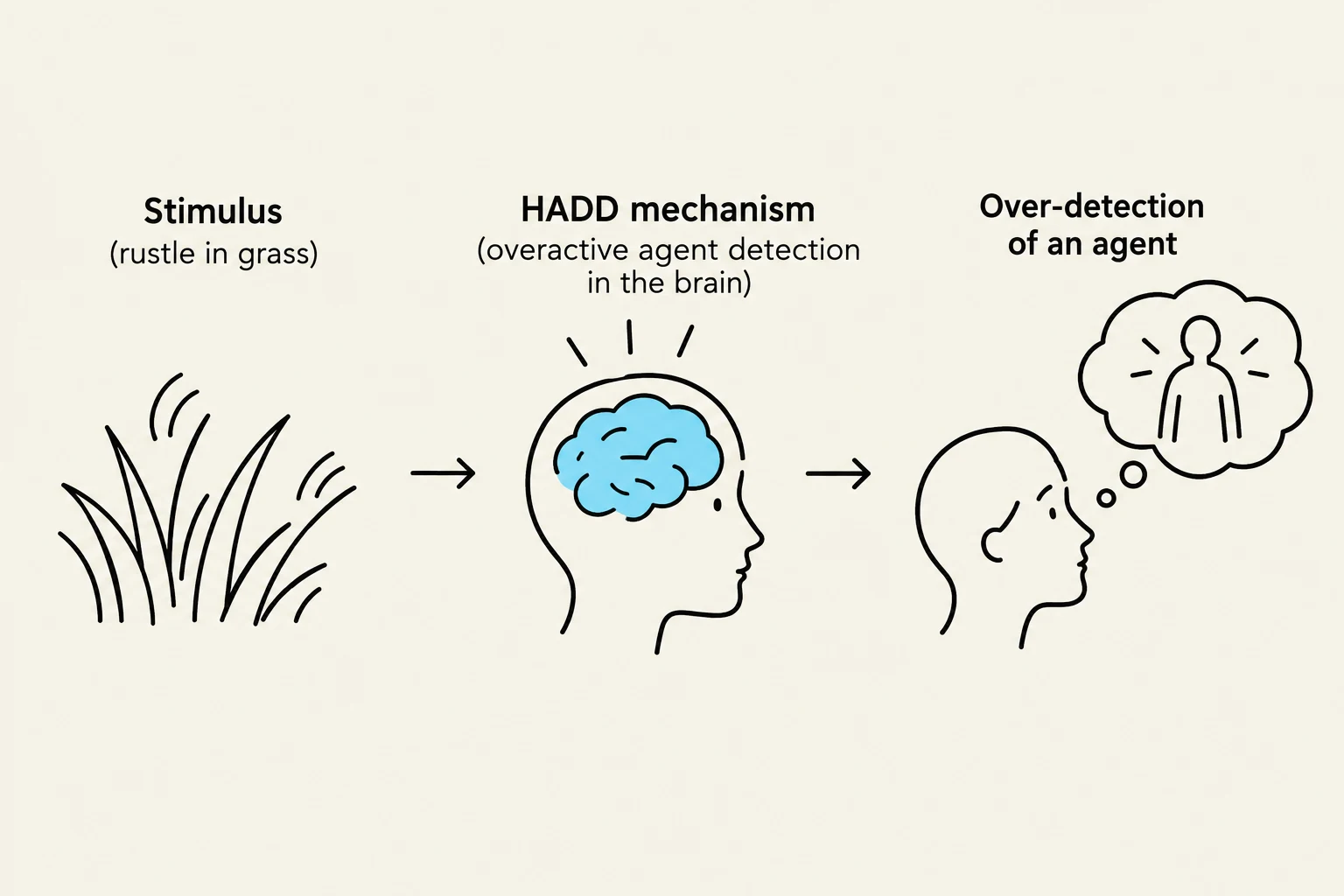
Humans have a survival instinct to detect "agency" (the presence of a living being) in their environment. If you hear a rustle in the grass, it is safer to assume it is a predator (an agent) rather than just the wind. This tendency to over-detect agency is known as the HADD. This mechanism can lead humans to attribute intention or "will" to natural events, such as a storm being caused by an angry deity.
2. Theory of Mind (ToM)
Theory of Mind is the ability to attribute mental states—beliefs, desires, and intentions—to others. This allows us to navigate social worlds. CSR suggests that we apply this same mechanism to unseen entities, allowing us to imagine what a god or spirit might be thinking or wanting.
This diagram illustrates the HADD mechanism, where a stimulus like a rustle in grass can lead to an over-detection of an agent in the brain due to an overactive agent detection system.
Integrating Brain and Behavior
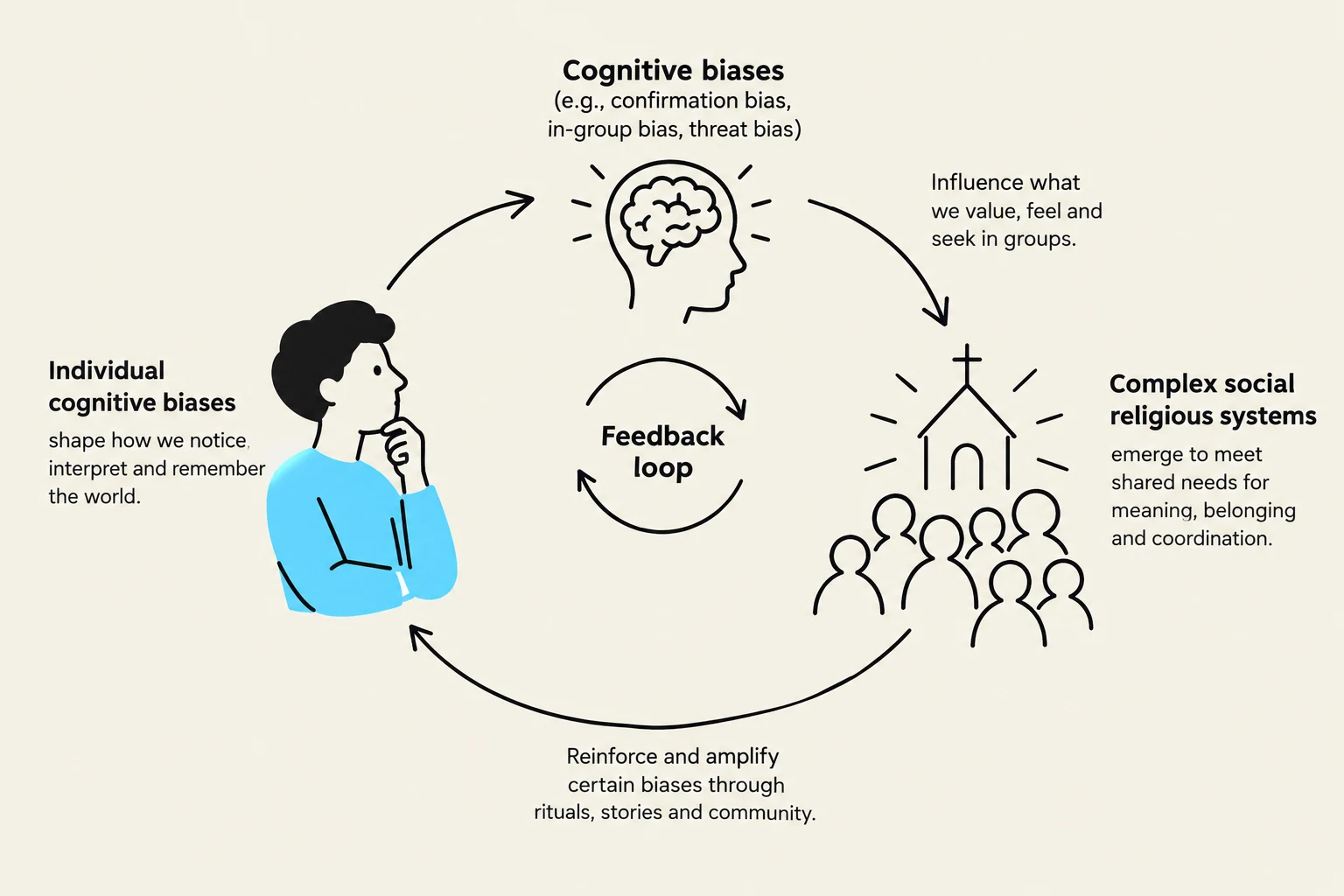
The final piece of the CSR puzzle is the connection between these internal cognitive processes and observable human behavior. When cognitive biases (like HADD) meet social structures, they manifest as rituals, taboos, and organized religion.
For example, a ritual might be a way to "appease" the agency we have detected in the environment. If a community believes a drought is caused by a specific entity, they may develop a collective ritual to address that entity. This behavior reinforces the group's shared identity and provides a sense of control over an unpredictable world.
Component
Focus Area
Role in CSR
Evolution
Survival & Selection
Explains the long-term persistence of religious traits.
Cognition
Mental Mechanisms
Explains the immediate generation of religious ideas.
Behavior
Social Action
Explains how beliefs manifest as rituals and group norms.
This diagram illustrates the feedback loop between individual cognitive biases and complex social-religious systems, showing how biases influence group dynamics and how group structures can reinforce those biases.
Summary for Students
To master the definition of CSR, remember that it is an interdisciplinary field. It does not look at religion in isolation; it looks at religion as the output of a complex system: