The Cognitive Revolution and the Science of Religion
Explore the shift from behaviorism to cognitive science, understanding the mind as an information processor and its application to the Cognitive Science of Religion (CSR). Learn how cognitive mechanisms like Agency Detection and Theory of Mind contribute to religious beliefs.
For much of the early 20th century, psychology was dominated by a philosophy that viewed the human mind as a "black box." Scientists focused exclusively on what could be seen: stimulus and response. However, a seismic shift occurred in the mid-20th century known as the Cognitive Revolution. This movement fundamentally changed how we understand human intelligence, moving away from mere observable actions toward the complex internal processes of memory, perception, and reasoning. Today, this revolution provides the foundational toolkit for the Cognitive Science of Religion (CSR), allowing researchers to investigate how the architecture of the human mind might make religious belief a natural byproduct of our evolutionary history.
The Era of Behaviorism: The Black Box Problem
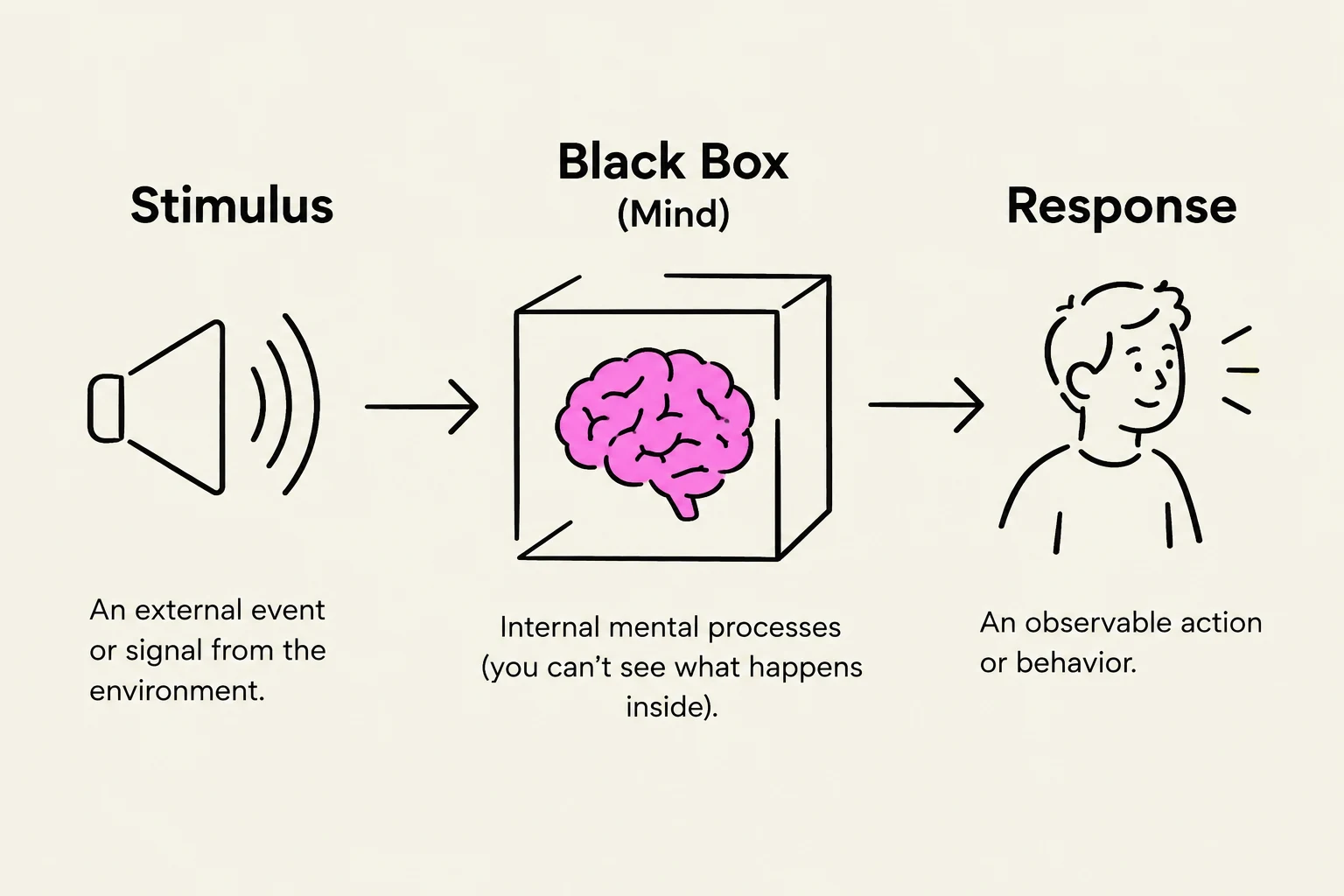
Before the revolution, the prevailing paradigm was Behaviorism. Behaviorists argued that because internal mental states—such as thoughts, feelings, or intentions—could not be objectively measured, they were not suitable for scientific study. Instead, they focused on the relationship between an environmental stimulus (S) and a behavioral response (R).
In this view, learning was seen as a process of conditioning. If a specific stimulus consistently preceded a specific behavior, the behavior would be reinforced. While this approach brought rigor and measurement to psychology, it left a massive gap in our understanding of human complexity. It could explain why a person might press a lever for food, but it could not explain how a person interprets a complex myth, remembers a ritual, or feels a sense of divine presence.
Exam Tip: When discussing Behaviorism, remember the "Black Box" metaphor. The theory treats the mind as an impenetrable container where we can see what goes in (stimulus) and what comes out (response), but we cannot scientifically analyze the processing happening inside.
A diagram illustrating the stimulus-response model, where an external stimulus triggers internal mental processes (the black box or mind), leading to an observable response or behavior.
The Cognitive Revolution: Opening the Box
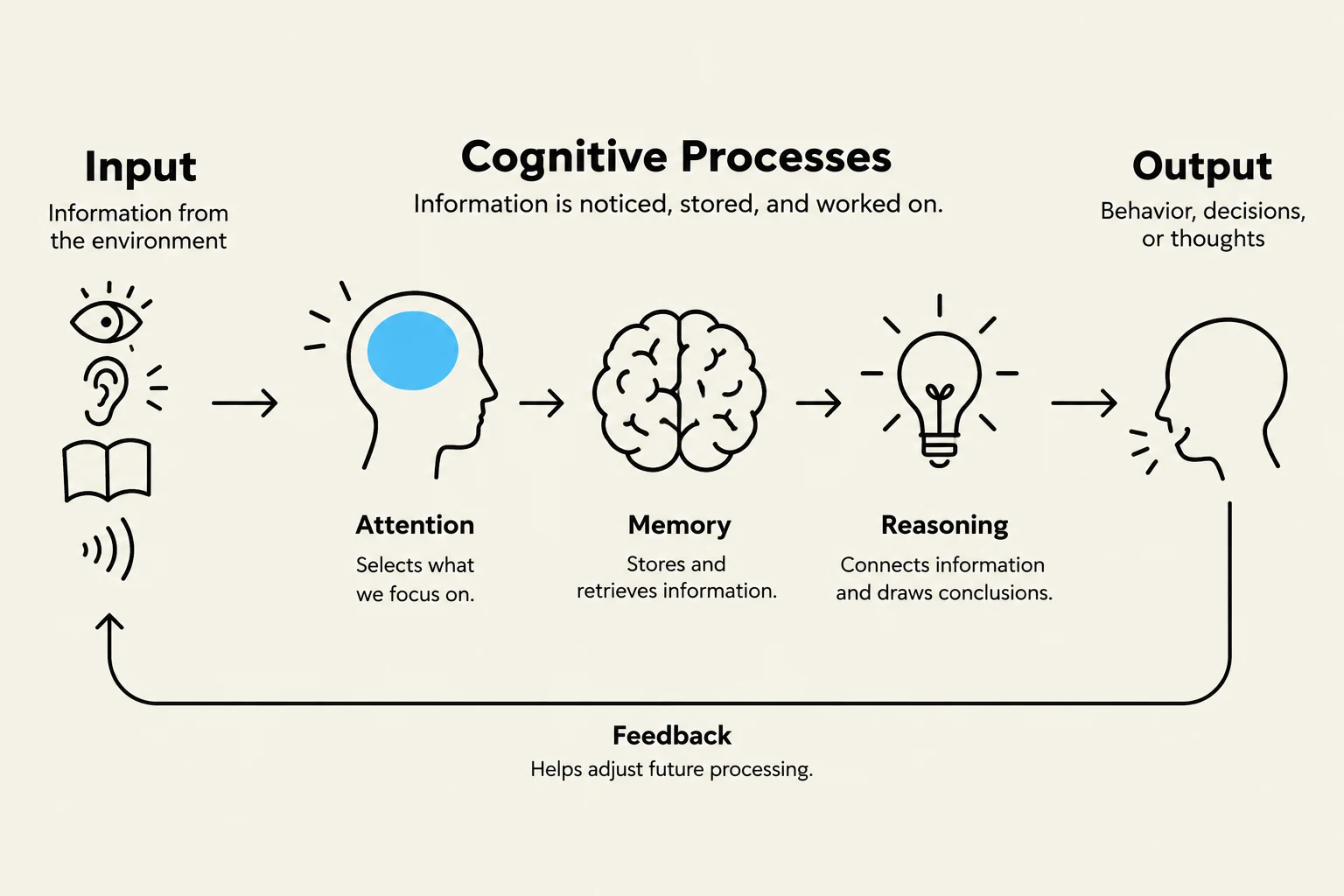
The Cognitive Revolution emerged in the 1950s and 60s, driven by advancements in linguistics, computer science, and neuroscience. The central breakthrough was the "Information Processing" metaphor: the idea that the human mind functions similarly to a computer. Just as a computer takes input, processes it through various sub-routines (logic, memory, storage), and produces output, the human mind performs complex computations on information.
This shift allowed scientists to move beyond S→R and begin modeling internal mechanisms. We began to study:
Perception: How we interpret sensory data.
Attention: How we filter information.
Memory: How we encode and retrieve data.
Language: How we use symbolic systems to communicate complex ideas.
By treating the mind as an active processor rather than a passive responder, researchers could finally begin to ask why certain patterns of thought occur consistently across different cultures and individuals.
This diagram illustrates the cognitive processes involved in how information is processed, from input and attention to memory, reasoning, and output, with a feedback loop.
Applying Cognitive Science to Religion
The most profound application of this revolution in the social sciences is the emergence of the Cognitive Science of Religion (CSR). Rather than asking whether religious claims are "true" in a metaphysical sense, CSR asks: How does the cognitive architecture of the human brain facilitate religious belief?.
If the mind is a collection of evolved cognitive mechanisms, then religious ideas may be "byproducts" or "spandrels" of these mechanisms. For example, humans have evolved a highly sensitive "Agency Detection Device." In an evolutionary context, it was safer to mistake a rustle in the grass for a predator (an agent) than to mistake a predator for just the wind. This tendency to attribute intention to unseen forces—known as Hyperactive Agency Detection—can lead to the belief in spirits, gods, or supernatural entities.
Key Mechanisms in CSR
To understand this, we can look at how specific cognitive modules interact with religious concepts:
Theory of Mind (ToM): The ability to attribute mental states (beliefs, desires, intentions) to others. This allows humans to conceptualize gods as beings with personalities and wills.
Dualism: The intuitive tendency to distinguish between the physical body and the non-physical mind/soul. This makes the concept of an afterlife or a disembodied spirit cognitively "easy" to process.
Minimally Counterintuitive (MCI) Concepts: Religious figures often possess qualities that are mostly normal but violate one or two expectations (e.g., a man who can walk through walls). These concepts are highly "sticky"—they are easy to remember and easy to communicate because they grab attention without being too bizarre to process.
This diagram illustrates evolutionary cognitive mechanisms such as Agency Detection, Theory of Mind, and Dualism, which contribute to the formation of religious thought or 'The Form'.
Conclusion: A New Lens for Human Culture
The transition from behaviorism to cognitive science represents a move from observing the "what" to understanding the "how." By moving past the limitations of the black box, we have gained the ability to map the internal landscape of human thought. In the realm of religion, this does not diminish the experience of faith; rather, it provides a rigorous framework to understand why religious thought is a near-universal feature of the human experience. We are no longer just looking at the ritual (the behavior); we are looking at the cognitive machinery that makes the ritual meaningful.
Summary Table for Study
Feature
Behaviorism
Cognitive Science
Primary Focus
Observable Behavior
Internal Mental Processes
Metaphor
Stimulus-Response (S→R)
Information Processing (Computer)
View of Mind
A "Black Box"
An active processor of information
Religious Study
Focus on rituals/actions
Focus on belief/mental representations
Keep reading for free.
Create an account to finish this reading and make it part of your study routine.