The Chemistry of the Atmosphere: Light, Ozone, and Warming
Explore the fundamental chemical processes governing Earth's atmosphere, including how light drives reactions, the natural cycle of ozone formation and destruction, and the mechanisms of atmospheric warming through infrared absorption by greenhouse gases.
The Earth's atmosphere is a complex, dynamic mixture of gases that protects life by filtering harmful radiation and regulating temperature. While the atmosphere is primarily composed of nitrogen ($78.1%$) and oxygen ($21.0%$), its chemical behavior is dictated by trace gases and, most importantly, by the energy provided by the sun. Understanding atmospheric chemistry requires a look at how light drives reactions, how the ozone layer maintains its balance, and how certain molecules trap heat to influence global temperatures.
Atmospheric Reactions Involving Light
This illustration shows how photons of different wavelengths and energies interact with chemical bonds. Low-energy infrared photons with longer wavelengths pass through without breaking the bond, while high-energy ultraviolet photons with shorter wavelengths have enough energy to break the bond.
Many of the most critical chemical transformations in our atmosphere are photochemical, meaning they are driven by light. For a chemical bond to break, a molecule must absorb a photon with sufficient energy. This energy is inversely proportional to the wavelength (λ) of the light, described by the equation:
Ephoton=λhc
Where h is Planck's constant and c is the speed of light. Because different molecules require different amounts of energy to dissociate, they absorb light at specific wavelengths. For example, nitrous oxide (N2O) requires very high-energy light (wavelengths less than 100 nm) to undergo photolysis.
Study Tip: Remember that shorter wavelengths (like Ultraviolet) carry more energy than longer wavelengths (like Infrared). This is why UV light is capable of breaking strong chemical bonds that visible light cannot.
The Chapman Cycle: Natural Ozone Chemistry
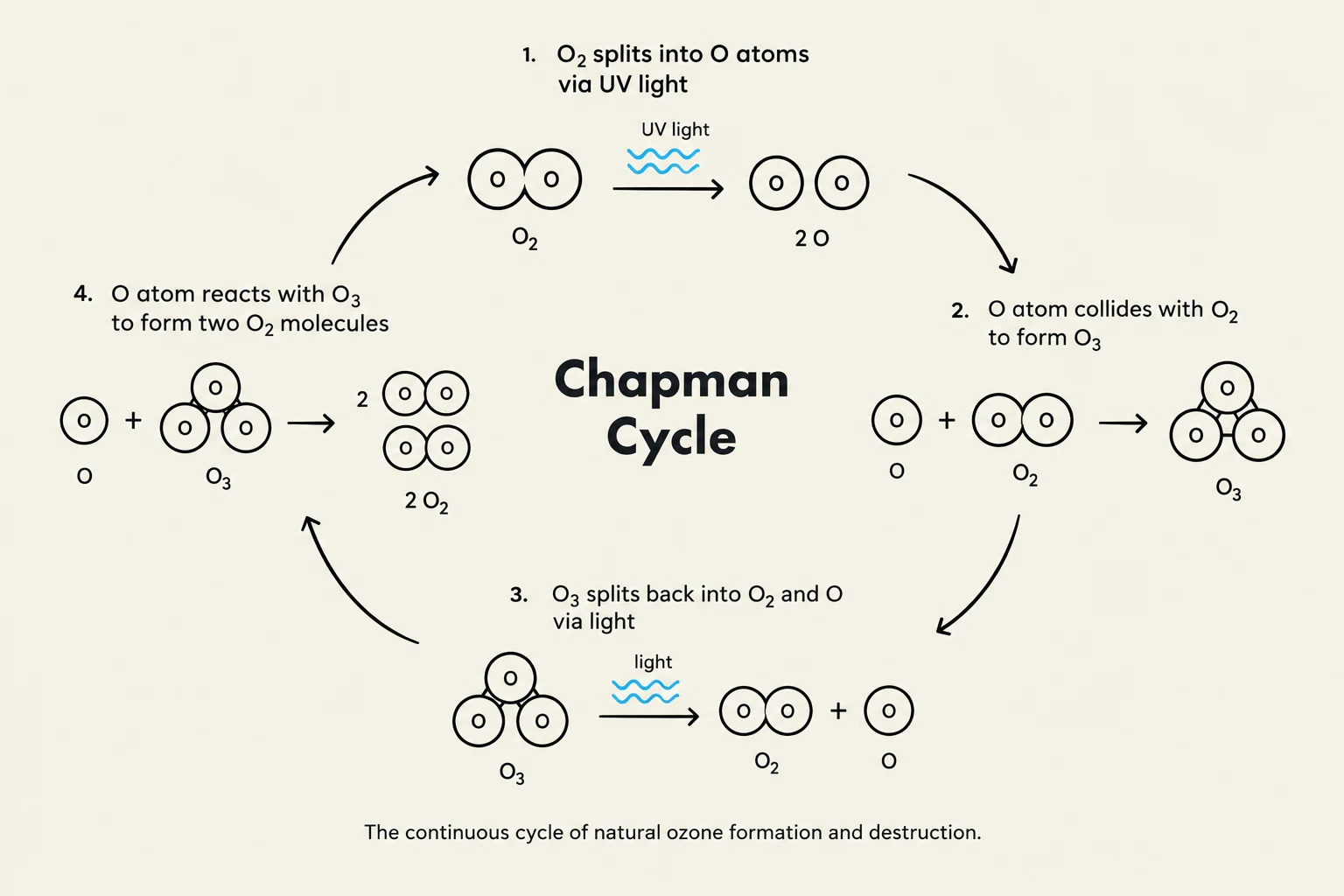
The Chapman Cycle illustrates the continuous formation and destruction of natural ozone in the Earth's atmosphere through a series of chemical reactions involving oxygen atoms and molecules.
The ozone layer in the stratosphere acts as a vital shield, absorbing much of the sun's harmful ultraviolet radiation. The natural lifecycle of ozone is described by the Chapman Cycle, a series of reactions that balance the formation and destruction of O3.
Ozone Formation
First, high-energy solar radiation breaks an oxygen molecule into two highly reactive oxygen atoms:
O2+hν→O+O
These individual oxygen atoms then collide with other O2 molecules to create ozone:
O+O2→O3
Ozone Destruction
To maintain a steady state, ozone is also naturally destroyed through two primary pathways:
Photolysis by light:
O3+hν→O2+O
Recombination with oxygen atoms:
O+O3→2O2
The concentration of ozone is measured in Dobson Units (DU). One Dobson Unit represents a layer of ozone that, if compressed to standard temperature and pressure (0∘C and 1 atm), would be only 0.01 mm thick.
Ozone Depletion and the Role of CFCs
The delicate balance of the Chapman Cycle can be disrupted by human-made chemicals, most notably chlorofluorocarbons (CFCs). Because CFCs are very stable, they do not break down in the lower atmosphere; instead, they diffuse up into the stratosphere.
Once in the stratosphere, intense UV light causes the CFCs to undergo photolysis, releasing highly reactive chlorine (Cl) atoms:
CClF3+hν→CF3+Cl
These chlorine atoms act as catalysts, meaning they participate in the destruction of ozone without being consumed themselves. The catalytic cycle works as follows:
The chlorine atom attacks ozone:
Cl+O3→O2+ClO
The resulting chlorine monoxide reacts with a free oxygen atom, regenerating the chlorine:
ClO+O→Cl+O2
The net result of this cycle is the conversion of ozone and oxygen atoms into stable oxygen molecules:
O3+O→2O2
Because the Cl atom is regenerated in the second step, a single chlorine atom can destroy thousands of ozone molecules before it is eventually removed from the atmosphere.
Atmospheric Warming and Infrared Absorption
While ozone depletion involves the absorption of UV light, atmospheric warming (the greenhouse effect) involves the absorption of infrared (IR) light. The Earth absorbs short-wavelength light from the sun and re-emits it as long-wavelength infrared radiation.
Certain gases, such as carbon dioxide (CO2), are "greenhouse gases" because they can absorb this outgoing IR radiation. However, for a molecule to absorb IR light, the vibration of the molecule must cause a change in its dipole moment.
Molecular Vibrations in CO2
Carbon dioxide is a linear molecule (O=C=O). Its ability to trap heat depends on how it vibrates:
Symmetric Stretch: The oxygen atoms move away from or toward the carbon atom simultaneously. This does not change the dipole moment, so this mode does not absorb IR radiation.
Asymmetric Stretch: One oxygen atom moves toward the carbon while the other moves away. This creates a change in the dipole moment, allowing the molecule to absorb IR light.
Bending Modes: The molecule bends out of its linear shape. This also creates a change in the dipole moment and is a highly effective way for CO2 to interact with and trap IR radiation.
By absorbing this energy, these gases prevent the heat from escaping into space, thereby warming the atmosphere.
Keep reading for free.
Create an account to finish this reading and make it part of your study routine.