The Chemical Level of Organization: Elements, Atoms, and Bonds
Explore the fundamental chemical building blocks of life, including elements, atoms, subatomic particles, and the different types of chemical bonds (ionic, covalent, hydrogen) that hold matter together.
At the most fundamental level of human biology, life is governed by the laws of chemistry. Before we can understand how a heart beats or how a brain thinks, we must look at the smallest, most basic material components: elements and atoms. These tiny units of matter combine in specific ways to form the complex molecules that make up our cells, tissues, and organs.
Elements and Atoms: The Foundation
Matter is anything that occupies space and has mass. All matter in the natural world is composed of one or more of the 92 fundamental substances called elements. An element is a pure substance that cannot be broken down by ordinary chemical means. While there are many elements, the human body is primarily composed of just four: oxygen (65.0%), carbon (18.5%), hydrogen (9.5%), and nitrogen (3.2%).
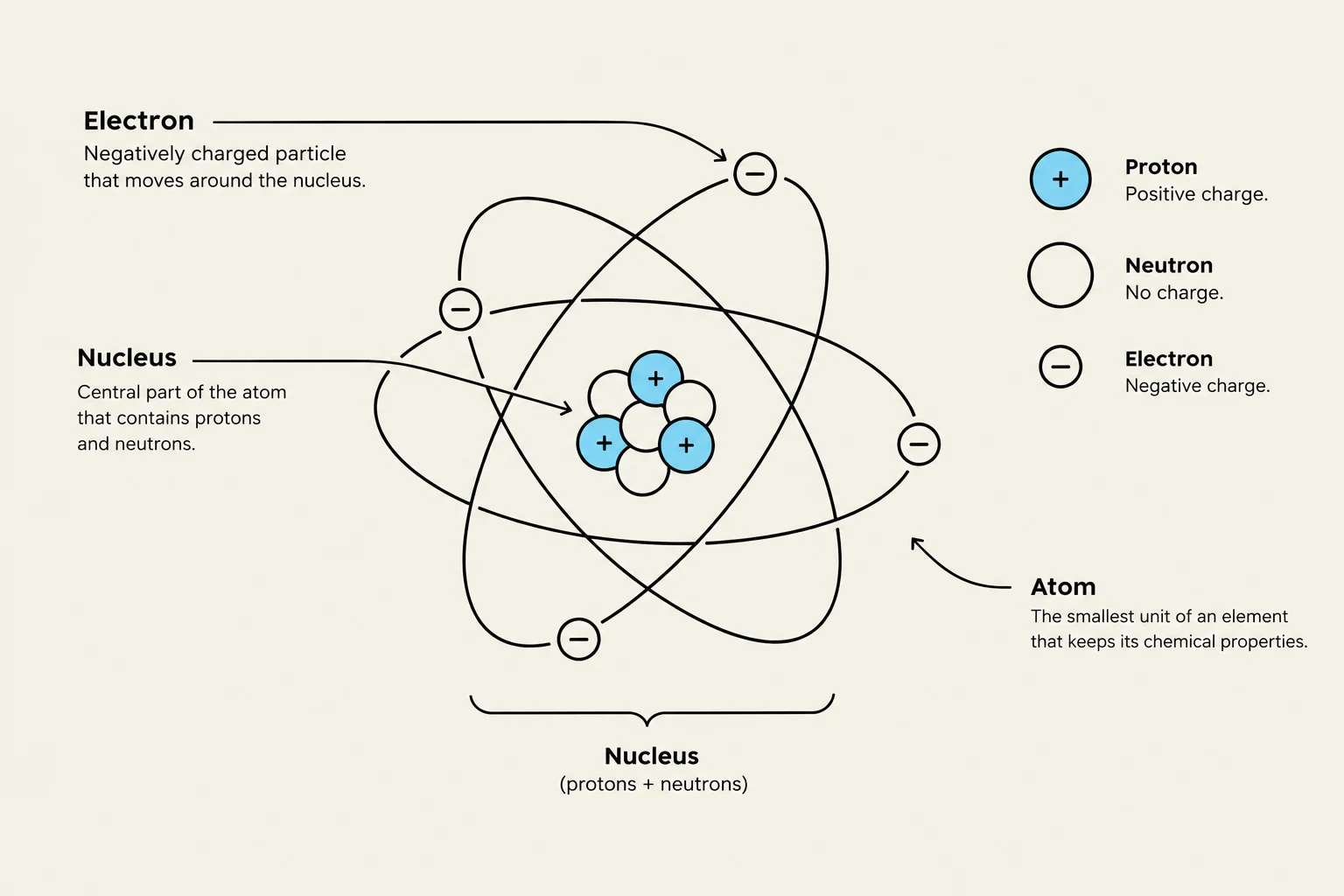
The smallest unit of an element that retains its unique properties is the atom. Atoms are composed of three subatomic particles:
Protons ($p^+$): Positively charged particles located in the nucleus.
Neutrons: Neutral particles located in the nucleus.
Electrons ($e^-$): Negatively charged particles that encircle the nucleus in an "electron cloud".
The identity of an element is determined by its atomic number, which is the number of protons in its nucleus. The atomic mass is the sum of the protons and neutrons. Sometimes, atoms of the same element have different numbers of neutrons; these are known as isotopes. If an isotope has an unstable nucleus that decays, releasing energy or particles, it is called a radioactive isotope.
Diagram illustrating the structure of an atom, showing the nucleus containing protons and neutrons, and electrons orbiting the nucleus.
The Octet Rule and Chemical Reactivity
An atom's tendency to participate in chemical reactions is largely determined by its electrons, specifically those in its valence shell—the outermost electron shell.
Most atoms are "seeking" stability. According to the octet rule, atoms are most stable when they possess exactly eight electrons in their valence shell. To achieve this stable state, atoms will gain, lose, or share electrons with other atoms. This process of electron exchange or sharing is what creates chemical bonds.
Exam Tip: If a question asks what governs an atom's reactivity, the answer is almost always the number of electrons in its valence shell.
Chemical Bonds: How Atoms Connect
Chemical bonds are electrical attractions that hold atoms in close proximity. Depending on how electrons are handled, these bonds fall into several categories.
Ionic Bonds: The Transfer of Electrons
An ionic bond occurs when one atom transfers one or more electrons to another atom. This transfer creates ions—atoms that possess an electrical charge.
Cations: Positively charged ions formed when an atom loses electrons (e.g., Na+).
Anions: Negatively charged ions formed when an atom gains electrons (e.g., $Cl^-$).
The strong mutual attraction between the positive cation and the negative anion forms the ionic bond. In biological fluids, these dissolved ions are known as electrolytes. Electrolytes are vital because they produce the electrical charges that allow for functions like heartbeats and brain activity.
Covalent Bonds: The Sharing of Electrons
Covalent bonds are generally stronger than ionic bonds because they involve the actual sharing of electrons to fill valence shells. There are two main types:
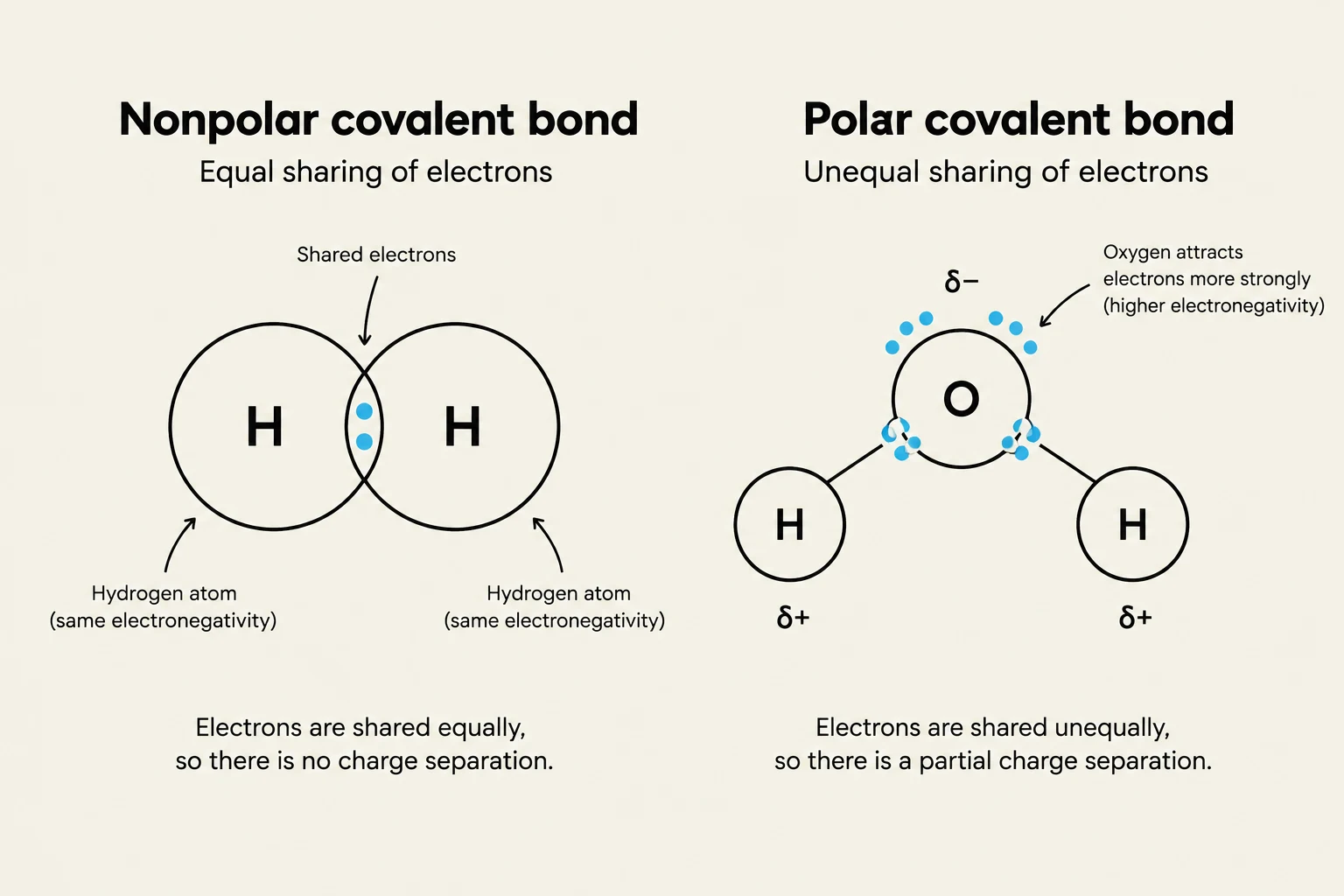
Nonpolar Covalent Bonds: These occur when atoms share electrons equally. Because the sharing is balanced, the molecule has no partial charges and is electrically neutral. An example is hydrogen gas (H−H).
Polar Covalent Bonds: These occur when atoms share electrons unequally due to differences in electronegativity (the "pull" an atom has on electrons). This creates polarity, where one side of the molecule becomes slightly negative and the other slightly positive.
Water (H2O) is the most important example of a polar molecule. The oxygen atom exerts a stronger pull on the electrons than the hydrogen atoms, making the oxygen end slightly negative and the hydrogen ends slightly positive.
This illustration compares nonpolar and polar covalent bonds, explaining the concept of electron sharing in chemical bonds.
Hydrogen Bonds: Weak but Vital Attractions
While covalent and ionic bonds involve the movement or sharing of electrons, hydrogen bonds are weaker attractions between molecules. A hydrogen bond forms when a weakly positive hydrogen atom (which is already part of a polar molecule) is attracted to a different electronegative atom (like Oxygen, Nitrogen, or Fluorine) on a neighboring molecule.
These bonds are essential for maintaining the structure of life. They hold the two strands of a DNA molecule together and help stabilize the complex shapes of proteins.
The Importance of Polarity
Understanding polarity is crucial for understanding biology because it dictates how substances move in and out of cells.
Polar molecules (like water) are attracted to other charged substances and ions.
Nonpolar molecules (like fats, lipids, and oils) are repelled by water.
This "like dissolves like" principle determines whether a nutrient can pass through a cell membrane or if a toxin will be repelled.
Diagram illustrating the polarity of water molecules and the formation of hydrogen bonds between them.
Summary Table of Chemical Bonds
Bond Type
Electron Action
Charge/Polarity
Strength
Ionic
Transferred
Creates Cations (+) and Anions (-)
Strong
Nonpolar Covalent
Shared Equally
No charge (Balanced)
Very Strong
Polar Covalent
Shared Unequally
Partial charges (δ+ and δ−)
Strong
Hydrogen
Attraction between polar molecules
Weak attraction
Weak
Keep reading for free.
Create an account to finish this reading and make it part of your study routine.