


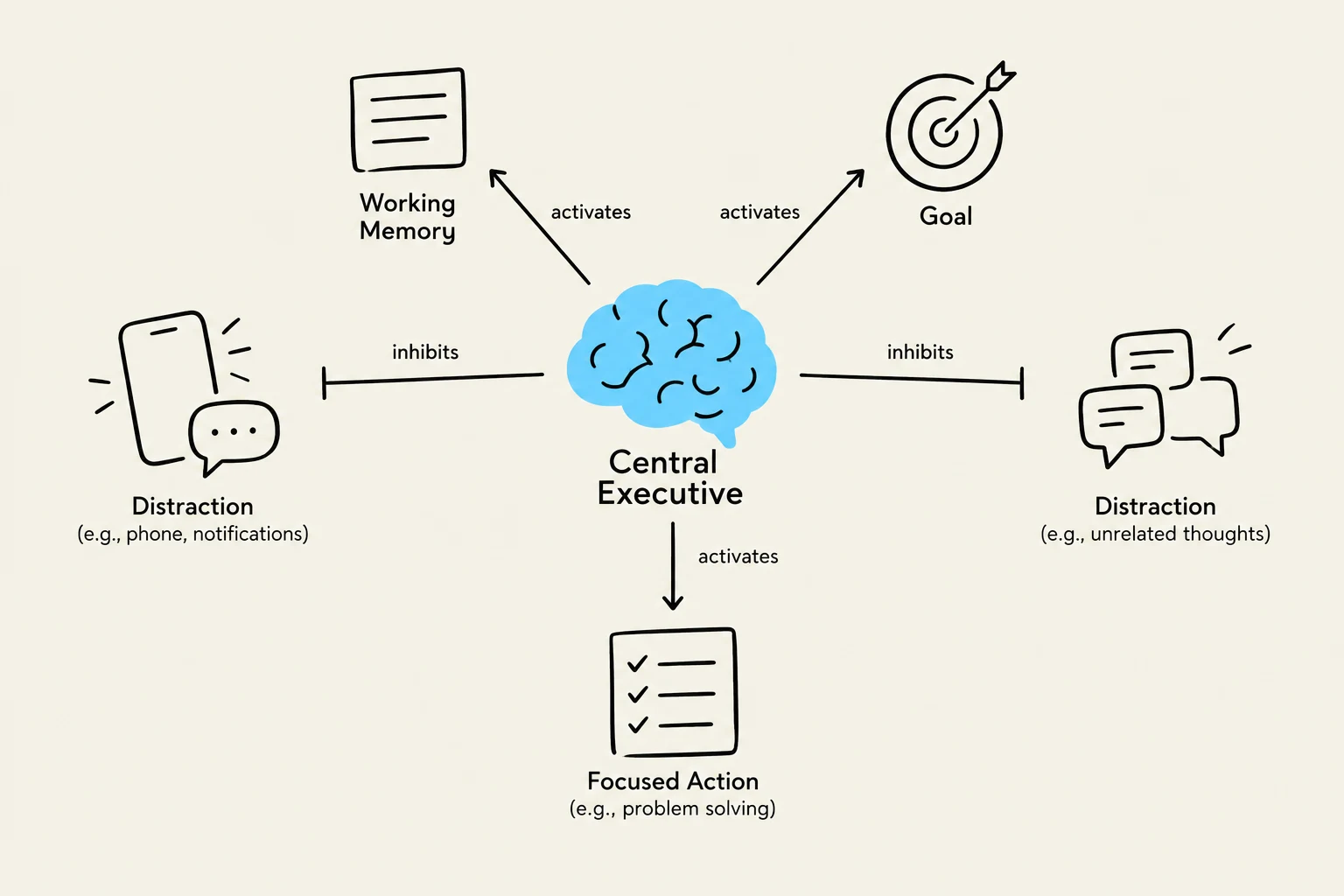
Imagine you are sitting in a busy coffee shop. You are trying to read a complex textbook, but around you, a barista is steaming milk, a group of friends is laughing at a nearby table, and music is playing softly over the speakers. Despite this barrage of sensory input, you are able to focus your eyes on the page and process the sentences. How is this possible? You aren't just passively receiving information; your brain is actively managing it. This management is the work of the Central Executive, the high-level control center of your cognitive system that coordinates attention and manages the exchange of information between different memory components.
Understanding the Role of the Central Executive
In the architecture of human memory and cognition, the Central Executive acts much like the conductor of an orchestra. While the individual musicians (representing different sensory inputs or memory stores) know how to play their specific parts, it is the conductor who ensures they play at the right tempo, start at the right time, and balance their volume so the music remains coherent.
The Central Executive is not a storage unit itself. Unlike your long-term memory, which holds facts and experiences, or your working memory buffers, which hold temporary information, the Central Executive is a process-oriented component. Its primary functions include:
- Attentional Control: Deciding which stimuli in the environment deserve focus and which should be ignored.
- Information Exchange: Moving data between different parts of the working memory system.
- Task Switching: Shifting focus from one mental operation to another when demands change.
- Problem Solving: Manipulating information held in mind to reach a logical conclusion.
Keep reading for free.
Create an account to finish this reading and make it part of your study routine.
Continue reading freeAlready have an account? Log in
Updated