The Central Dogma of Molecular Biology: DNA, RNA, and Protein Synthesis
Explore the fundamental processes of DNA replication, transcription, and translation, which collectively form the central dogma of molecular biology. Understand how genetic information flows from DNA to RNA and ultimately to proteins, the functional molecules of life.
In the study of biology, one of the most fundamental concepts is understanding how life's "instructions" are stored and then used to build a living organism. This flow of information—from a stable storage molecule to a functional, working machine—is known as the Central Dogma of Molecular Biology. This process is the foundation of Gene Expression, the mechanism by which a cell converts the digital-like code of its genome into the physical reality of proteins [[1]].
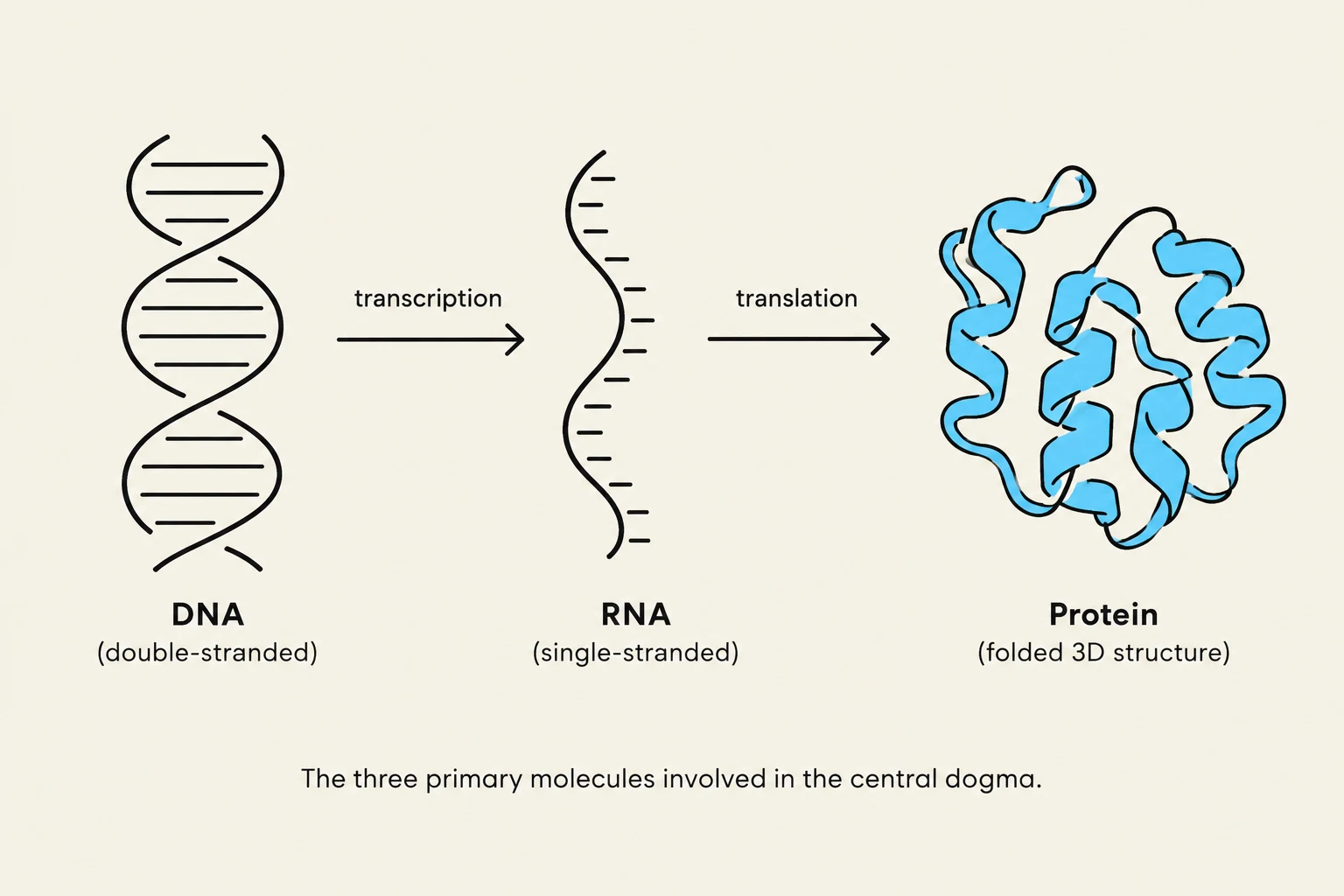
The diagram illustrates the central dogma of molecular biology, showing the processes of transcription from DNA to RNA and translation from RNA to protein.
Overview of Replication, Transcription, and TranslationFigure 7.1: Overview of Replication, Transcription, and Translation. The entire pathway from DNA to Protein is collectively known as Gene Expression.
The Players: DNA, RNA, and Protein
To understand the flow of information, we must first identify the three primary molecules involved:
DNA (Deoxyribonucleic Acid): DNA serves as the permanent repository of genetic information [[1]]. It is typically a double-stranded, helical structure where each strand is a chain of deoxyribonucleotide subunits [[1]]. The complete set of genetic information in a cell (including chromosomes and plasmids) is called its genome [[1]].
RNA (Ribonucleic Acid): RNA acts as the intermediate messenger [[1]]. While DNA is the master blueprint, RNA is a slightly different molecule that carries specific instructions from the DNA to the site of protein synthesis [[1, 2]].
Protein: Proteins are the final functional products [[1]]. They are composed of amino acid subunits arranged in specific sequences [[1]]. Proteins serve various roles, such as structural components of a cell or enzymes that direct cellular activities like energy conversion [[1]].
Concept Check: Think of the genome like a massive library of books. The DNA is the original, rare manuscript that must stay protected in the library, while the RNA is a photocopy of a single chapter that you can take to a workbench to actually use.
DNA Replication: Passing the Blueprint
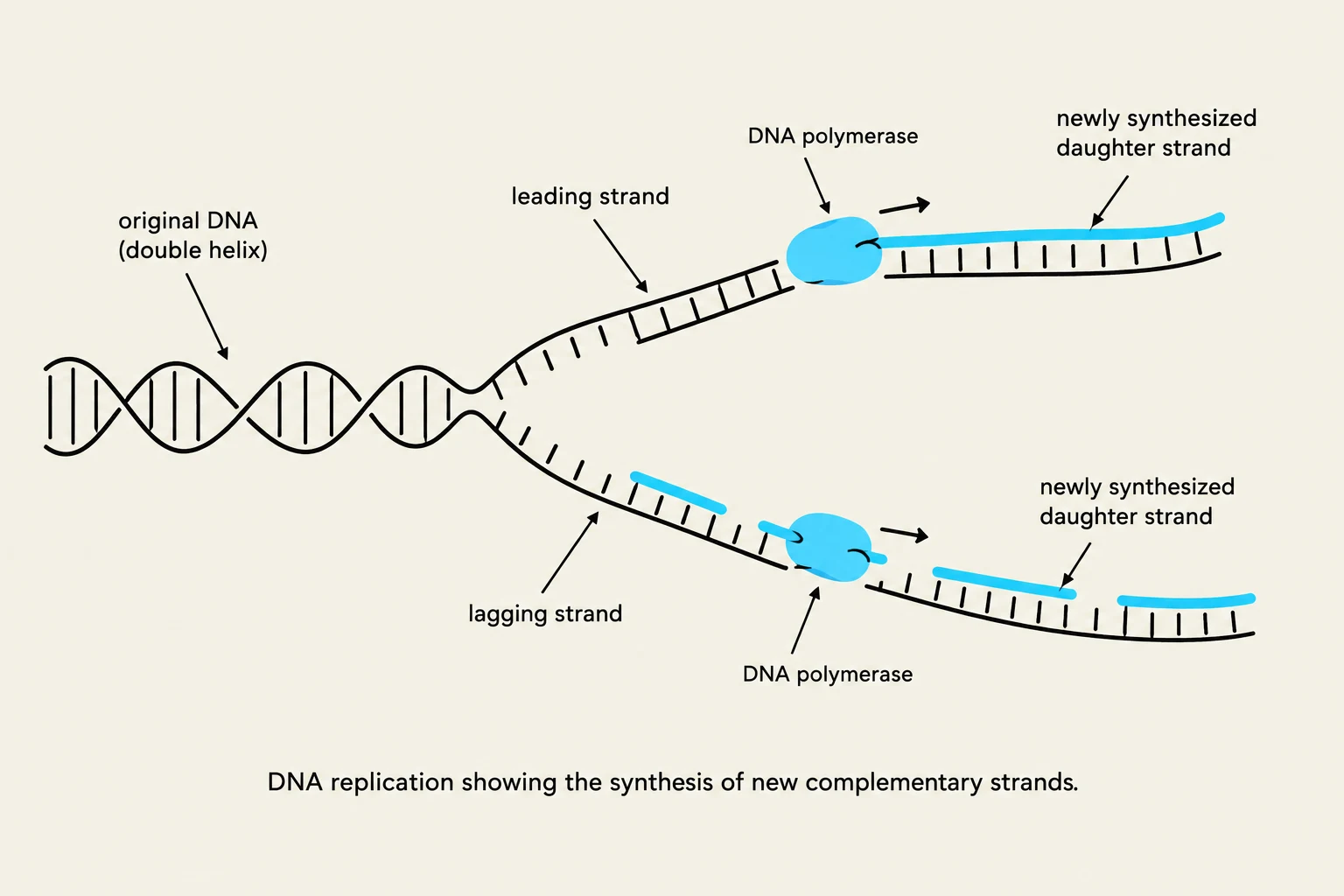
DNA replication showing the synthesis of new complementary strands.
Before a cell can divide, it must ensure that its progeny receives a complete set of instructions. This is achieved through DNA Replication [[1]]. During this process, the DNA molecule duplicates itself so that its encoded information can be passed on to the next generation [[1]].
Replication is a highly precise process. It begins at a specific site called the "origin of replication" and proceeds in both directions. Enzymes known as DNA polymerases synthesize new DNA strands by reading an existing strand as a template.
Transcription: Copying the Code
Once the information is stored, the cell needs to "read" it. Transcription is the process of copying the information encoded in DNA into a molecule of RNA [[1, 2]].
The Mechanics of Transcription
Transcription is not a random process; it is directed by specific nucleotide sequences within the DNA [[2]]:
Promoter: A DNA sequence that signals the RNA polymerase to start transcription [[2]].
Terminator: A DNA sequence that signals the end of the transcription process [[2]].
Region Transcribed: The specific stretch of DNA located between the promoter and the terminator [[2]].
The enzyme RNA polymerase is responsible for synthesizing the RNA strand [[2]]. Much like DNA polymerase, RNA polymerase can only add nucleotides to the $3'$ end of a growing chain, meaning the new RNA is always synthesized in a $5'to3'$ direction [[2]].
Complementarity and Directionality
The relationship between the DNA template and the new RNA strand is both complementary and antiparallel. This means the RNA strand runs in the opposite direction of the DNA template strand. Furthermore, the bases pair specifically: where the DNA template has a Cytosine (C), the RNA will have a Guanine (G); where the DNA has an Adenine (A), the RNA will have a Uracil (U) instead of Thymine (T).
RNA Is Complementary and Antiparallel to the DNA TemplateFigure 7.9: Detailed molecular view of base-pairing between the 3′→5′ DNA template and the 5′→3′ RNA strand.
Translation: Building the Protein
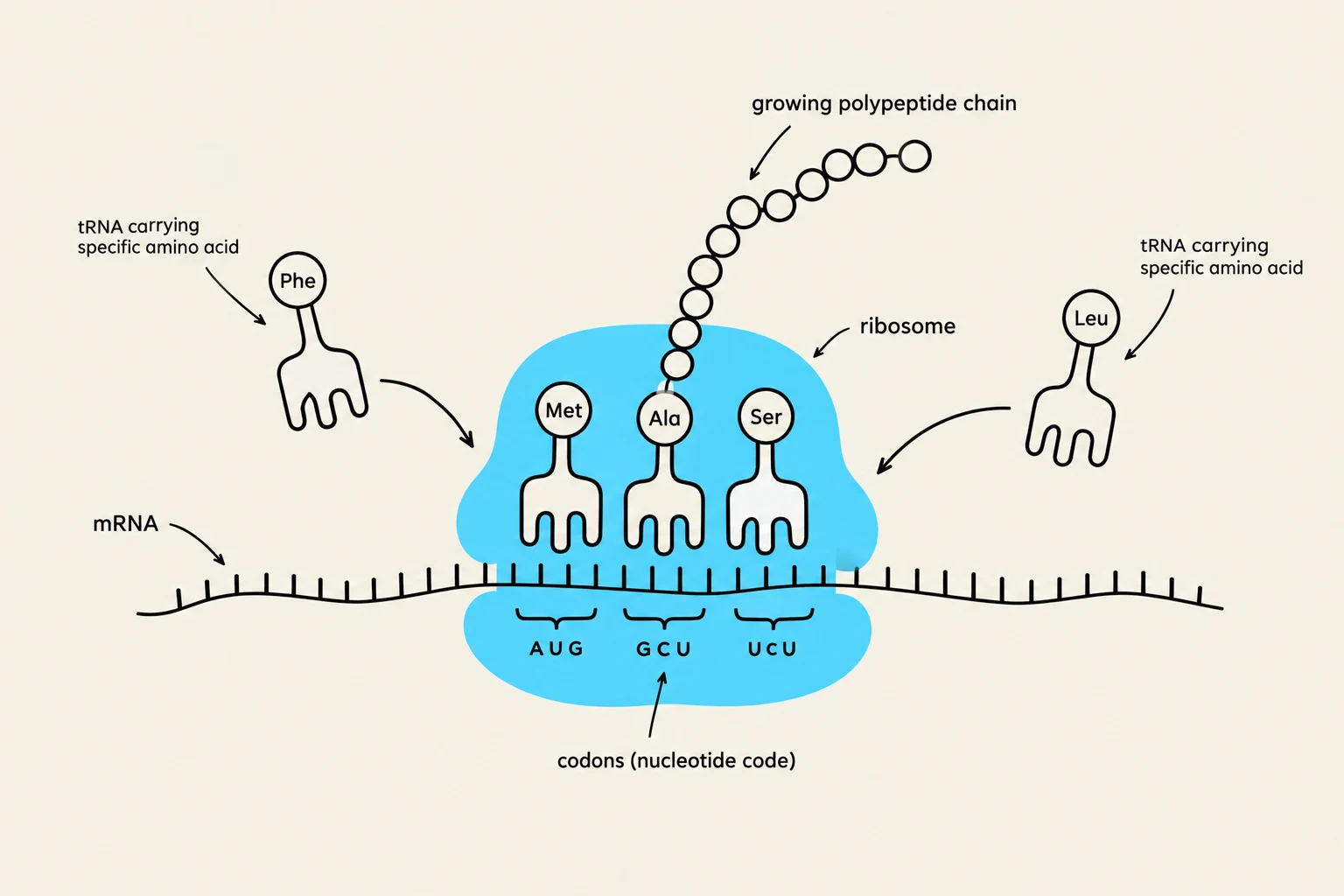
This diagram illustrates the process of translation in molecular biology, where a ribosome moves along an mRNA strand and synthesizes a polypeptide chain. Transfer RNA (tRNA) molecules, each carrying a specific amino acid, bind to codons on the mRNA, contributing to the growing chain.
The final stage of gene expression is Translation. During this stage, the information carried by the messenger RNA (mRNA) is interpreted to build a functional product [[1]].
While the term "protein" is often used colloquially, a more precise term is polypeptide [[2]]. A polypeptide is a simple chain of amino acids, whereas a protein is a functional, complex, three-dimensional molecule that may consist of one or more polypeptides [[2]]. The specific order of these amino acids is what dictates the protein's final structure and function [[1]].
Summary of the Information Flow
The relationship between these components is hierarchical and directional. We can summarize the flow of genetic information as follows:
To copy genetic instructions into a mobile format.
Translation
RNA
Protein
To convert nucleotide sequences into amino acid chains.
Exam Tip: If a question asks which mistake has more long-term consequences—a mistake in DNA synthesis or RNA synthesis—the answer is DNA synthesis. Because DNA is the permanent template for all future generations of that cell, a mutation there will be copied every time the cell replicates. An error in RNA is temporary and will be "washed out" when that specific RNA molecule is degraded.
Keep reading for free.
Create an account to finish this reading and make it part of your study routine.