The Central Dogma: Gene Expression in Prokaryotes and Eukaryotes
Explore the fundamental processes of gene expression, including transcription and translation, and understand the differences between prokaryotic and eukaryotic mechanisms. Learn about operons, introns, exons, and alternative splicing.
At the core of all living organisms lies a fundamental process that converts stored genetic information into functional biological machinery. This process is governed by the Central Dogma of Molecular Biology, which describes the unidirectional flow of information from DNA to RNA, and finally to protein. While the basic principle is universal, the mechanisms by which cells execute this flow differ significantly between simple bacteria and complex multicellular organisms.
The Central Dogma: DNA to Protein
The central dogma is a three-step process: replication, transcription, and translation.
DNA (The Blueprint): Double-stranded molecules containing the genetic code.
RNA (The Messenger): Single-stranded molecules that carry instructions from the genome.
Protein (The Worker): Chains of amino acids that perform cellular functions.
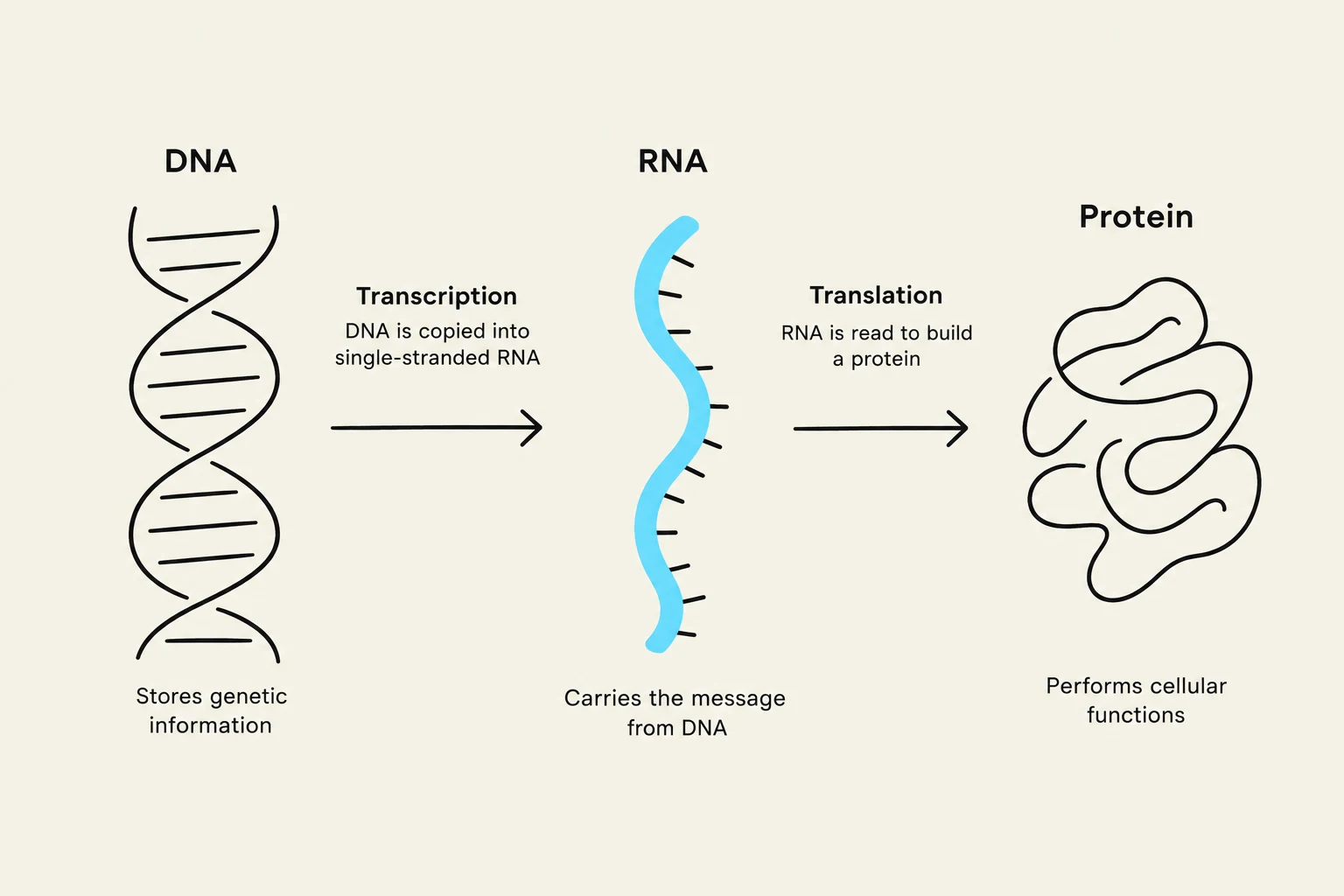
During transcription, a DNA template is used to synthesize a complementary RNA strand. This RNA is then used during translation, where ribosomes read the RNA sequence to assemble amino acids into a specific protein sequence.
This diagram illustrates the central dogma of molecular biology, showing the flow of genetic information from DNA to RNA to protein.
Prokaryotic Gene Expression: Speed and Efficiency
In bacteria (prokaryotes), gene expression is designed for maximum speed and metabolic flexibility. Because bacterial cells lack a nucleus, their chromosomal DNA is "naked" in the cytoplasm. This lack of physical separation allows for coupled transcription and translation. As soon as an mRNA strand begins to emerge from the RNA polymerase, ribosomes can attach to it and begin synthesizing protein immediately.
Operons and Polycistronic mRNA
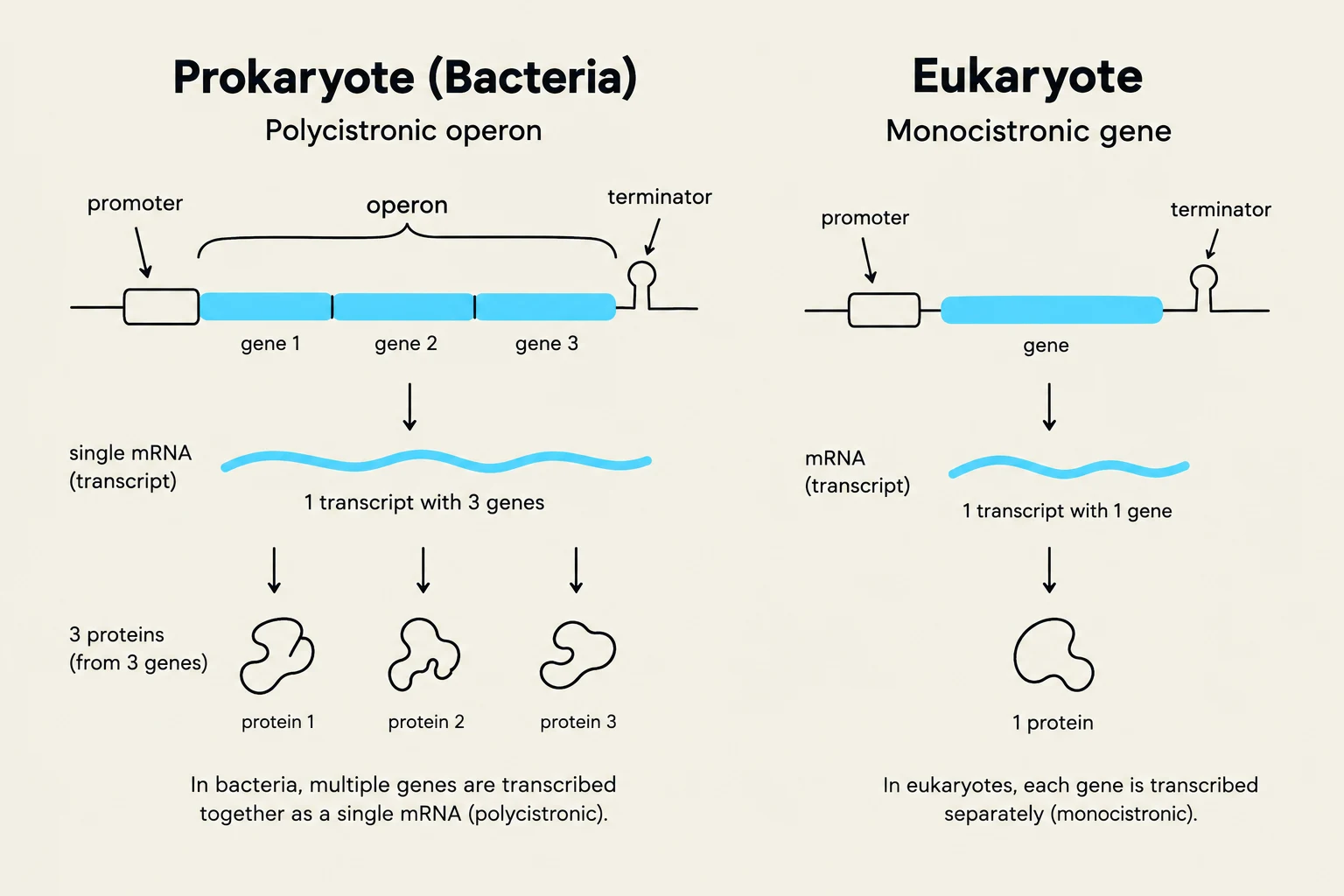
To save energy, bacteria often group genes that function in the same metabolic pathway together into a single unit called an operon. When an operon is turned on, the entire cluster is transcribed into one long, continuous mRNA molecule known as polycistronic mRNA. This allows the cell to produce all the necessary enzymes for a process—such as breaking down a specific sugar—simultaneously with a single "genetic switch".
Exam Tip: If a question asks why bacteria are more efficient at responding to environmental changes, mention "coupled transcription/translation" and "polycistronic mRNA via operons."
The Machinery of Transcription
Transcription is driven by the enzyme RNA polymerase. This complex consists of core alpha and beta subunits that catalyze the formation of phosphodiester bonds to link nucleotides into a growing RNA chain.
However, the core enzyme cannot find its target alone; it requires sigma (σ) factors to form a functional holoenzyme. The sigma factor is responsible for recognizing specific DNA sequences called promoters located upstream of the gene. These promoters are highly conserved because they must interact precisely with the polymerase via hydrogen bonds and Van der Waals forces within the DNA grooves.
Bacterial vs. Eukaryotic Promoters
The specific sequences within a promoter vary by organism:
In Bacteria: Promoters typically contain two consensus sequences: the -35 region (often TTGACA) and the -10 region, also known as the Pribnow Box (often TATAAT).
In Eukaryotes: The promoter is more complex. A common feature is the TATA Box (consensus 5′-TATAWAAR-3′), located approximately 25 bases upstream of the start site.
Regulation via Sigma Factors
Bacteria can redirect their entire metabolism by swapping sigma factors. While "housekeeping" sigma factors manage routine daily functions, alternative sigma factors are released in response to environmental stress or during pathogenesis. These alternative factors compete with housekeeping factors to bind to different sets of genes, known as regulons.
Diagram illustrating the process of transcription initiation in biology, showing DNA, a promoter sequence, and the RNA polymerase holoenzyme composed of the core enzyme and sigma factor.
Transcription Termination
Transcription does not continue indefinitely. It concludes through transcription termination. One common method in bacteria is the use of palindromic intrinsic terminators. When the polymerase encounters these sequences, the RNA forms a stable GC-rich hairpin loop. This structure, followed by a string of Uracil nucleotides, destabilizes the connection between the RNA and the DNA template, causing the transcript to be released.
Eukaryotic Gene Expression: Complexity and Processing
Eukaryotic gene expression is significantly more complex than prokaryotic expression due to the presence of a nucleus and the structure of the genes themselves.
Introns, Exons, and Splicing
Unlike bacterial genes, eukaryotic genes are often interrupted by non-coding sequences called introns. The coding sequences that actually provide instructions for proteins are called exons.
Before an mRNA can leave the nucleus to be translated, it must undergo splicing to remove the introns and join the exons together. This process is performed by a complex of small nuclear RNA (snRNA) and proteins.
A critical feature of this process is alternative splicing, where different combinations of exons are joined together. This allows a single gene to produce multiple different proteins, greatly increasing the functional diversity of the organism.
Monocistronic mRNA and Nuclear Export
Because of the way eukaryotic genes are structured, their transcripts are monocistronic, meaning one mRNA molecule typically contains the code for only one protein. Furthermore, because transcription occurs in the nucleus and translation occurs in the cytoplasm, these processes are uncoupled. To ensure the mRNA is ready for the cytoplasm, it undergoes several modifications:
5' Capping: A cap is added to the 5' end.
Polyadenylation: A poly-A tail is added to the 3' end.
Export Signaling: Proteins like the Exon Junction Complex (EJC) mark the mRNA for transport through the nuclear pore.
This diagram illustrates the difference between prokaryotic (bacterial) and eukaryotic gene transcription. Prokaryotes use polycistronic operons where multiple genes are transcribed into a single mRNA molecule, leading to multiple proteins. Eukaryotes use monocistronic genes, where each gene is transcribed into a separate mRNA molecule, resulting in a single protein per transcript.
Practical Application Note: When cloning human genes (like MLF1) into bacteria for protein production, you cannot use genomic DNA because bacteria lack the machinery for splicing. Instead, scientists use cDNA (complementary DNA) synthesized from mature mRNA, which has already had its introns removed.
Keep reading for free.
Create an account to finish this reading and make it part of your study routine.