The Canadian Appeals Process: From Trial Courts to the Supreme Court
This guide explains the journey of a legal case through the Canadian court system, detailing the roles of trial courts, appellate courts, and the Supreme Court of Canada. It covers the distinction between questions of fact and law, the grounds for appeal, and the critical concept of 'leave to appeal'.
In the Canadian legal system, a trial is not necessarily the final word on a legal dispute. While trial courts are responsible for determining the facts of a case—such as whether a witness was telling the truth or what actually occurred during an incident—the law itself can often be subject to interpretation. When a party believes that a legal error was made during the trial, they have the right to seek a review through the appeals process.
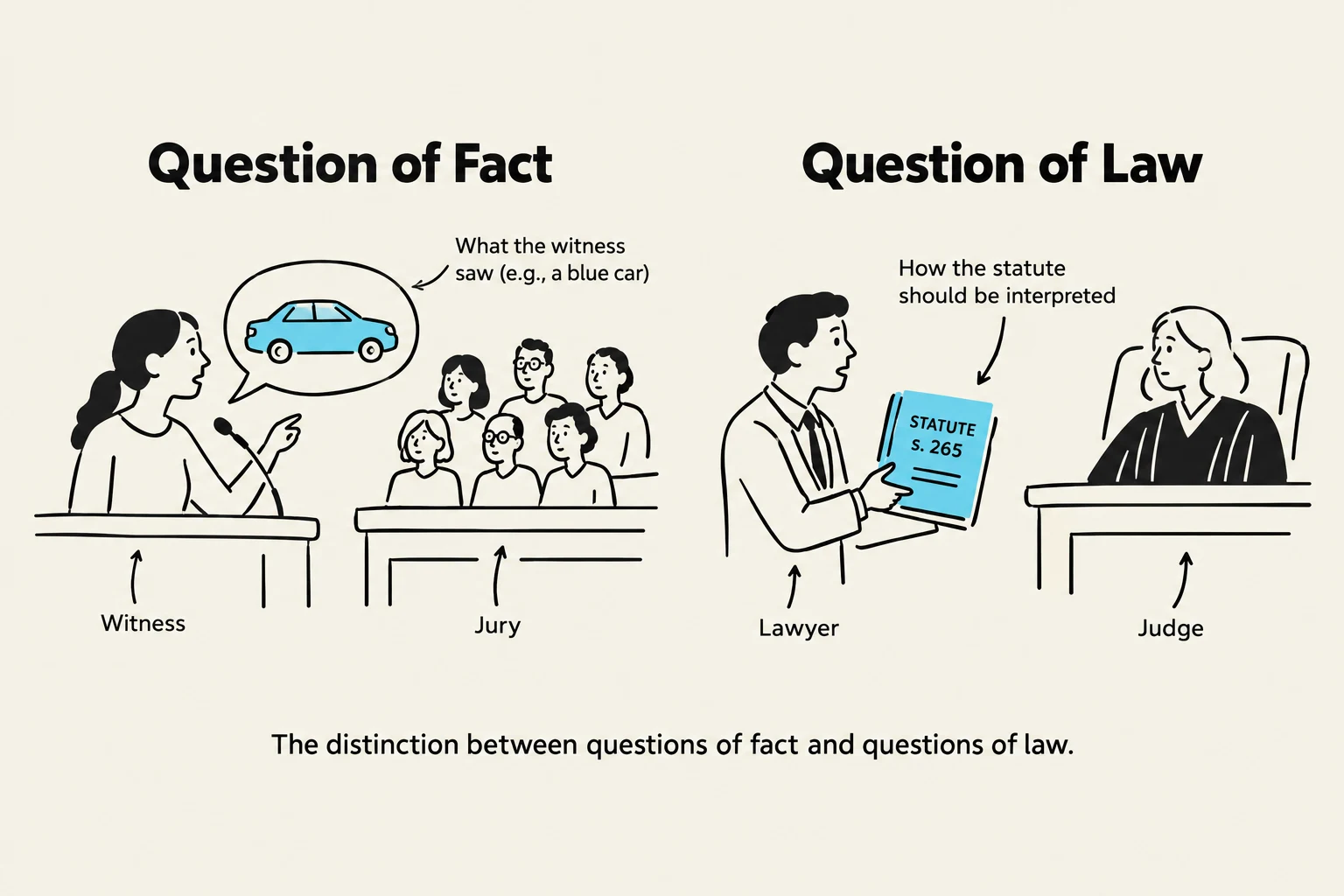
This illustration distinguishes between a question of fact, which involves what a witness observed, and a question of law, which concerns the interpretation of a statute.
This article explores the journey a case takes as it moves from the initial trial through the appellate courts and, potentially, to the highest court in the land: the Supreme Court of Canada.
The Starting Point: Trial Courts
Every legal journey begins in a trial court. These courts are the "fact-finders" of the justice system. During a trial, evidence is presented, witnesses are cross-examined, and a judge (or sometimes a jury) determines the facts of the case.
Once the trial concludes and a judgment is rendered, the losing party may feel that the decision was flawed. However, an appeal is not a "re-do" of the trial. You cannot simply ask for a new trial because you are unhappy with the outcome or because you believe the judge didn't believe your witness. Instead, an appeal must be based on a specific legal error or a significant error in the finding of facts.
Exam Tip: Fact vs. Law
Remember the distinction: Trial courts deal with questions of fact (what happened?), while appellate courts primarily deal with questions of law (how should the law be applied to what happened?).
Moving Up: The Appellate Courts
If a party successfully files an appeal, the case moves to an appellate court. In Canada, these are typically provincial or territorial Courts of Appeal.
How Appellate Courts Function
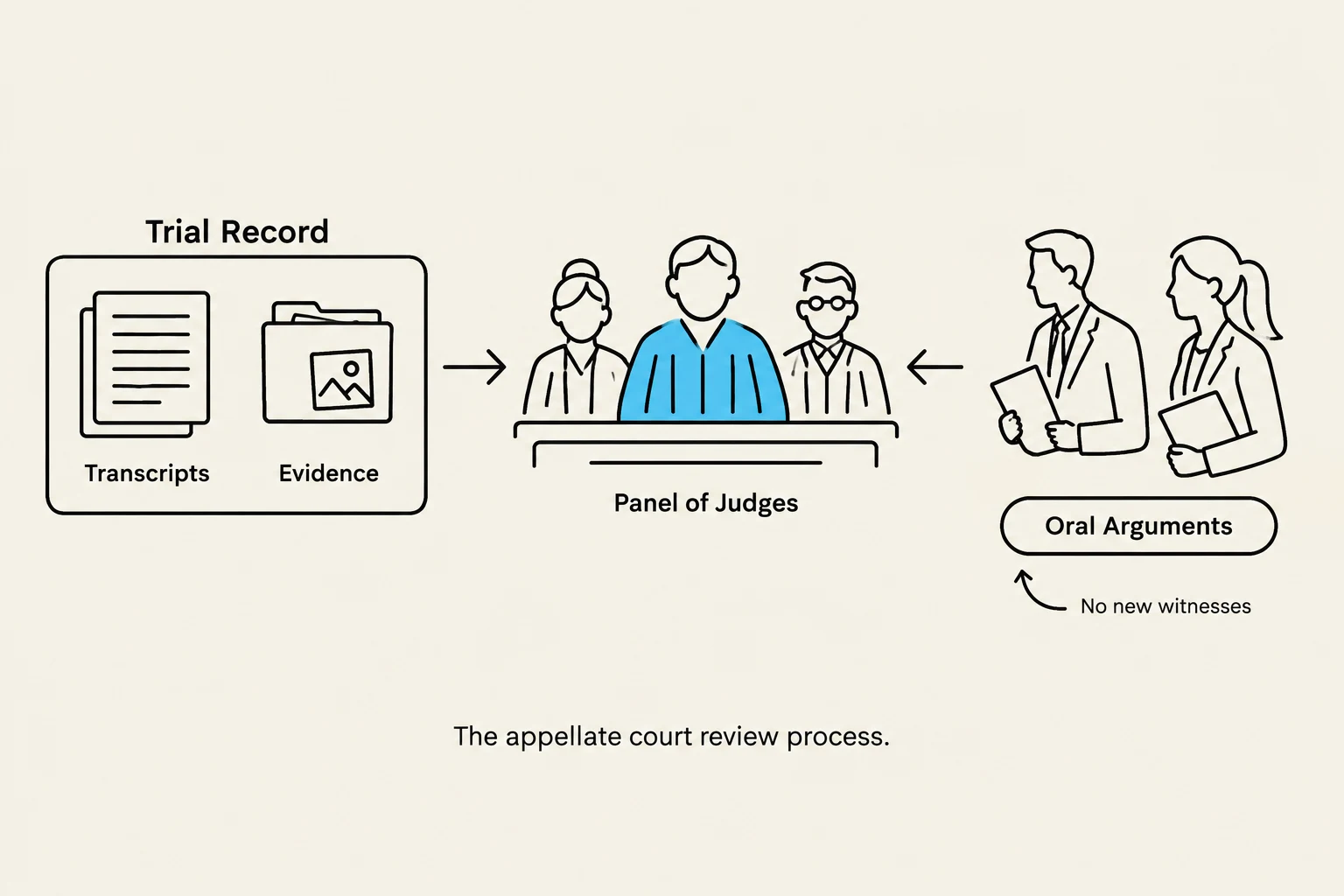
This diagram illustrates the appellate court review process, showing the flow from trial records and oral arguments to a panel of judges, with a note that no new witnesses are involved.
Unlike a trial, there are no witnesses and no new evidence is typically introduced at this stage. Instead, the appellate court reviews the "record" of the original trial—this includes the transcripts of what was said and the evidence that was admitted.
A panel of judges (usually three or more) will hear oral arguments from lawyers representing both sides. Their role is to determine if the trial judge made a mistake that affected the outcome of the case. Common grounds for appeal include:
Errors of Law: The judge applied the wrong legal test or misinterpreted a statute.
Errors of Fact: The judge's conclusion about the facts was so unreasonable that no reasonable person could have reached it based on the evidence.
Procedural Errors: The trial was conducted in a way that violated the principles of natural justice or fairness.
The Concept of 'Leave to Appeal'
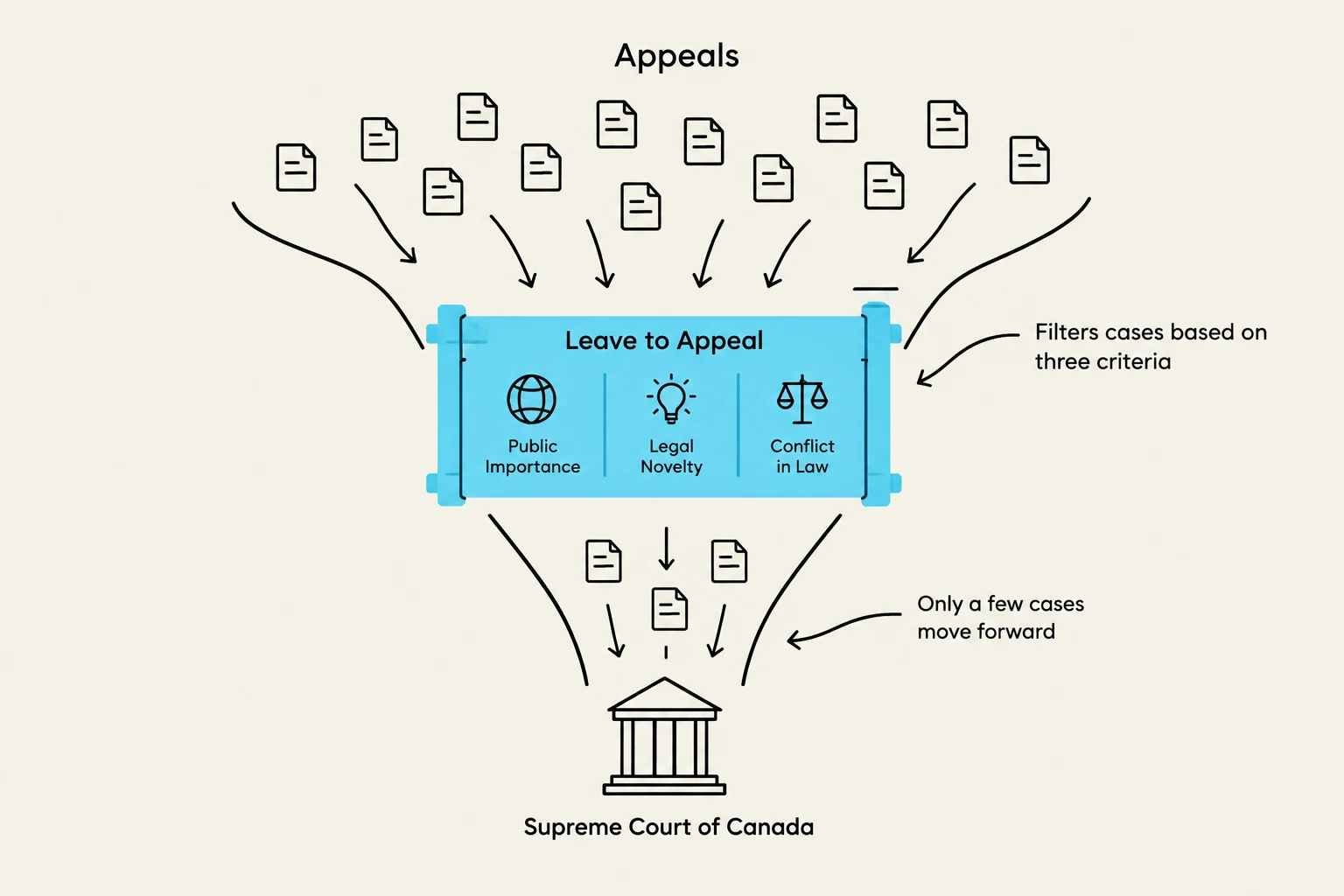
Diagram illustrating the process of appeals to the Supreme Court of Canada, highlighting criteria such as public importance, legal novelty, and conflict in law.
As you move higher up the judicial hierarchy, the right to have your case heard is no longer automatic. This is where the concept of "leave" becomes critical.
In many stages of the appeals process, a party does not have an absolute right to appeal. Instead, they must ask the court for permission to proceed. This permission is known as "leave to appeal".
Why is Leave Required?
Courts have limited time and resources. They cannot hear every single case that is appealed. Therefore, they use the "leave" process as a gatekeeping mechanism. To grant leave, a court typically looks for cases that involve:
Public Importance: The case raises a legal question that affects more than just the immediate parties involved.
Legal Novelty: The case addresses a new area of law or clarifies an ambiguous existing law.
Conflict in Law: There are conflicting decisions from different lower courts that need to be resolved to ensure consistency across the country.
If a party's application for leave is denied, the decision of the lower court stands, and the legal journey ends there.
The Final Destination: The Supreme Court of Canada
The Supreme Court of Canada (SCC) is the highest court in the country. Its decisions are binding on all other courts in Canada, meaning they set the final precedent for how laws must be interpreted nationwide.
Reaching the Supreme Court
Because the SCC is the ultimate authority, it is almost entirely a "leave-only" court. This means that parties cannot appeal to the Supreme Court as a matter of right; they must apply for leave.
The Supreme Court is extremely selective. It generally only hears cases that are of "national importance." It is not interested in correcting minor errors made by trial judges; rather, it focuses on resolving fundamental legal questions that shape the legal landscape of Canada.
Summary of the Hierarchy
To visualize the progression, consider the following flow:
Stage
Court Type
Primary Function
Right of Appeal?
Level 1
Trial Court
Determines facts and applies law
N/A (Starting point)
Level 2
Appellate Court
Reviews errors of law/fact
Often an automatic right
Level 3
Supreme Court
Resolves national legal issues
Requires Leave
Worked Example: The Path of a Case
Trial: A company is sued for breach of contract in a provincial Superior Court. The judge rules against the company.
First Appeal: The company believes the judge misinterpreted a specific clause in the contract (an error of law). They appeal to the Provincial Court of Appeal. They have a right to this appeal.
Second Appeal: The winning party wants to challenge the appellate decision. They must apply for leave to the Supreme Court of Canada. If the SCC decides the contract interpretation is a matter of national importance, they grant leave and hear the case. If not, the case ends.
Keep reading for free.
Create an account to finish this reading and make it part of your study routine.