


Vision is one of our most complex sensory processes, acting as a bridge between the physical world of light and the psychological world of experience. While we often think of seeing as a passive act, it is actually a sophisticated sequence of physical interactions, biological conversions, and neural interpretations. To understand vision, we must look at how light behaves, how the eye captures it, and how the brain constructs a three-dimensional world from two-dimensional retinal images.
The Physics of Light: Photons, Wavelength, and Amplitude
Everything we see begins with photons, which are particles of light that travel in waves. When photons reflect off an object, they arrange themselves into the shape of that object before entering our eyes. The specific characteristics of these light waves dictate exactly what we perceive:
- Wavelength: This determines the hue, or the color, that we experience. Different wavelengths correspond to different colors in the visible spectrum.
- Amplitude: This refers to the height of the light wave, which determines the brightness of the color.
Study Tip: Remember the distinction between wavelength and amplitude. If you change the wavelength, you change the color (e.g., red to blue). If you change the amplitude, you change the intensity (e.g., dim to bright).
The Anatomy of the Eye: Capturing the Image
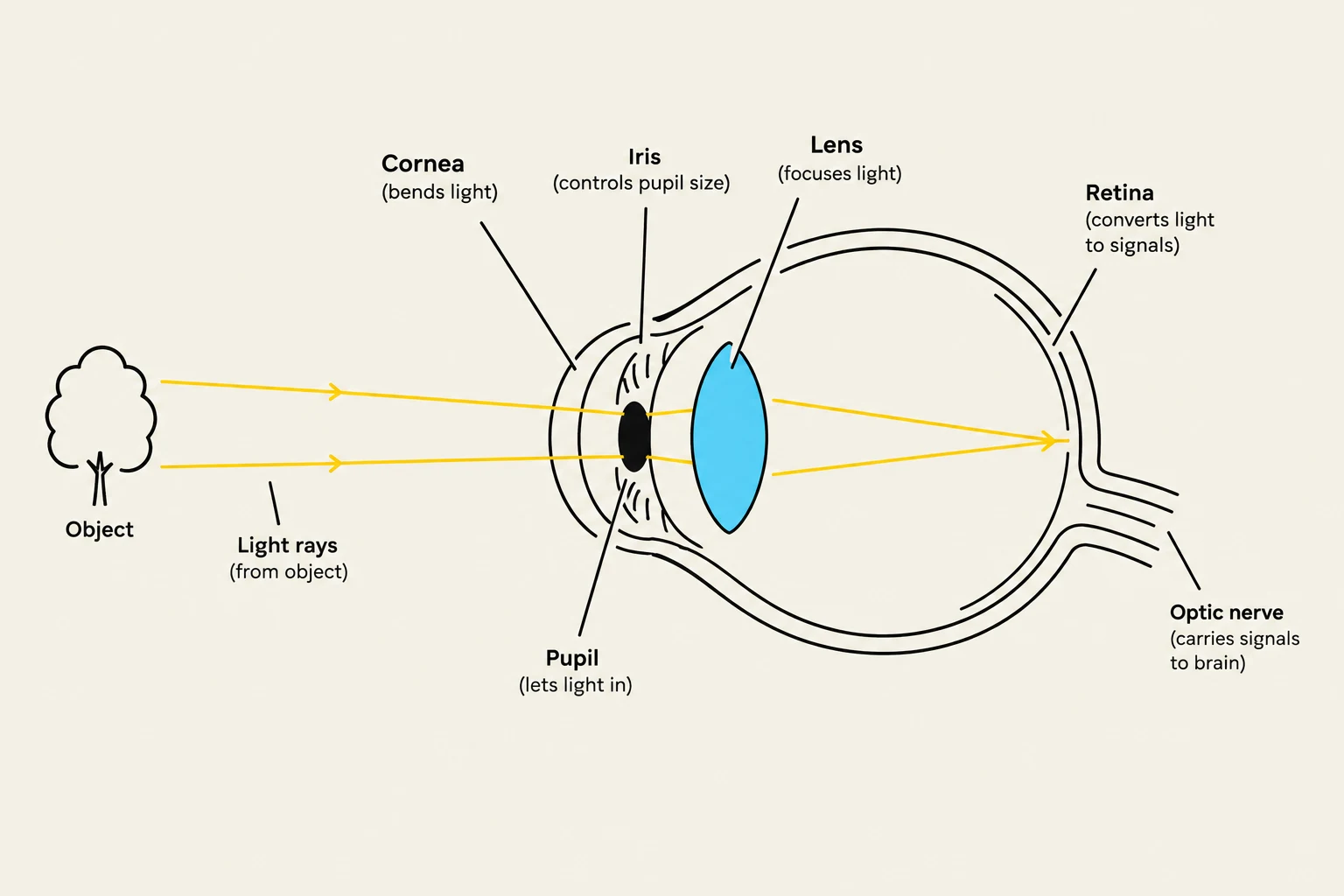
The eye acts as a biological camera, using several specialized structures to direct light toward the sensory tissue at the back of the eyeball.
- Cornea: The protective outer layer of the eye. Its primary job is to bend (refract) light rays inward so they can pass through the pupil.
- Pupil: The small, dark opening in the center of the eye through which light enters.
- Iris: The colored part of the eye. It acts as a shutter, using a reflex to dilate or contract the pupil to regulate how much light enters.
- Lens: Located behind the pupil, the lens is responsible for fine-tuning the focus of the light to ensure a sharp image is projected onto the retina.
- Retina: A thin membrane at the back of the eye containing the sensory receptors.
Keep reading for free.
Create an account to finish this reading and make it part of your study routine.
Continue reading freeAlready have an account? Log in
Updated