Explore the science of gustation, detailing the structures of papillae and taste buds, the five basic tastes, and the interplay between taste and smell.
Have you ever wondered why a lemon makes your mouth pucker or why a piece of dark chocolate feels so complex on your tongue? The sensation of taste, known scientifically as gustation, is one of our most vital chemical senses. It allows us to derive pleasure from nutrition while simultaneously acting as a biological warning system against toxins or spoiled food. To understand how this works, we must look beyond the surface of the tongue and explore the microscopic structures that translate chemical signals into neural impulses.
The Surface Landscape: Papillae
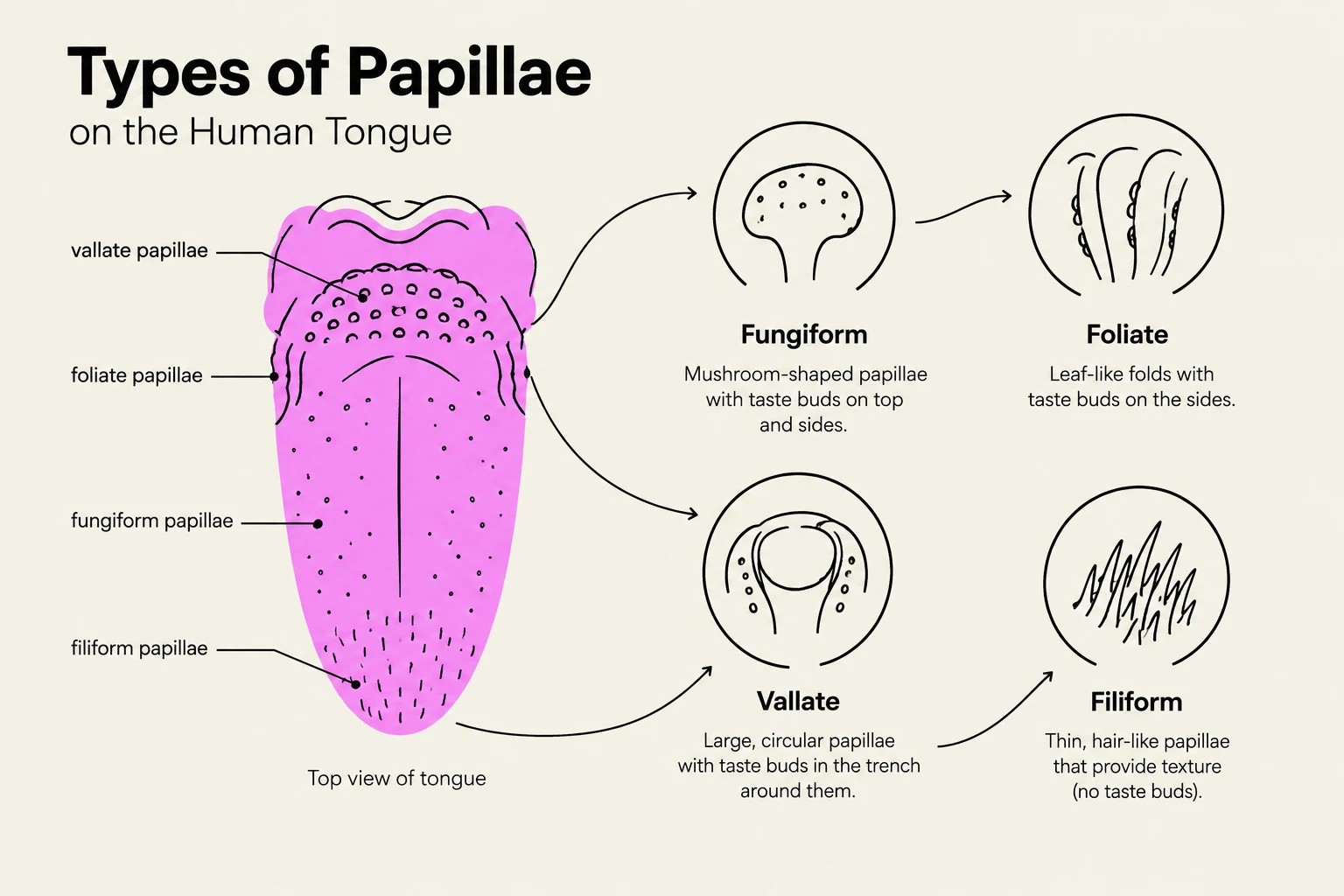
When you look in a mirror and stick out your tongue, you notice a bumpy, textured surface. These bumps are not just random irregularities; they are specialized structures called papillae. While many people use the terms "papillae" and "taste buds" interchangeably, they are distinct anatomical features. Papillae are the visible protrusions on the surface of the tongue, and they serve as the housing for the actual sensory organs.
There are several different types of papillae, each serving a unique role in the oral cavity:
Fungiform Papillae: These are mushroom-shaped and scattered across the surface of the tongue. They contain taste buds and are easily visible to the naked eye.
Foliate Papillae: Located on the sides of the tongue, these appear as short vertical folds or ridges.
Vallate (Circumvallate) Papillae: These are much larger and are arranged in a V-shape at the back of the tongue. They contain a high concentration of taste buds.
Filiform Papillae: Unlike the others, these do not contain taste buds. They are small, cone-shaped projections that provide friction, helping the tongue move food around the mouth.
This diagram illustrates the different types of papillae found on the human tongue, including vallate, foliate, fungiform, and filiform papillae, along with their characteristic shapes and functions related to taste buds.
Exam Tip: If a question asks which structure is responsible for the texture or tactile sensation of food rather than the flavor, the answer is likely the filiform papillae, as they lack taste buds.
The Microscopic Detectors: Taste Buds
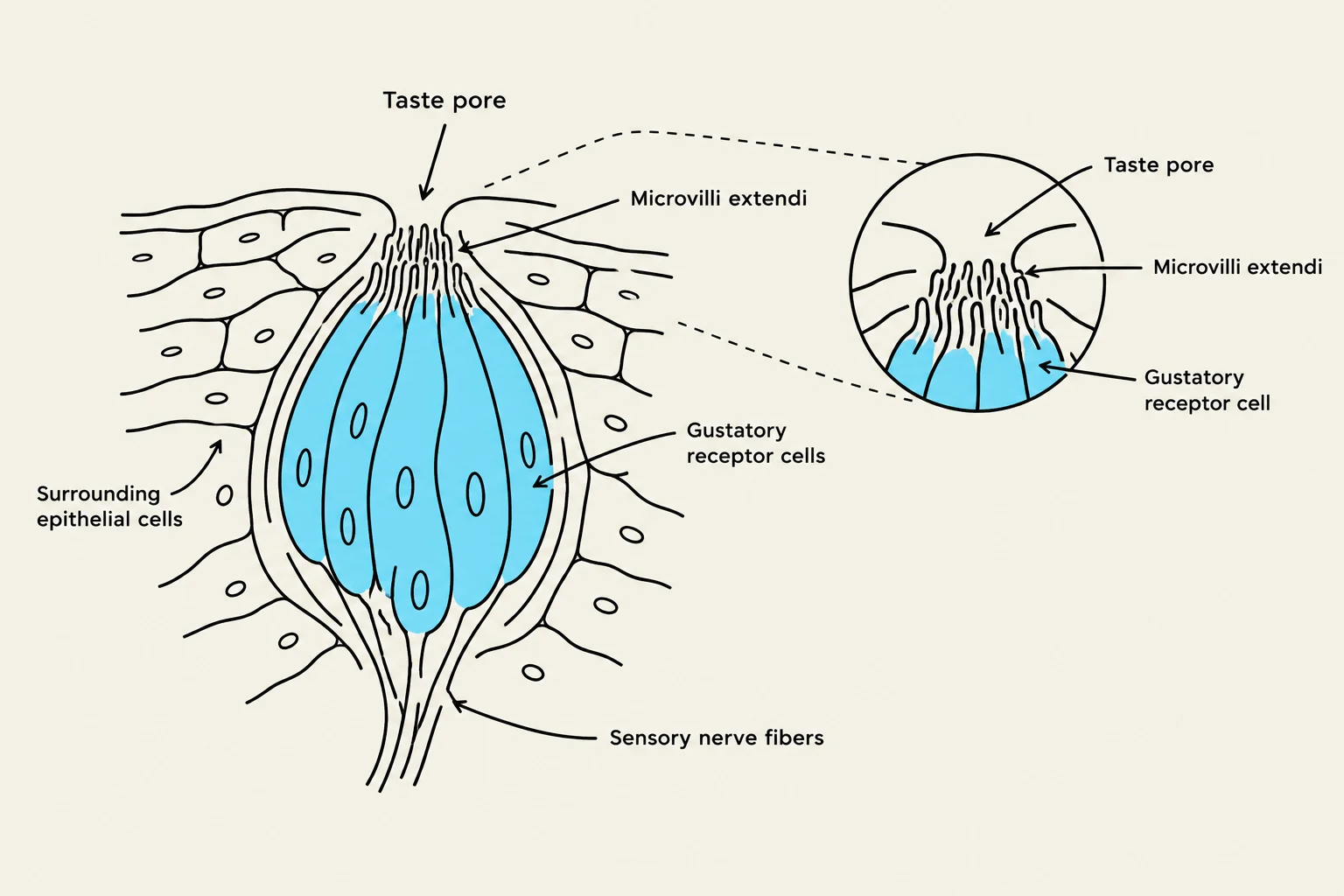
Deep within the papillae lie the true sensory receptors: the taste buds. A single taste bud is a microscopic cluster of cells that acts as a chemical detector.
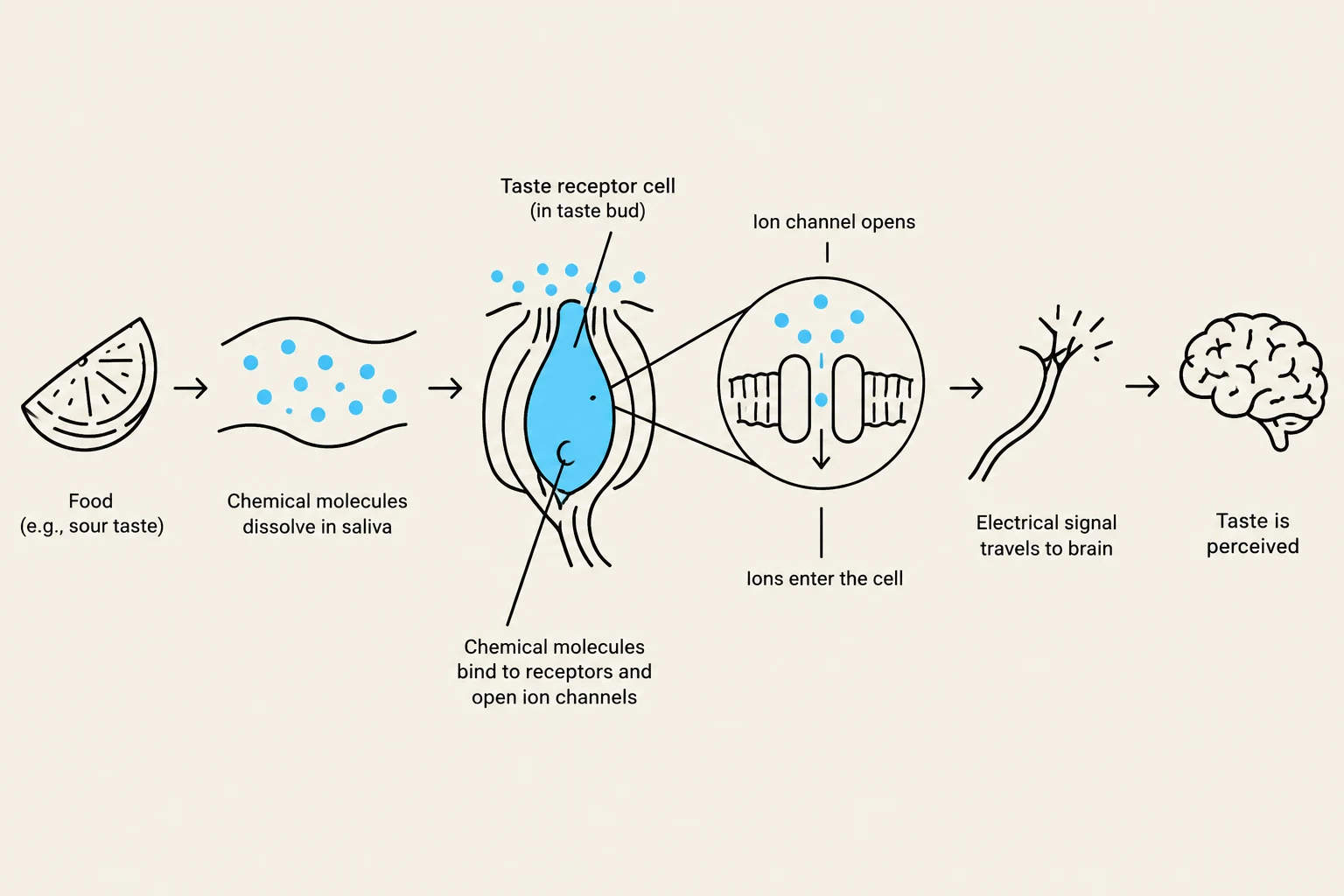
Each taste bud is composed of several specialized cells, including gustatory receptor cells. These cells have tiny hair-like projections called microvilli that extend through a small opening in the papilla known as a taste pore. When you eat, chemicals from your food (solutes) dissolve in your saliva and enter this pore, coming into direct contact with the microvilli of the receptor cells.
This contact triggers a chemical reaction within the receptor cell, which then sends an electrical signal through sensory neurons to the brain. This process is a classic example of transduction—the conversion of physical or chemical energy into a biological signal that the nervous system can interpret.
Diagram illustrating the structure of a taste bud, including taste pore, microvilli, gustatory receptor cells, surrounding epithelial cells, and sensory nerve fibers.
How Taste Functions as a Receptor
The primary function of the taste bud is to act as a chemoreceptor. Unlike mechanoreceptors (which respond to pressure) or photoreceptors (which respond to light), chemoreceptors respond specifically to chemical stimuli.
The human tongue is generally categorized as being able to detect five basic qualities of taste:
Sweet: Often indicates energy-rich carbohydrates.
Sour: Typically indicates acidity (which can signal spoiled food).
Salty: Indicates the presence of sodium and other essential minerals.
Bitter: Often a warning sign for potentially toxic alkaloids.
Umami: A savory taste associated with amino acids, such as glutamate.
It is a common misconception that different parts of the tongue are "mapped" to specific tastes (e.g., the tip for sweet, the back for bitter). Modern science has debunked this "tongue map." While some areas may have slightly different sensitivities, all areas of the tongue containing taste buds are capable of detecting all five basic tastes.
This diagram illustrates the biological process of taste perception, starting from food intake and chemical dissolution in saliva, leading to the activation of taste receptor cells, signal transmission to the brain, and finally, the perception of taste.
The Intersection of Taste and Smell
While we often use the word "taste" to describe the entire experience of eating, what we are actually experiencing is a combination of gustation (taste) and olfaction (smell).
The taste buds on your tongue provide the basic "building blocks" of flavor (sweet, salty, etc.), but the complex nuances—like the difference between a strawberry and a raspberry—are largely provided by the olfactory system. When you chew, aromas are released from the food and travel through the back of your throat to the nasal cavity (a process called retronasal olfaction). Without your sense of smell, food would seem bland and one-dimensional, regardless of how many taste buds you have.
Summary Table: Anatomy of Taste
Structure
Level
Primary Function
Papillae
Macroscopic (Visible)
Housing for taste buds; texture/friction
Taste Bud
Microscopic
Cluster of receptor cells
Gustatory Cell
Cellular
Transduces chemical signals into neural impulses
Microvilli
Sub-cellular
Surface area for chemical contact
Keep reading for free.
Create an account to finish this reading and make it part of your study routine.