The American Revolution and the Founding of the United States
An educational overview of the causes, key events, and outcomes of the American Revolutionary War, the challenges of the Articles of Confederation, and the creation of the U.S. Constitution.
The transition of the thirteen colonies from British subjects to a sovereign nation is a complex narrative of economic tension, military struggle, and intense political debate. To master this era for your exam, you must look beyond isolated dates and focus on the "cause-and-effect" chain: how British economic policies triggered colonial resistance, how specific military victories secured independence, and how the failures of the first national government necessitated the Constitution.
The Road to Revolution: Tension and Resistance
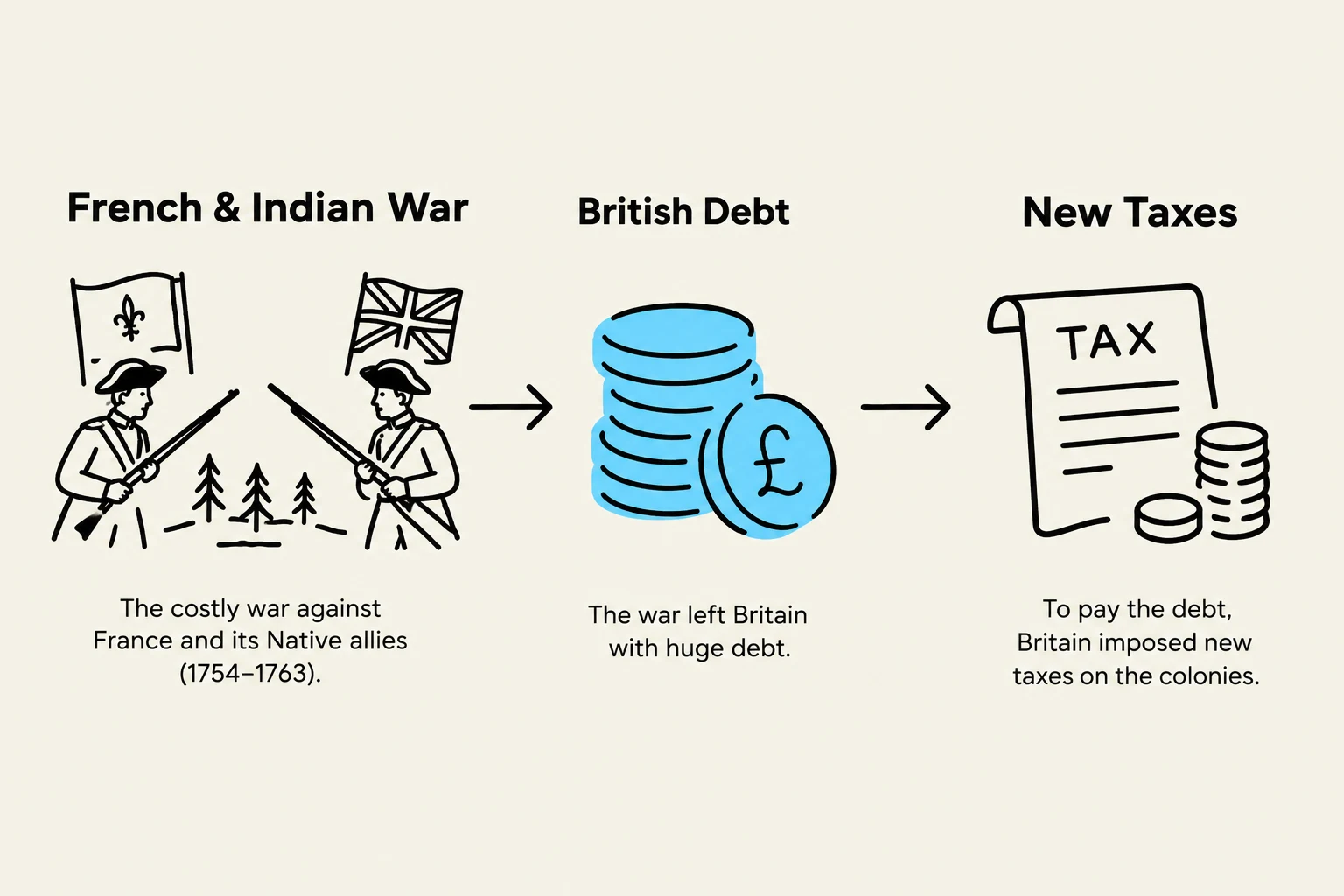
The friction between Great Britain and the American colonies was rooted in mercantilism, an economic system where Britain used its colonies to supply raw materials and serve as a market for manufactured goods. Following the French and Indian War, Britain faced massive debts and sought to recoup costs by imposing new taxes on the colonies.
Colonists viewed these measures—such as the Stamp Act and the Townshend Acts—as violations of their rights, famously summarized by the principle of "no taxation without representation". Tensions reached a breaking point through several key events:
The Boston Massacre (1770): A confrontation where British soldiers fired into a crowd, killing colonists; Patriots used this as powerful propaganda.
The Tea Act (1773): Designed to help the British East India Company, this act triggered the Boston Tea Party.
The Coercive Acts (1774): Also known as the Intolerable Acts, these were British punishments that closed Boston Harbor and stripped Massachusetts of self-government, ultimately unifying the colonies against British rule.
Before the war turned into open combat, conflicts like Pontiac’s Rebellion highlighted the growing tensions regarding British expansion into Native American territories.
This illustration depicts the historical progression from the French and Indian War to British debt and the subsequent imposition of new taxes on the colonies.
The Revolutionary War: Turning Points and Victories
The war began with the British march on Lexington and Concord, where colonial minutemen and militia first confronted British troops. While the war was characterized by immense hardship, several key battles and leaders determined the outcome.
Military Milestones
Battle of Bunker Hill (1775): A British victory, but one that came at a high cost in casualties, proving that the colonial forces could stand their ground.
Trenton and Princeton (1776–1777): Crucial winter victories for George Washington that provided a massive boost to Patriot morale.
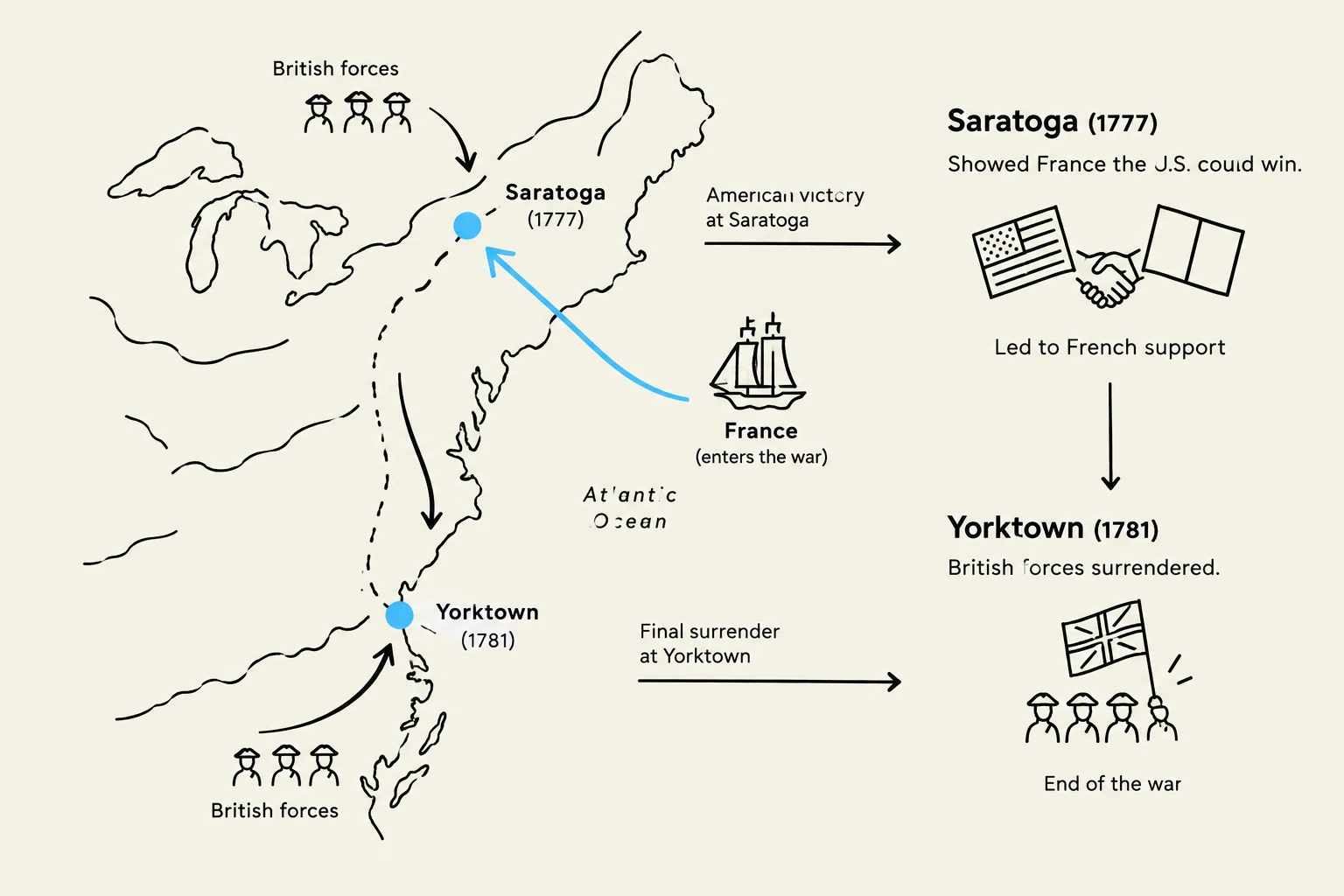
Battle of Saratoga (1777): Perhaps the most strategic turning point, this American victory convinced France to enter the war as an ally, providing essential military and naval support.
Battle of Cowpens (1781): A significant victory in the Southern campaign led by Daniel Morgan.
Battle of Yorktown (1781): The decisive conclusion where Washington and French forces surrounded Cornwallis, forcing a British surrender and effectively ending the war.
Exam Tip: When studying battles, don't just memorize the year. Ask: Who won? and What was the significance? (e.g., Saratoga = French alliance; Yorktown = End of fighting).
Leadership and Resilience
The Continental Army faced extreme suffering, most notably during the winter at Valley Forge, where hunger and disease were rampant. However, the arrival of Friedrich Wilhelm von Steuben helped transform the army through rigorous training in discipline and drill. Other key figures included Francis Marion (the "Swamp Fox"), who utilized guerrilla tactics in South Carolina.
This diagram illustrates the key events of the American Revolutionary War, including the battles of Saratoga and Yorktown, and the crucial role of French support in the American victory.
From Confederation to Constitution
After winning independence, the new nation initially operated under the Articles of Confederation. This first national government was intentionally weak, prioritizing state sovereignty over central authority. This lack of central power made governing the new states difficult.
The Constitutional Convention
To fix these weaknesses, delegates met to debate new frameworks. Two competing visions emerged:
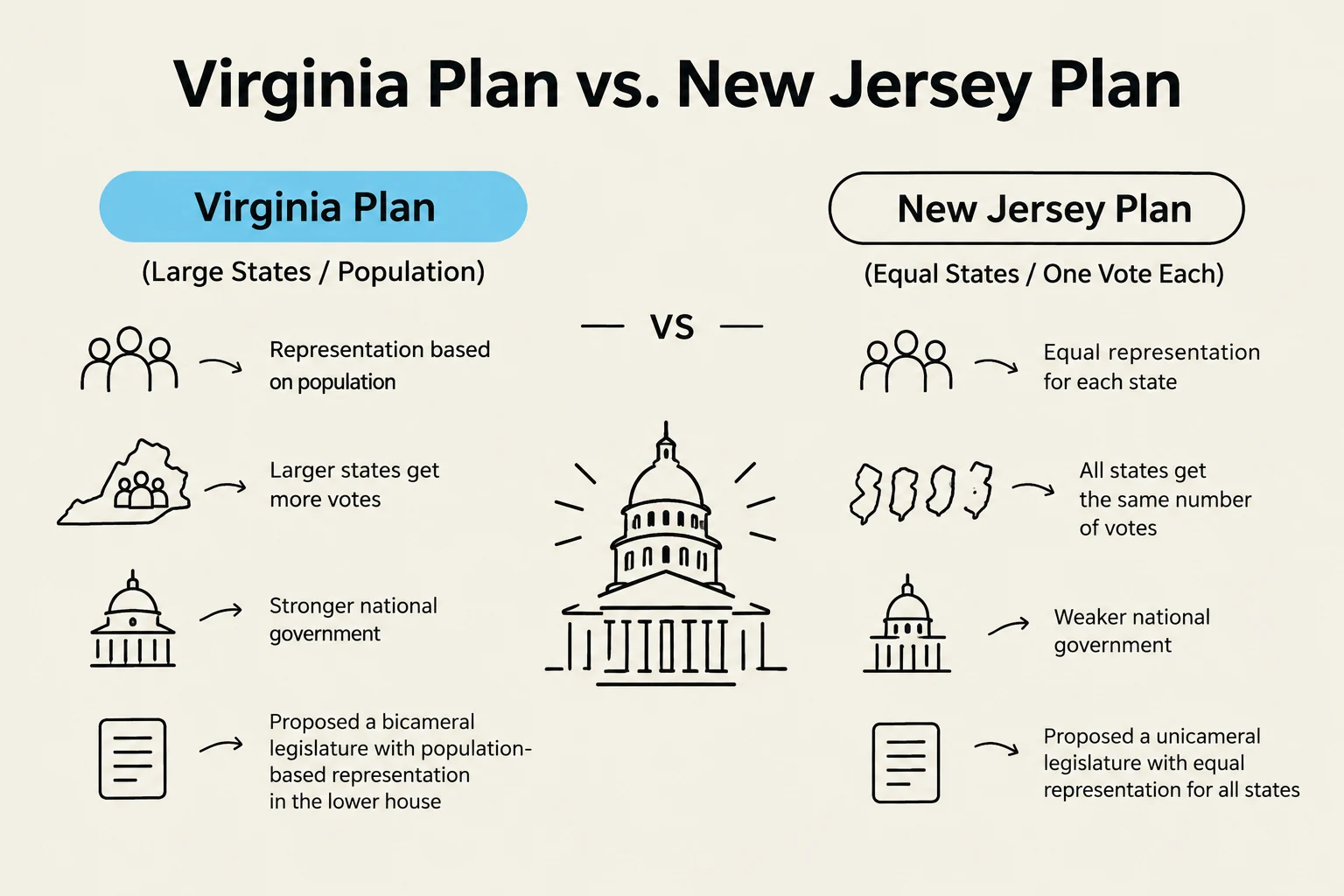
The Virginia Plan: Favored large states by proposing representation based on population.
The New Jersey Plan: Favored small states by proposing equal representation for every state.
These debates were resolved by the Great Compromise, which created a bicameral legislature: the House of Representatives (population-based) and the Senate (equal representation).
Ratification Debates
The proposed Constitution faced intense scrutiny from two groups:
Federalists: Led by figures like Alexander Hamilton and James Madison (the "Father of the Constitution"), they advocated for a strong central government. They used the Federalist Papers (written under the pseudonym Publius) to argue for ratification.
Anti-Federalists: They feared a powerful central government would infringe upon individual liberties and state rights. Their persistence ensured the addition of the Bill of Rights to protect citizens.
Comparison of the Virginia Plan and the New Jersey Plan, outlining their key differences in representation and government structure.
The New Republic and Political Divisions
The early years of the United States were defined by the implementation of the Social Compact—the idea that government derives its authority from the people to protect their unalienable rights (life, liberty, and the pursuit of happiness).
Governance and Early Challenges
The Constitution established a system of checks and balances. For example:
The President can negotiate treaties, but they require two-thirds Senate approval.
The President can veto legislation, but Congress can override that veto with a two-thirds vote in both houses.
The First Amendment was established to protect fundamental freedoms like speech, religion, and assembly.
The Northwest Ordinance (1787) was a landmark piece of legislation that organized new territories and, importantly, prohibited slavery in those areas.
The Rise of Political Parties
Disagreements over the role of government led to the first political divisions:
Hamiltonian System: Advocated by Alexander Hamilton, focusing on a strong national government, a national bank, and manufacturing.
Jeffersonian Republicans: Associated with Thomas Jefferson and James Madison, they favored states' rights, a smaller federal government, and an agricultural society.
Diplomatic tensions also tested the young nation, such as the XYZ Affair during John Adams's presidency, where French officials demanded bribes, nearly pushing the U.S. into war.
Keep reading for free.
Create an account to finish this reading and make it part of your study routine.