


The American Civil War and the subsequent Reconstruction era represent one of the most turbulent and transformative periods in United States history. Defined by intense conflict over the institution of slavery, the expansion of federal versus state power, and the agonizing struggle to define the rights of newly freed citizens, this era fundamentally reshaped the American social, political, and economic landscape.
The Road to Disunion: Long-term Causes
The path to the Civil War was paved by deep-seated sectionalism, driven by the differing economic needs of the North and South. While the North moved toward industrialization, the South remained heavily reliant on an agrarian economy built upon the labor of enslaved people.
Legislative Battles and Territorial Expansion
As the nation expanded westward, the central question became whether slavery would be permitted in new territories. Several key milestones attempted—and often failed—to manage this tension:
-
The Compromise of 1850: This package of laws sought to balance interests by admitting California as a free state and banning the sale of slaves in Washington, D.C. However, it included the controversial Fugitive Slave Act, which required citizens to assist in the capture of runaway slaves.
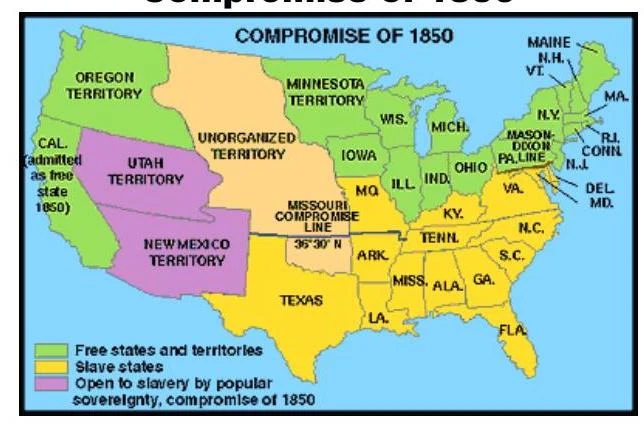
Map of the United States showing the Compromise of 1850, illustrating free states, slave states, and territories open to slavery by popular sovereignty. -
Popular Sovereignty: This concept suggested that the residents of a territory should decide for themselves whether to allow slavery.
-
The Kansas-Nebraska Act: Introduced by Stephen Douglas, this act applied popular sovereignty to the Kansas and Nebraska territories, effectively repealing the Missouri Compromise. This instability led to the formation of the Republican Party, which opposed the extension of slavery.

Map of the United States in 1854, illustrating the Kansas-Nebraska Act and the division of territories into free states, slave states, and those determined by popular sovereignty. -
The Dred Scott Decision: In 1857, the Supreme Court ruled that African Americans were not citizens and had no right to sue for freedom. The ruling further claimed that Congress could not prohibit slavery in any territory, rendering the Missouri Compromise unconstitutional.
-
The Freeport Doctrine: During debates with Abraham Lincoln, Stephen Douglas argued that territories could still ban slavery through local legislation, despite the Supreme Court's ruling.

Keep reading for free.
Create an account to finish this reading and make it part of your study routine.
Continue reading freeAlready have an account? Log in
Updated