The Agency Problem and Strategic Implementation in Business
Explores the agency problem arising from the separation of ownership and management in corporations, detailing managerial perks and risk distortion. Discusses strategic implementation through control, reward systems, and organizational structure to align principal and agent interests.
In the world of strategic management, a brilliant plan is only as effective as its execution. As the saying goes, "strategy is only as good as its implementation". While many leaders focus on the formulation of vision, mission, and objectives, the true challenge often lies in the transition from theory to action. This transition requires a robust organizational structure and, more importantly, a way to ensure that the people executing the strategy are actually working toward the same goals as the people who own the company.
The Core of the Issue: Separation of Ownership and Management
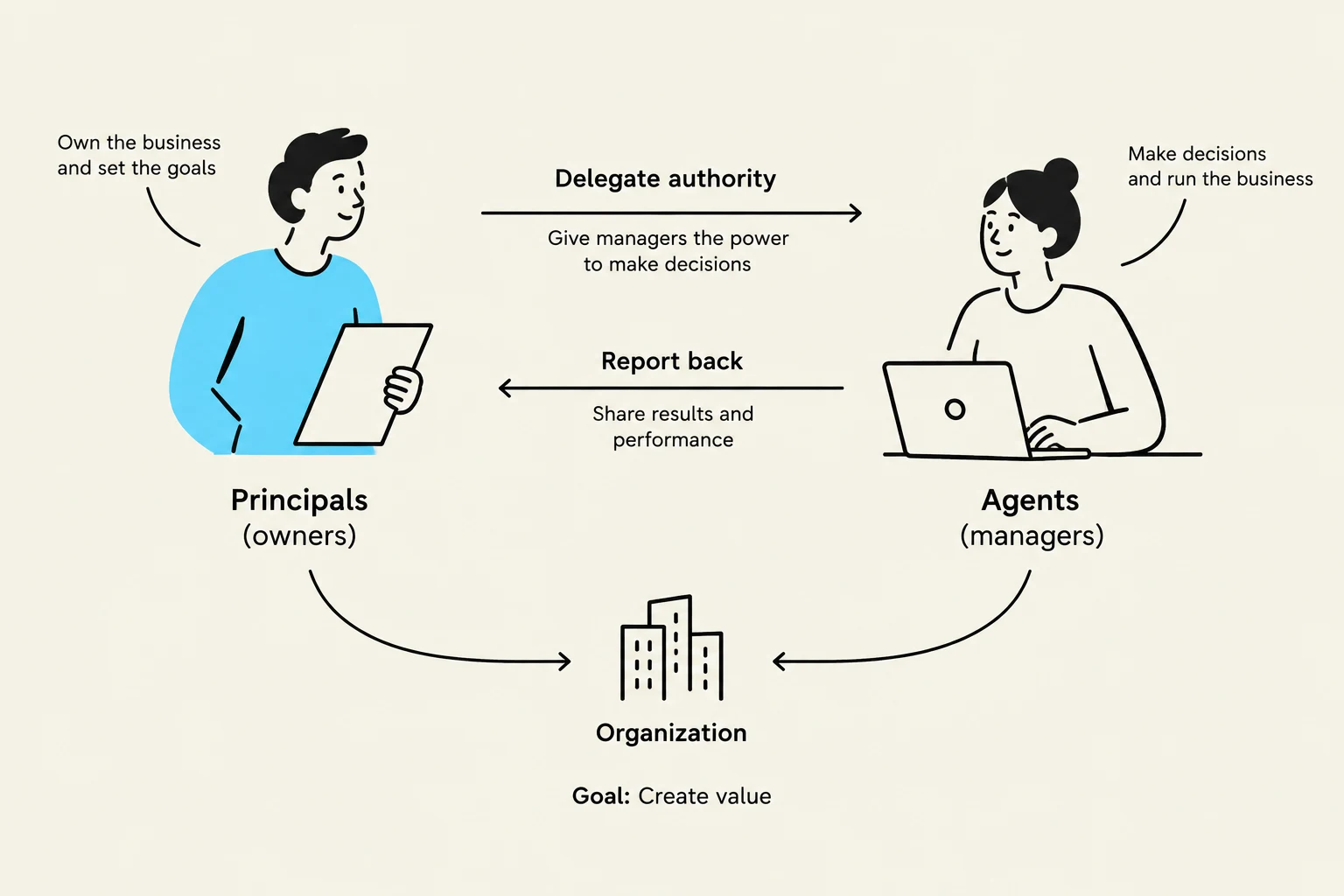
In modern, large-scale corporations, there is a fundamental separation of ownership and management. In a small business, the owner is often the manager; their personal wealth and the company's success are one and the same. However, as firms grow and become more complex, the owners (the principals) often lack the logistical capability or the desire to manage daily operations.
To solve this, principals hire professional managers (the agents) to run the business on their behalf. While this allows for specialized expertise, it creates a structural tension known as the agency problem. This problem arises when the interests of the agents diverge from those of the principals, leading to decisions that benefit the manager at the expense of the owner.
This diagram illustrates the principal-agent relationship in an organization, where principals (owners) delegate authority to agents (managers) to make decisions and run the business, with the ultimate goal of creating value.
Two Primary Distortions in Managerial Behavior
When the agency problem is present, it typically manifests in two distinct ways that erode company value:
1. Managerial Perks
Agents may use corporate resources to fund personal luxuries that do not contribute to the firm's strategic goals. These "perks" can range from extravagant office decorations and high-end travel to excessive lifestyle expenses funded by corporate capital. While these benefits might make the manager's life more comfortable, they represent a direct drain on the wealth of the principals.
2. Distortion in Risk-Taking
There is a natural conflict regarding how much risk an organization should undertake.
Principals tend to be diversified. Because they likely hold many different investments, they can tolerate high risk in one specific firm if there is a chance for massive returns, knowing that one failure won't ruin them.
Agents, however, are often undiversified. Their primary livelihood, reputation, and wealth are tied to a single firm. To protect their job security, self-interested managers often become "risk-averse," avoiding bold, high-reward strategies that might lead to failure and subsequent unemployment.
The economic fallout from these behaviors—both the direct cost of perks and the opportunity cost of missed growth due to low risk-taking—is categorized as agency costs.
Strategic Implementation: Building the Solution
To combat the agency problem, organizations must focus on strategic implementation. Implementation is not just about "doing things"; it is about designing the right environment to influence behavior. Successful implementation relies on three key building blocks: structure, control, and reward systems.
Control and Reward Systems
The most effective way to mitigate the agency problem is to develop control and reward systems that align the interests of managers with those of the owners. If a manager's compensation is tied directly to the long-term stock price or specific value-creation metrics, they are incentivized to avoid wasteful perks and to take calculated risks that benefit the shareholders.
Exam Tip: When asked how to solve the agency problem, focus on "alignment." The goal is to ensure that when a manager acts to improve their own position (e.g., earning a higher bonus), they are simultaneously acting to maximize value for the principals.
Organizational Structure and Information Flow
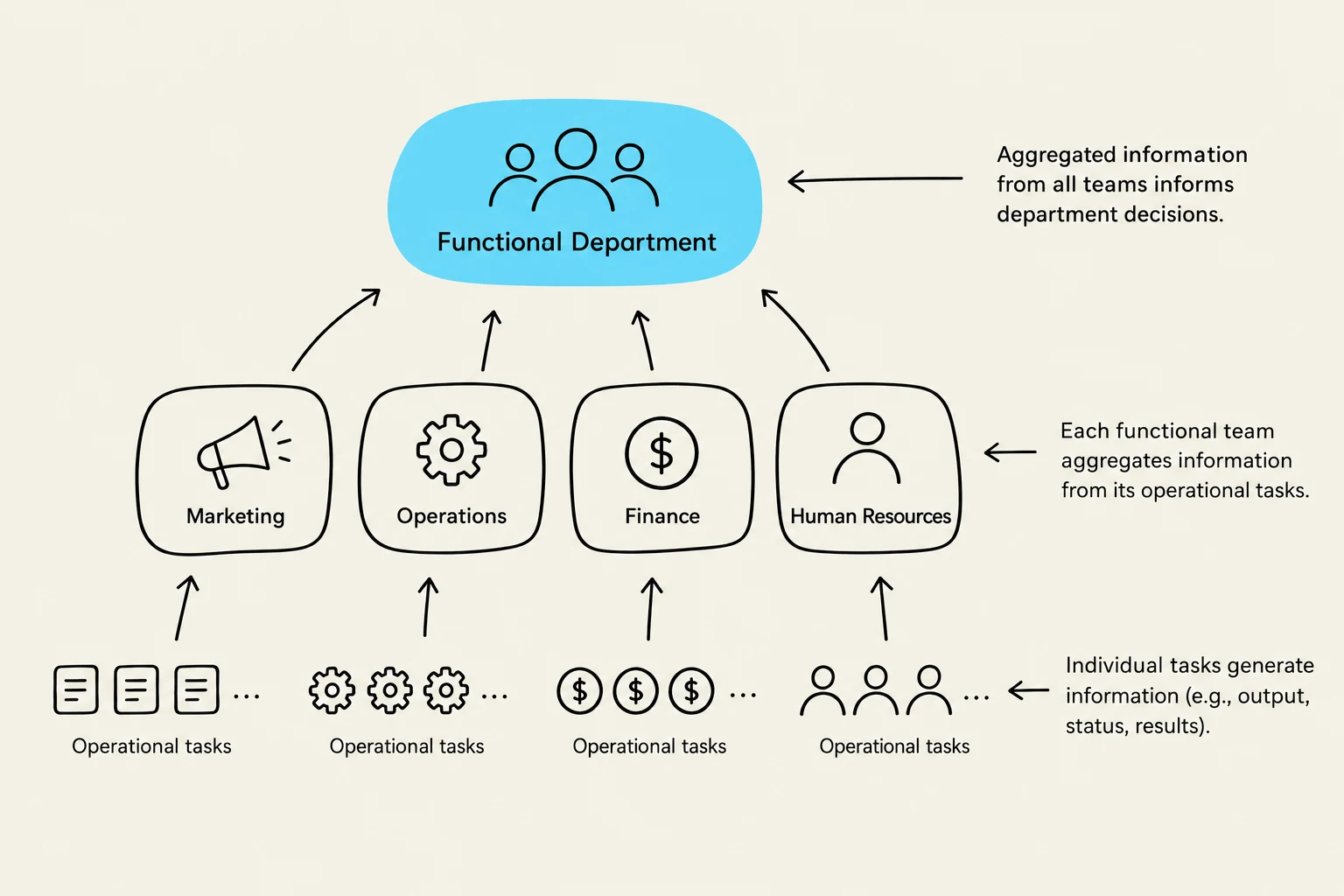
Structure is the framework that determines who reports to whom and how authority is delegated. An effective structure helps manage the "information processing" requirements of a firm. As a company grows, the sheer volume of data can overwhelm decision-makers. A well-designed structure breaks information into manageable blocks, ensuring that the right information reaches the right person at the right time.
This diagram illustrates a functional department structure where individual operational tasks feed into functional teams (Marketing, Operations, Finance, Human Resources), which then aggregate information to inform department decisions.
Summary of Implementation Frameworks
Depending on the complexity of the firm, different structures are used to implement strategy:
Structure Type
Best Use Case
Key Characteristic
Simple Structure
Small businesses/startups
One or two people handle everything; high flexibility but high risk of things "falling through the cracks".
Functional Structure
Single-business firms
Employees are grouped by specialty (Marketing, Finance, etc.); promotes high efficiency through division of labor.
Multi-divisional
Diversified corporations
Independent divisions (e.g., Chevy vs. Cadillac) act as semi-autonomous businesses; best for complex, multi-product firms.
By understanding the agency problem and implementing robust control and structural systems, organizations can bridge the gap between ownership and management, ensuring that strategic goals are not just formulated, but successfully achieved.
Keep reading for free.
Create an account to finish this reading and make it part of your study routine.