The ADPIE Nursing Process: A Framework for Patient Care
This guide explains the ADPIE framework (Assessment, Diagnosis, Planning, Implementation, Evaluation), a systematic method used by nurses to provide patient-centered care. It details each step, including data collection, problem identification, goal setting, action, and outcome assessment.
In the fast-paced environment of healthcare, nurses must make critical decisions rapidly and accurately. To ensure patient safety and provide high-quality care, nursing is not merely a series of tasks, but a systematic, scientific method known as the Nursing Process. This method is encapsulated in the acronym ADPIE: Assessment, Diagnosis, Planning, Implementation, and Evaluation.
By following this cyclical framework, nurses can move beyond "task-oriented" care and instead provide "patient-centered" care that addresses the unique physiological, psychological, and social needs of every individual.
1. Assessment: The Foundation of Data Collection
The first step in the ADPIE cycle is Assessment. This is the systematic collection of data regarding a patient's health status. Without a thorough assessment, the subsequent steps of the nursing process will be based on incomplete or incorrect information, potentially leading to errors in care.
Assessment data is generally categorized into two types:
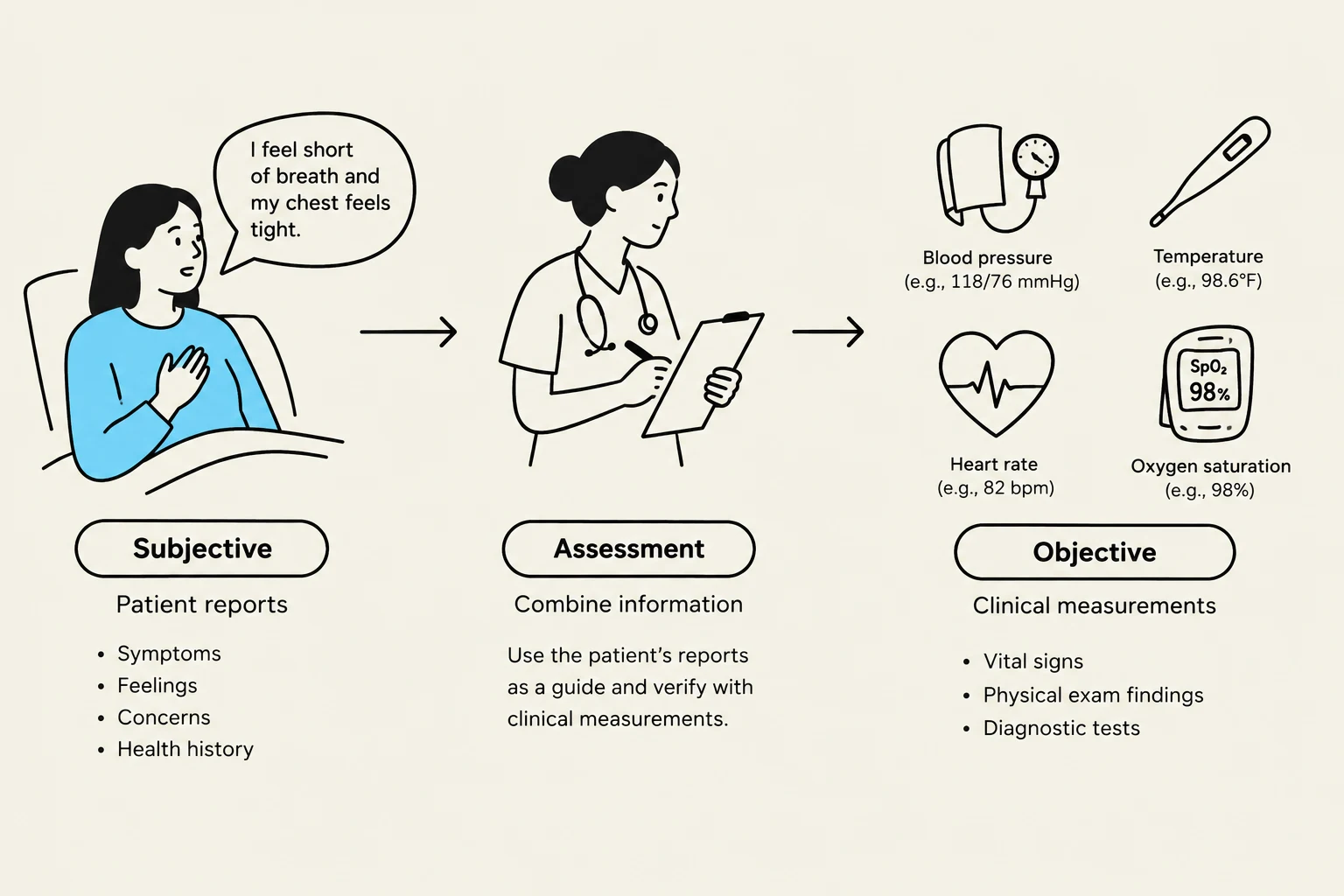
Subjective Data: Information provided by the patient (or their family) that cannot be measured by the nurse, such as "I feel nauseated" or "My pain is a 7 out of 10."
Objective Data: Observable and measurable facts obtained through physical examination, laboratory results, or vital signs, such as a blood pressure reading of 140/90 mmHg or a visible skin rash.
Exam Tip: On nursing exams, always distinguish between subjective and objective data. If the question asks for "signs" (objective) versus "symptoms" (subjective), your answer choice must reflect that distinction.
This illustration depicts the process of a medical assessment, categorizing information into subjective (patient reports) and objective (clinical measurements) data, with an assessment phase to combine these findings.
2. Diagnosis: Identifying the Problem
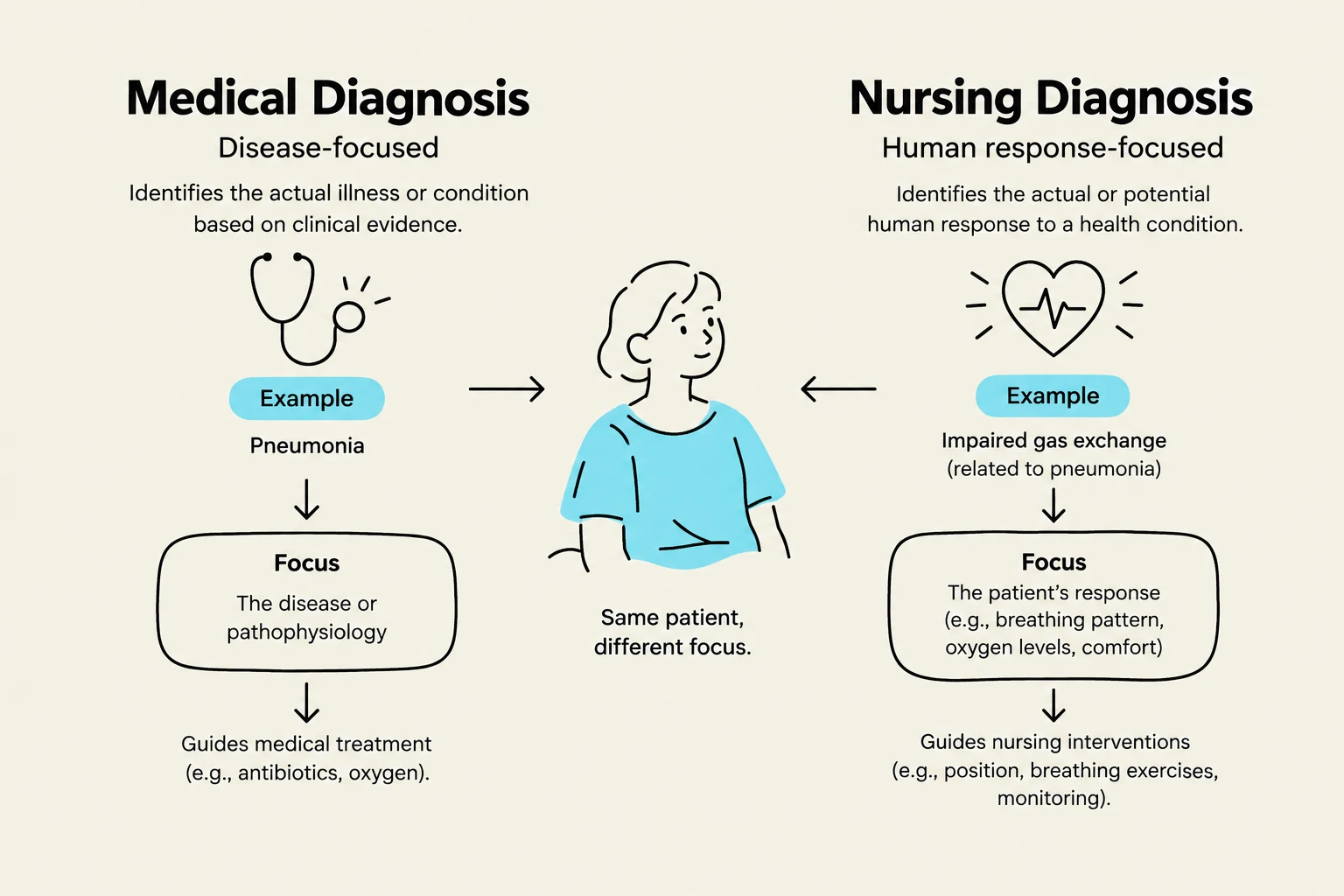
Once the data is collected, the nurse must analyze it to identify the patient's problems. In the context of the nursing process, a Nursing Diagnosis is different from a medical diagnosis. While a medical diagnosis identifies a disease (e.g., Diabetes Mellitus), a nursing diagnosis identifies the human response to that disease (e.g., Risk for Unstable Blood Glucose or Deficient Knowledge regarding insulin administration).
A formal nursing diagnosis often follows a specific structure, such as:
Problem: The NANDA-I approved label.
Etiology: The "related to" (r/t) factor (the cause).
Signs/Symptoms: The "as evidenced by" (AEB) factor (the proof).
This diagram illustrates the difference between a medical diagnosis, which focuses on the disease itself, and a nursing diagnosis, which focuses on the patient's human response to the disease. Both approaches are essential for comprehensive patient care.
3. Planning: Setting Goals and Outcomes
With a diagnosis established, the nurse moves into the Planning phase. The goal here is to develop a care plan that addresses the identified nursing diagnosis. This phase involves two critical components: setting patient outcomes and selecting nursing interventions.
Effective planning relies on SMART goals. Every goal or expected outcome must be:
Specific
Measurable
Attainable
Realistic
Timed
For example, instead of saying "The patient will feel better," a SMART goal would be: "The patient will report a pain level of 3 or less on a 0–10 scale within 30 minutes of receiving analgesic medication".
4. Implementation: Taking Action
Implementation is the "doing" phase of the nursing process. This is where the nurse carries out the interventions identified during the planning stage. Implementation can include a wide variety of actions, such as:
Direct Care: Administering medication, performing wound care, or repositioning a patient to prevent pressure ulcers.
Indirect Care: Documenting care, collaborating with the multidisciplinary team, or managing the patient's environment.
Teaching: Educating the patient on how to manage their condition at home.
It is vital to remember that implementation must always be grounded in the assessment data collected in step one. If a patient's vital signs change during implementation, the nurse must pause and re-assess.
5. Evaluation: Closing the Loop
The final step, Evaluation, is not the end of the process, but rather a way to determine if the nursing interventions were successful. The nurse compares the patient's current status against the SMART goals established during the Planning phase.
There are three possible outcomes during evaluation:
Goal Met: The patient achieved the desired outcome. The nursing problem is resolved, and the care plan can be discontinued.
Goal Partially Met: Some progress was made, but the target was not fully reached. The plan may need modification.
Goal Not Met: No progress was made. This requires a complete re-evaluation of the entire ADPIE cycle.
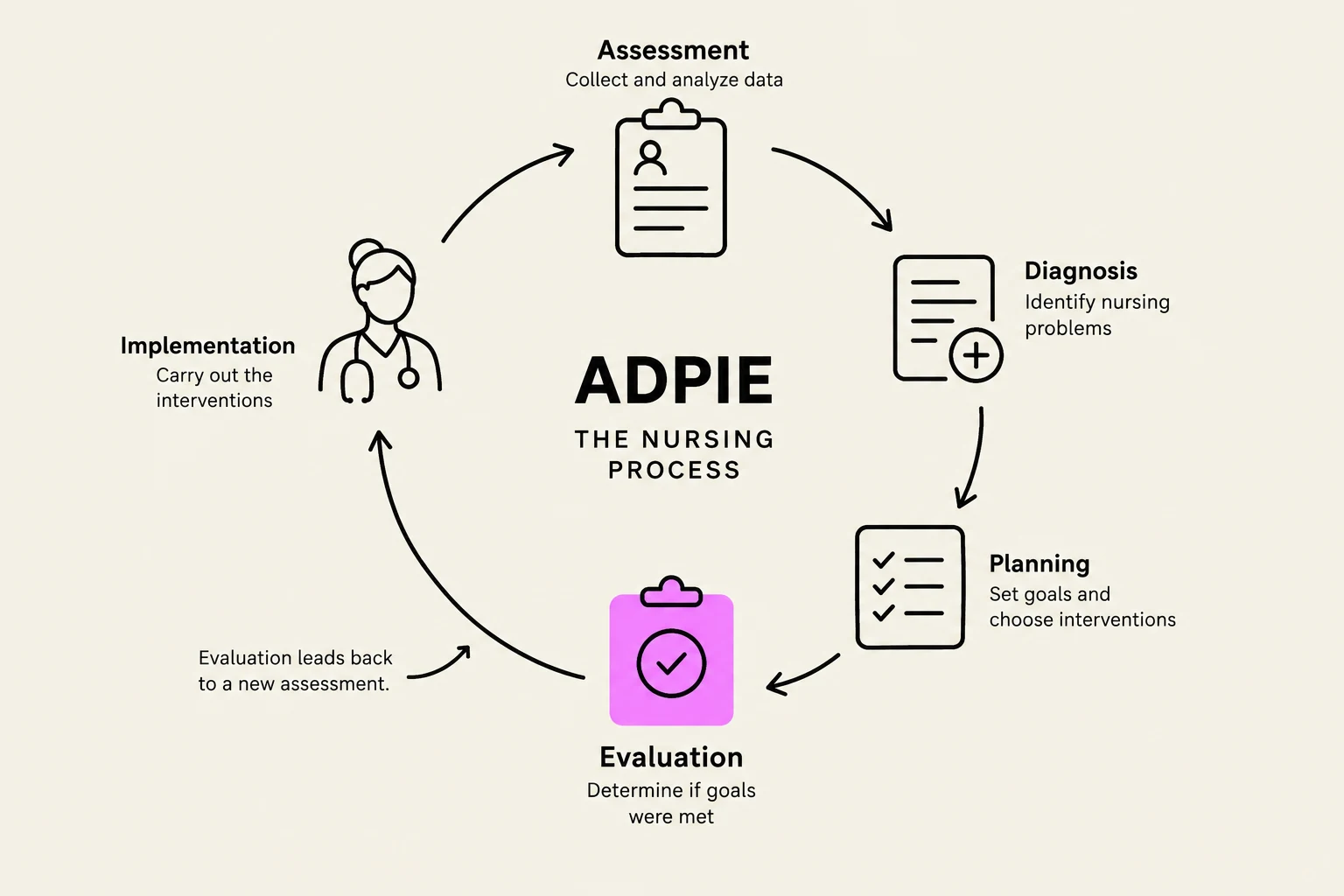
The ADPIE model outlines the five steps of the nursing process: Assessment, Diagnosis, Planning, Implementation, and Evaluation.
Clinical Reasoning Note: The ADPIE process is cyclical, not linear. If you are in the Evaluation phase and realize the patient's condition has worsened, you immediately loop back to Assessment to gather new data.
Summary Table of ADPIE
Step
Action
Key Question
Assessment
Collect data (Subjective/Objective)
What is happening with the patient?
Diagnosis
Identify nursing problems
What is the patient's response to the problem?
Planning
Set SMART goals and interventions
What do we want to achieve and how?
Implementation
Execute the plan
How do we perform the interventions?
Evaluation
Compare outcomes to goals
Did our plan work?
By mastering this framework, you ensure that your nursing care is organized, purposeful, and, most importantly, safe for your patients.
Keep reading for free.
Create an account to finish this reading and make it part of your study routine.