An explanation of the accounting cycle, including GAAP principles, adjusting journal entries (deferrals and accruals), and the preparation of financial statements (income statement, statement of owner's equity, and balance sheet).
In the world of finance, accuracy is not just a goal; it is a requirement. To provide a true picture of a company's health, accountants follow a systematic process known as the accounting cycle. This cycle ensures that every transaction is captured, processed, and reported in a way that complies with Generally Accepted Accounting Principles (GAAP).
At the heart of this cycle lies a critical step: the preparation of adjusting journal entries (AJE). Without these adjustments, financial statements would fail to reflect the true economic reality of a business, potentially misleading investors and managers alike.
The Accounting Cycle and GAAP Principles
The accounting cycle is a repetitive sequence of steps used to record and report financial information. While the cycle begins with recording daily transactions, it reaches a pivotal moment at the end of the accounting period. Before the final reports are generated, accountants must adjust account balances to ensure they reflect what has actually been earned and what has actually been expensed.
This necessity is driven by three core GAAP principles:
Revenue Recognition: Revenue should be recorded when it is earned, regardless of when the cash is received.
The Matching Principle: Expenses must be matched with the revenues they helped generate in the same period.
Timeliness: Financial information must be reported in the correct period to be useful for decision-making.
The accounting cycle illustrates the process from recording transactions to preparing financial statements, including steps like posting, trial balance, adjusting entries, and closing entries.
Understanding Adjusting Journal Entries (AJE)
Adjusting entries are made at the end of an accounting period to update account balances. They are generally categorized into two main groups: Deferrals and Accruals.
1. Deferrals (Deferred Costs and Revenues)
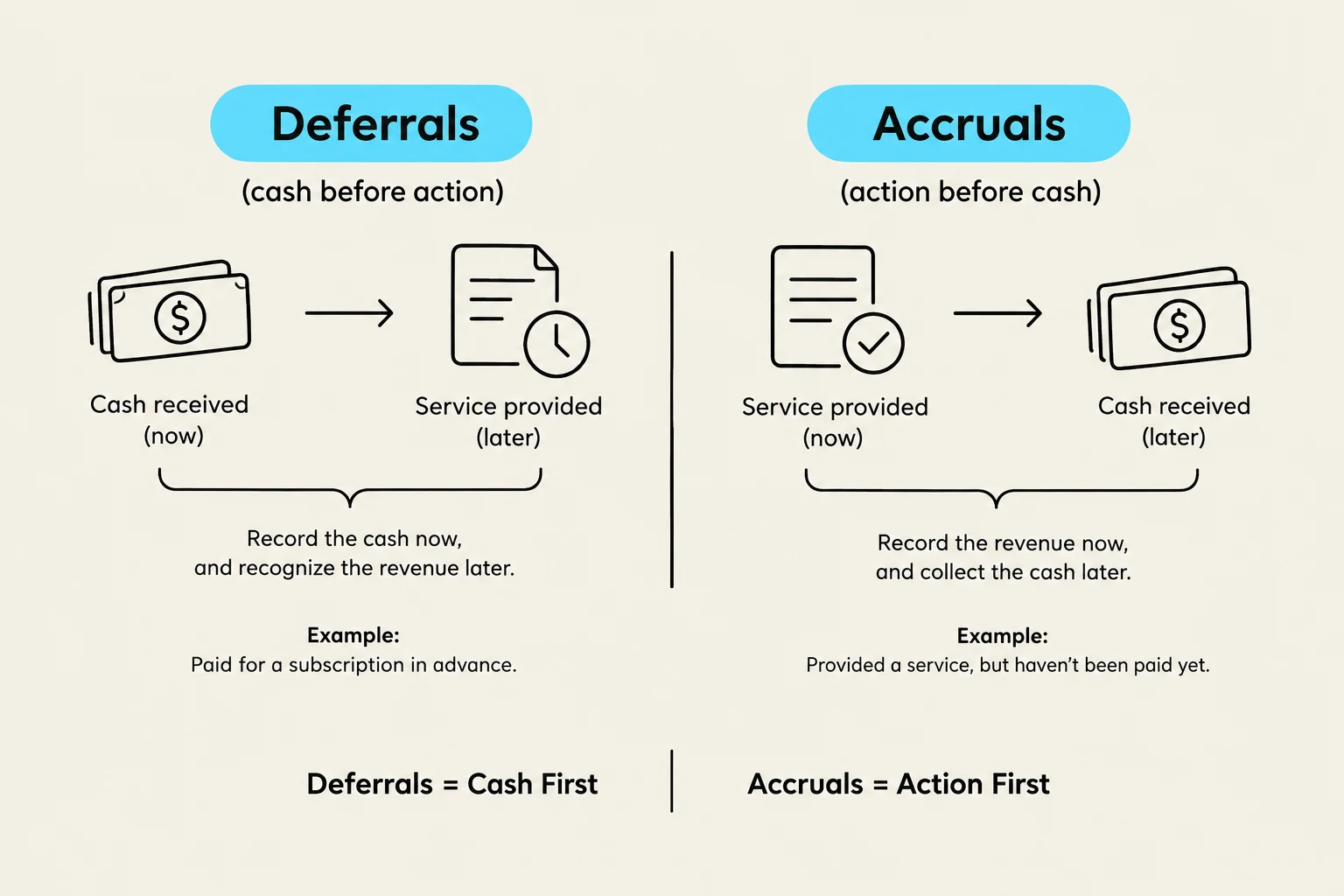
Deferrals occur when cash is exchanged before the service is provided or the expense is incurred. In these cases, the recognition of the item is "delayed" to a future period.
Prepaid Expenses (Deferred Costs): These are assets paid for in advance that will be used over time. For example, if a company pays three months of rent upfront, it records an asset called Prepaid Rent. As each month passes, an AJE is required to recognize the portion used as an expense and reduce the asset.
Example AJE:
Debit: Rent Expense
Credit: Prepaid Rent
Unearned Revenues (Deferred Revenue): This occurs when a company receives cash before providing a service. This creates a liability because the company owes the service to the customer. As the service is performed, an AJE recognizes the amount as Revenue and reduces the liability.
2. Accruals (Accrued Revenues and Expenses)
Accruals occur when the economic event happens before the cash is exchanged.
Accrued Expenses: These are expenses incurred in the current period that have not yet been paid. A common example is a utility bill or a phone bill that arrives after the month has ended.
Example AJE:
Debit: Phone Expense
Credit: Phone Payable
Accrued Revenues: This is revenue that has been earned by providing a service or product, but the cash has not yet been received.
This diagram illustrates the accounting concepts of deferrals and accruals, differentiating between when cash is exchanged relative to when a service is provided or revenue is recognized.
Exam Tip: Remember that adjusting entries never involve the Cash account. If you are debiting or crediting Cash in an adjusting entry, you have likely made an error!
From Trial Balance to Financial Statements
Once the adjusting entries are posted to the ledger, the next step is to prepare an adjusted trial balance. This is a list of all accounts and their updated balances, used to prove that total debits equal total credits.
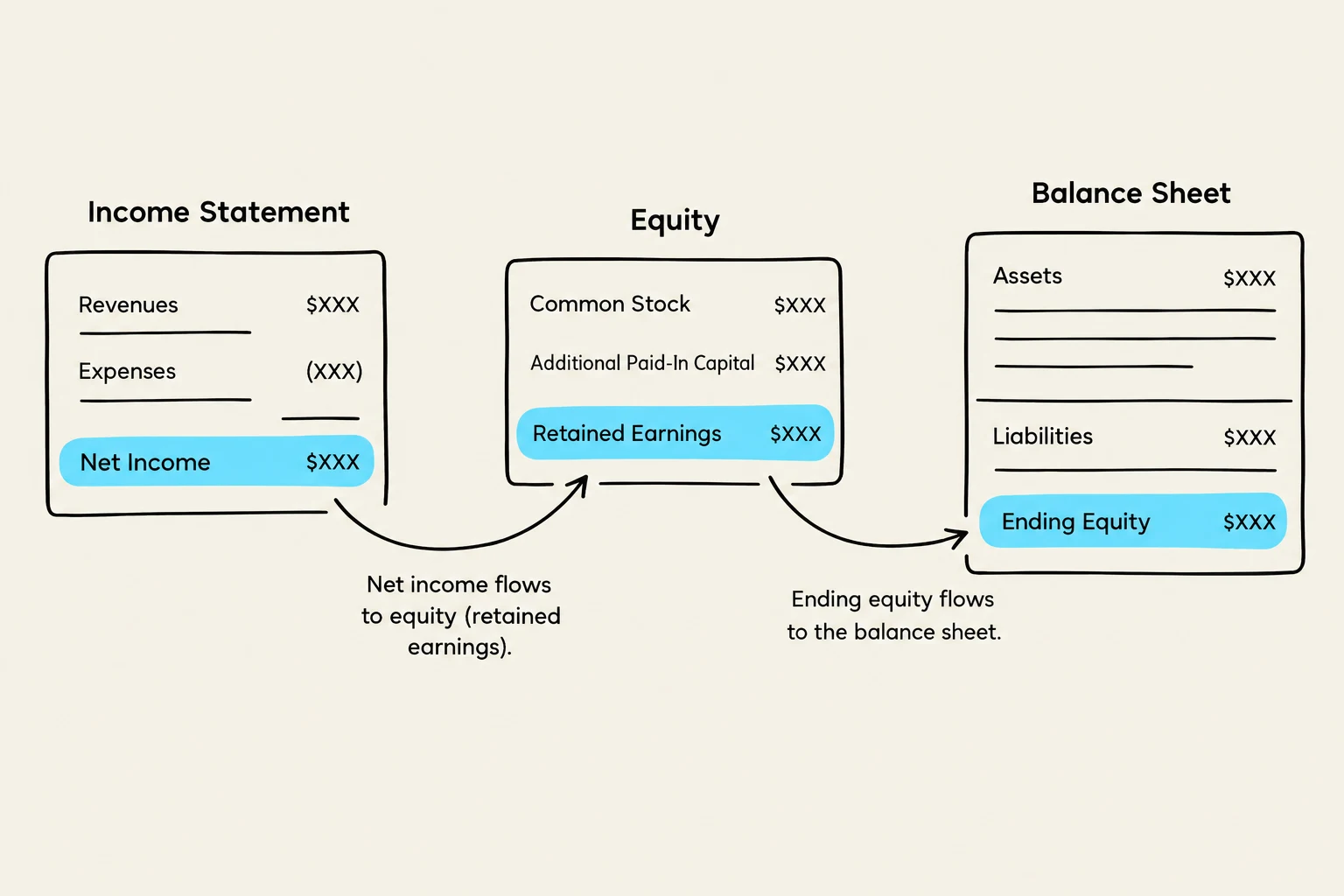
Once the trial balance is verified, the accountant begins the process of preparing financial statements. This process relies on articulation, where the output of one statement becomes the necessary input for the next.
The Sequence of Articulation
To ensure the numbers flow correctly, statements must be prepared in this specific order:
Income Statement: This is the first step. It calculates the company's profitability by subtracting expenses from revenues to find Net Income (or Net Loss).
Net Income=Revenue−Expenses
Statement of Owner's Equity (or Retained Earnings): This statement uses the Net Income from the first step to determine the change in equity. For a Corporation, this statement tracks Retained Earnings—the accumulated earnings minus any distributions to shareholders known as Dividends.
Ending Retained Earnings=Opening Balance+Net Income−Dividends
Balance Sheet: The final step uses the ending equity balance from the previous statement to report the company's financial position at a specific point in time. It must satisfy the fundamental accounting equation:
Assets=Liabilities+Equity
This diagram illustrates the relationship between an income statement, equity, and a balance sheet, showing how net income flows to retained earnings and then to ending equity on the balance sheet.
Business Structures and Equity Reporting
The way equity is reported on the Balance Sheet depends on the legal structure of the business:
Proprietorship: The simplest form, owned by one individual. It shows a single amount called Owner's Equity or Capital.
Partnership: An agreement between two or more partners. Depending on the type, partners may have unlimited or limited liability.
Corporation: A separate legal entity owned by shareholders. Unlike proprietorships, corporations report Share Capital (money from issuing shares) separately from Retained Earnings.
By following this cycle and mastering the art of the adjusting entry, accountants ensure that the financial story told by the statements is both accurate and compliant with the rules of the profession.
Keep reading for free.
Create an account to finish this reading and make it part of your study routine.