The 13th Amendment: Abolishing Slavery in the U.S.
An explanation of the 13th Amendment to the U.S. Constitution, its historical context, its role in abolishing slavery, and the loophole that allowed for convict leasing.
The 13th Amendment to the United States Constitution stands as one of the most transformative legal milestones in American history. Ratified in 1865 in the immediate aftermath of the Civil War, it fundamentally altered the social, economic, and legal fabric of the nation by providing a constitutional mandate for the abolition of slavery. While the Emancipation Proclamation had previously declared certain enslaved people free, it was the 13th Amendment that permanently and legally dismantled the institution of chattel slavery across the entire United States.
The Constitutional Context: From Proclamation to Amendment
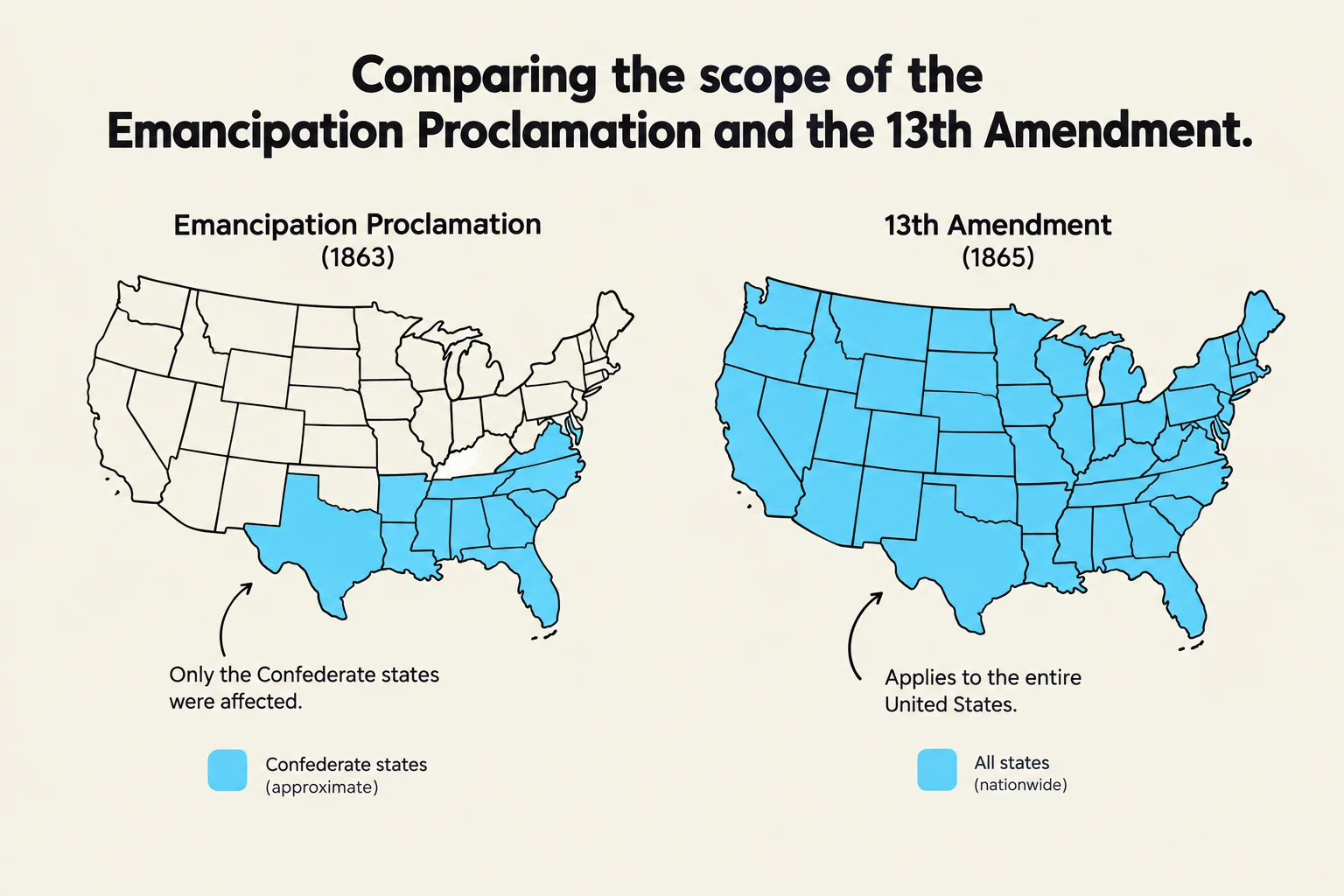
This graphic compares the geographical scope of the Emancipation Proclamation in 1863, which affected only Confederate states, with the 13th Amendment in 1865, which applied to the entire United States.
To understand the significance of the 13th Amendment, one must distinguish it from the Emancipation Proclamation issued by President Abraham Lincoln in 1863. The Proclamation was a wartime measure that applied only to states in rebellion; it did not legally abolish slavery in the "border states" that remained in the Union, nor did it have the permanent legal standing of a constitutional amendment.
The 13th Amendment was designed to close these legal loopholes. It was part of a suite of "Reconstruction Amendments" (which also includes the 14th and 15th Amendments) intended to redefine citizenship and civil rights in the wake of the war.
Exam Tip: When studying the Reconstruction era, remember that the 13th Amendment is the "Abolition Amendment." It focuses on the status of the person (freedom from bondage), whereas the 14th focuses on citizenship and the 15th focuses on voting rights.
![A flowchart showing the progression from the Emancipation Proclamation (limited scope) to the 13th Amendment (nationwide legal abolition) to the subsequent Reconstruction Amendments.
![A flowchart showing the progression from the Emancipation Proclamation (limited scope) to the 13th Amendment (nationwide legal abolition) to the subsequent Reconstruction Amendments
This text contains two critical components:
The General Prohibition: It bans both "slavery" and "involuntary servitude." This was intended to ensure that no person could be owned by another or forced to work against their will.
The Exception Clause: The phrase "except as a punishment for crime" created a significant legal loophole.
This exception allowed states to implement "convict leasing" programs, where individuals—disproportionately Black Americans—were arrested for minor offenses and leased out to private corporations for forced labor. This effectively allowed a new form of involuntary servitude to persist under the guise of criminal justice.
![A diagram illustrating the two sides of the 13th Amendment: the broad prohibition of slavery versus the specific 'punishment for crime' exception.
![A diagram illustrating the two sides of the 13th Amendment: the broad prohibition of slavery versus the specific 'punishment for crime' exception.
The Reconstruction Era and the Amendment Suite
The progression of the Reconstruction Amendments, illustrating the 13th Amendment (Abolition), the 14th Amendment (Citizenship and Equal Protection), and the 15th Amendment (Suffrage or the right to vote).
The 13th Amendment did not exist in a vacuum. It was the first step in a legal trilogy designed to rebuild the American democratic system during the Reconstruction period.
To visualize the relationship between these amendments, consider the following logical progression:
Amendment
Primary Focus
Legal Goal
13th
Abolition
End the institution of slavery
14th
Citizenship
Guarantee equal protection and due process
15th
Suffrage
Protect the right to vote regardless of race
While the 13th Amendment ended the legal ownership of humans, it did not guarantee social equality or political power. This is why the subsequent 14th and 15th Amendments were necessary to address the rights of the newly freed population.
![A diagram showing the interconnectedness of the 13th, 14th, and 15th Amendments as a foundation for civil rights.