


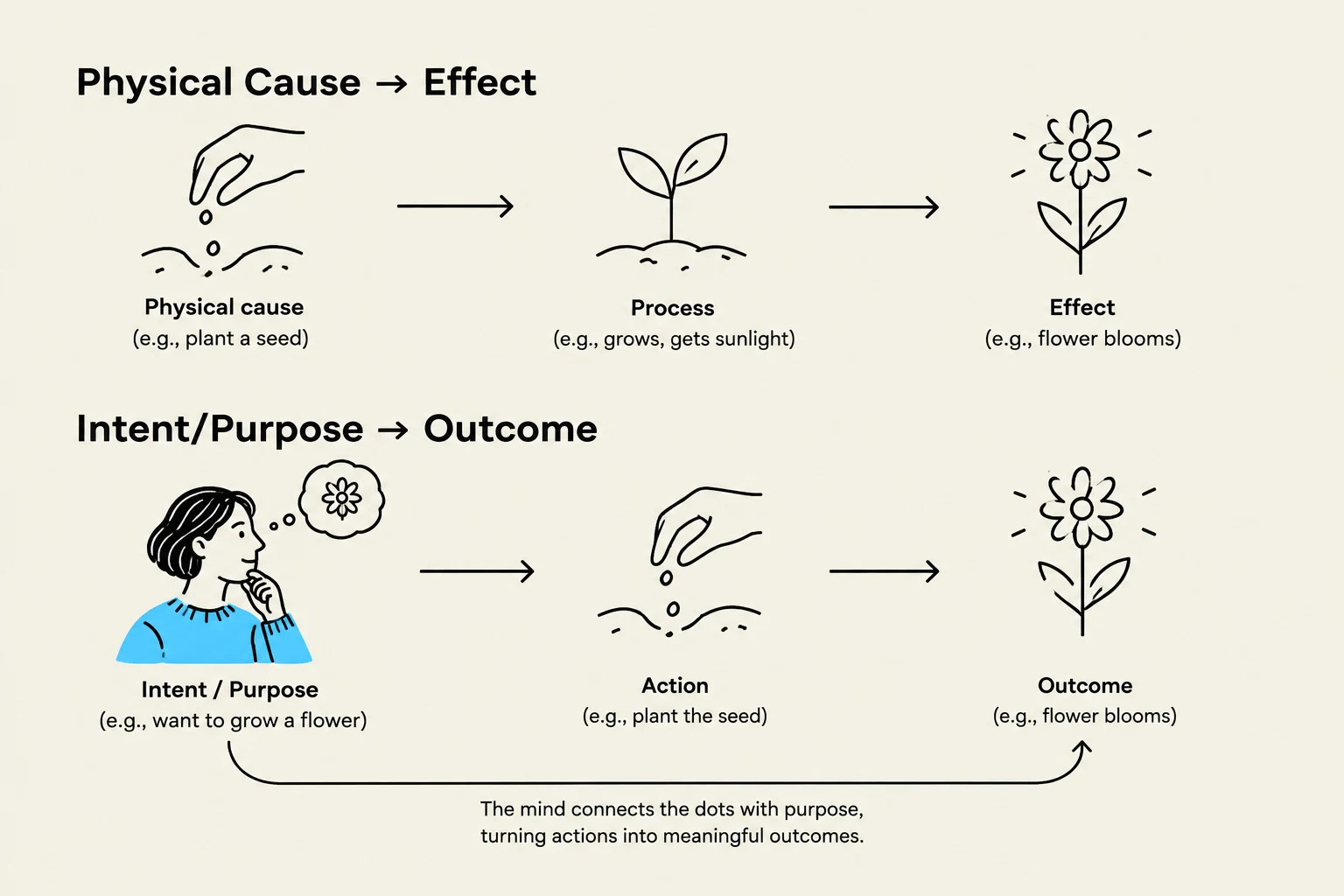
How do we make sense of a world filled with complex organisms, shifting weather patterns, and diverse objects? To the human mind, the world rarely appears as a collection of random atoms or accidental occurrences. Instead, we tend to see things as having "essences"—deep, unchanging qualities that make a thing what it is—and "purposes"—reasons why things exist or behave in certain ways. These two cognitive tendencies, known as essentialism and teleology, form the bedrock of how we perceive reality, categorize nature, and even construct religious or mythological frameworks.
Essentialism: The Search for the "True Nature"
Essentialism is the belief that every entity has a set of attributes that are necessary to its identity and function. According to this view, if you take away an object's "essence," it ceases to be that thing. For example, while a chair can be made of wood, plastic, or metal, the "essence" of a chair is its function as a seat.
In cognitive science, essentialism is viewed as a mental shortcut for categorization. Instead of memorizing every single physical variation of a concept, our brains assume there is an underlying, often invisible, "core" that unites all members of a category.
Types of Essentialism
- Natural Essentialism: The belief that certain categories (like "animals" or "trees") are real, objective divisions of the world, whereas human-made categories (like "furniture" or "languages") are arbitrary.
- Immaterial Essentialism: The idea that an essence might be non-physical, such as a soul or a spiritual spark that defines a person.
Exam Tip: When distinguishing between natural and arbitrary categories, remember that essentialists view natural categories as having "internal" properties that exist regardless of human thought, while arbitrary categories are seen as social constructs.

Keep reading for free.
Create an account to finish this reading and make it part of your study routine.
Continue reading freeAlready have an account? Log in
Updated