This content explains tectonic deformation, stress, strain, and the processes of orogeny, including brittle and ductile deformation, faulting, folding, and mountain building through plate interactions.
Geology is often a study of movement and change. While the Earth's surface may appear static, it is constantly being reshaped by immense forces acting deep within the crust and mantle. These forces manifest as stress—the force applied per unit area (N/m2)—which results in strain, or the actual deformation of the rock. Depending on the temperature, pressure, and rate of application, rocks may undergo brittle deformation (fracturing) or ductile deformation (bending). When these deformations occur on a massive, regional scale to form mountain ranges, the process is known as orogeny.
The Mechanics of Deformation
Before understanding how mountains form, we must distinguish between the two primary ways rocks respond to stress: brittle and ductile deformation.
Brittle Deformation: Faults and Joints
When rocks are under high stress but relatively low temperature or high strain rates, they break. This is brittle deformation.
Joints: These are fractures in the rock where no movement has occurred on either side.
Veins: A specific type of joint that has been filled with minerals.
Faults: These are fractures where significant movement has occurred along the fault surface.
Faults are categorized by the direction of movement:
Normal Faults: Caused by tensional stress, where the hanging wall moves downward relative to the footwall.
Reverse Faults: Caused by compressional stress, where the hanging wall moves upward relative to the footwall.
Strike-slip Faults: Caused by shearing stress, where blocks move horizontally past one another.
Ductile Deformation: Folds
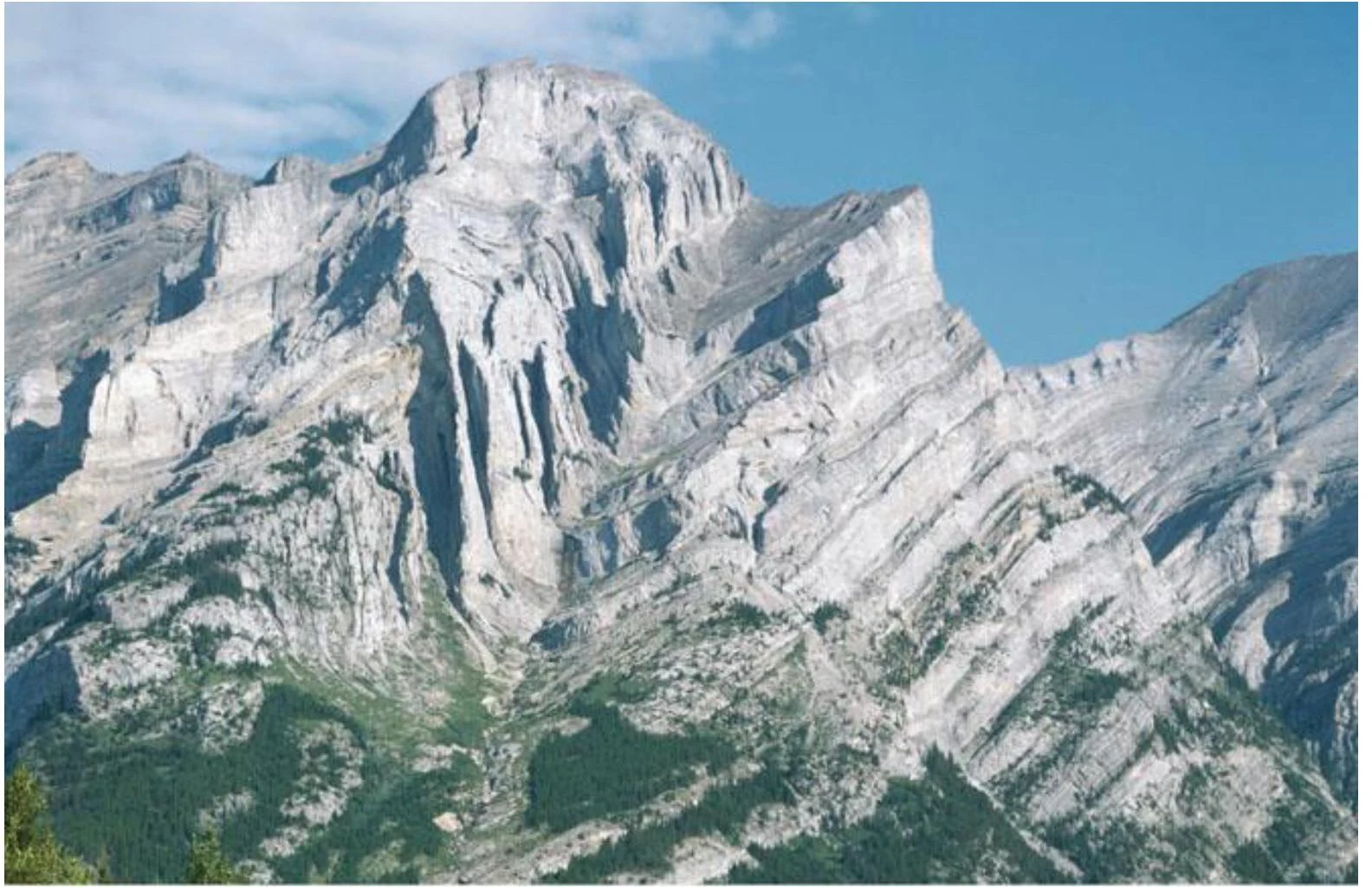
Under higher temperatures and pressures, rocks tend to flow or bend rather than break. This is ductile deformation, which results in folds.
A geological formation showing folded rock strata in a mountain range.
Common fold structures include:
Anticlines: Folds where the limbs dip away from the axial plane.
Synclines: Folds where the limbs dip toward the axial plane.
Monoclines: A step-like fold in otherwise horizontal layers.
Domes and Basins: Complex structures where folding occurs in multiple perpendicular directions.
Exam Tip: To identify the age of rocks in a fold, remember that in an eroded anticline, the oldest rocks are typically found in the center, whereas in a syncline, the youngest rocks are in the center.
Orogenic Settings: How Mountains are Built
Orogeny is driven by different types of plate interactions, each producing unique geological signatures.
1. Collision
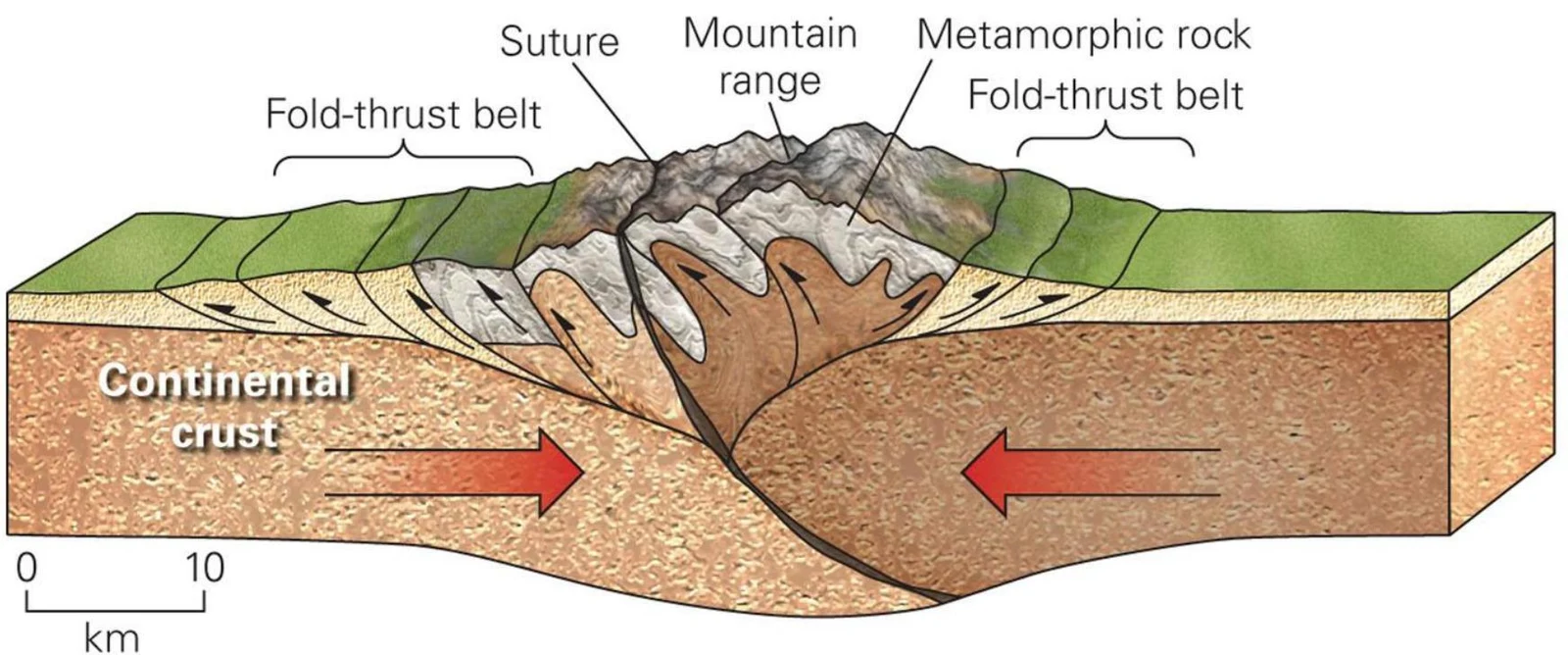
When two continental plates converge, the compressional stress is so great that neither plate can subduct easily. Instead, they collide, causing massive crustal shortening and the formation of a fold-thrust belt. This process is characterized by high-grade regional metamorphism due to the intense pressure and heat generated during the collision.
Diagram illustrating the geological processes involved in the formation of a mountain range through continental crust collision, featuring fold-thrust belts, sutures, and metamorphic rock.
2. Subduction
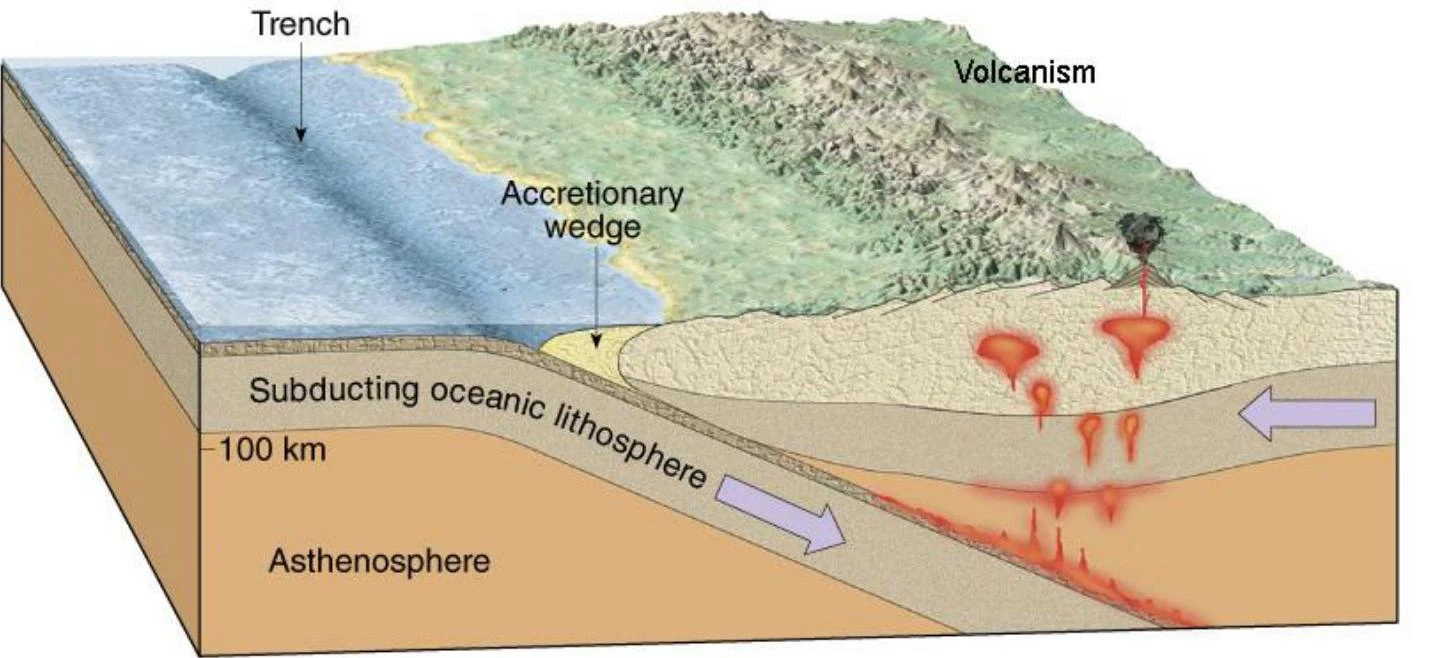
In subduction zones, an oceanic plate is forced beneath another plate (either oceanic or continental) due to compressional stress. This leads to:
Crustal shortening and volcanism as the subducting slab melts.
Fold-thrust belts on the overriding plate.
High-pressure, low-temperature metamorphism, a distinct signature of the subduction environment.
Diagram illustrating the geological process of subduction, where oceanic lithosphere descends beneath continental lithosphere, leading to the formation of trenches, accretionary wedges, and volcanic arcs.
3. Continental Rifting
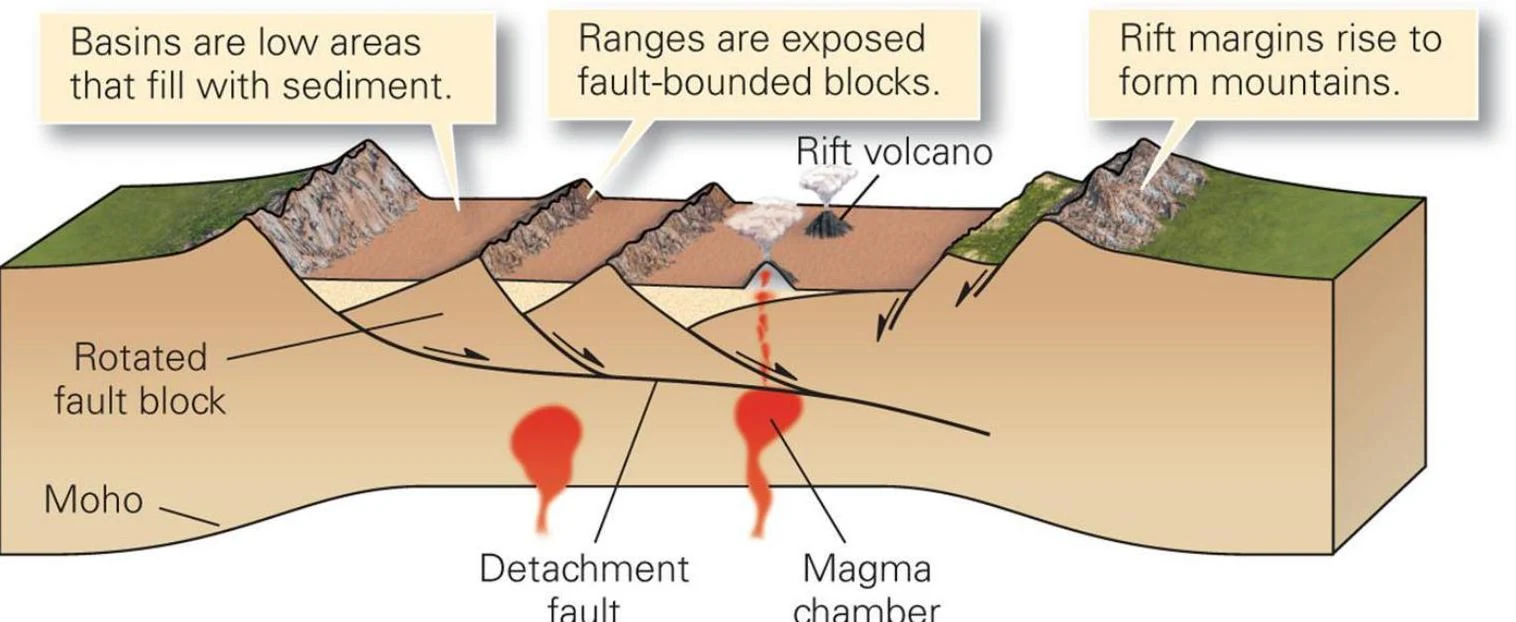
Unlike the previous two, rifting is driven by tensional stress that pulls the continental lithosphere apart. This creates normal faults and can lead to contact metamorphism as magma rises toward the surface in rift valleys.
This diagram illustrates geological features associated with rifting, including basins, fault blocks, rift volcanoes, and magma chambers.
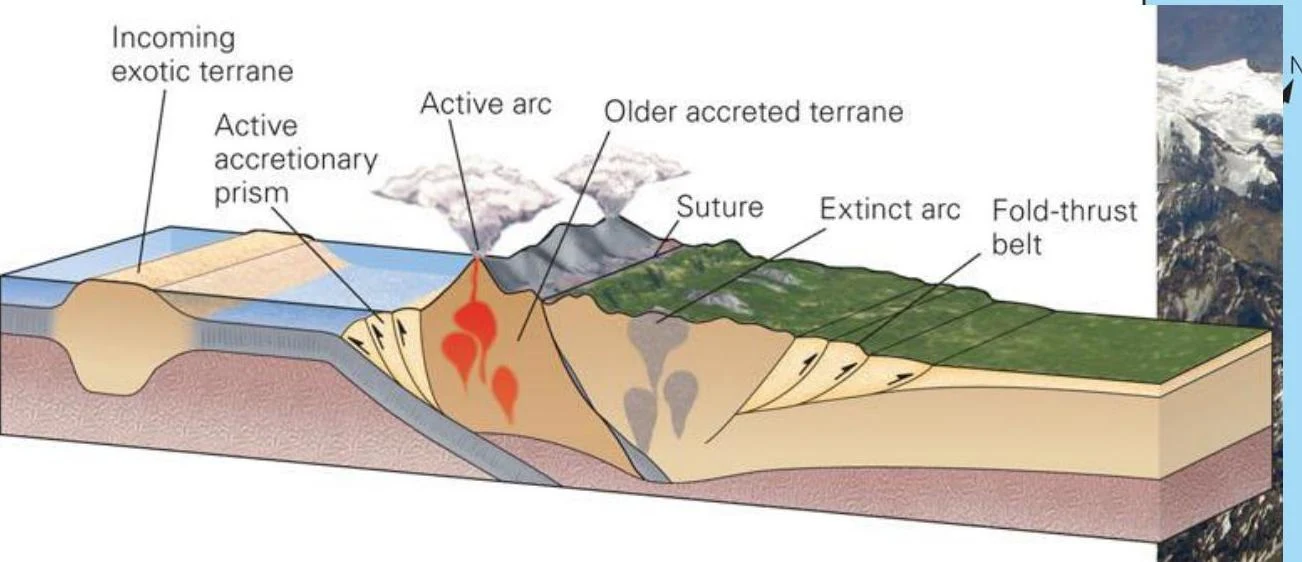
4. Exotic Terrane Accretion
Sometimes, young and light oceanic lithosphere is too buoyant to subduct during convergence. Instead of sinking, it "plows" into the edge of a continent, suturing itself to the continental margin to form an accreted terrane. These regions are characterized by reverse faults and fold-thrust belts.
Diagram illustrating the geological processes at a convergent plate boundary, showing an incoming exotic terrane, an active accretionary prism, an active arc with volcanic activity, an older accreted terrane, a suture zone, an extinct arc, and a fold-thrust belt.
Topographic Evolution: Rising and Falling Mountains
Once an orogen is formed, its height is not permanent. Several processes influence whether a mountain range grows taller or erodes away.
Isostasy and Crustal Thickening
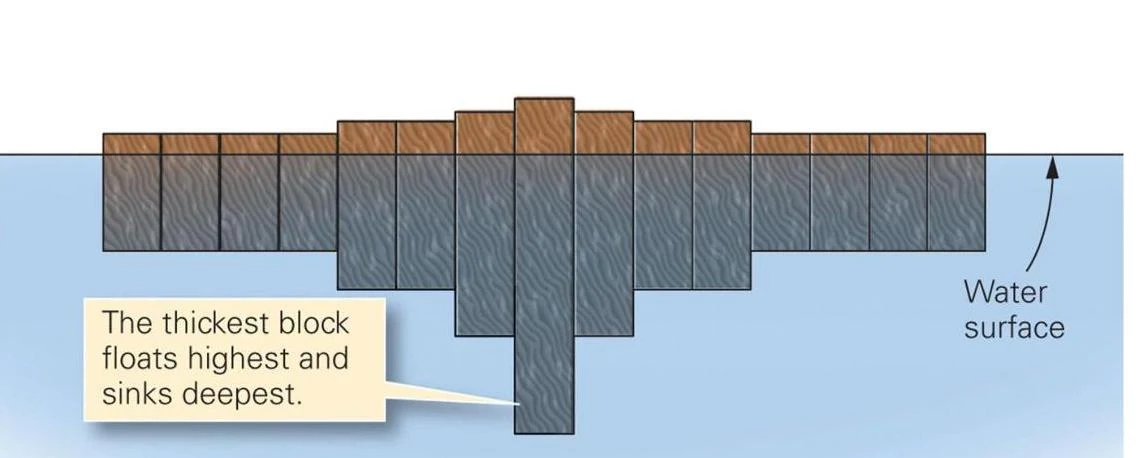
Mountain building involves crustal shortening and thickening, which adds more rock to the crust. Because the crust is less dense than the mantle below, thicker blocks of crust experience isostasy—they float higher on the mantle, much like a large iceberg floats higher in water than a small one.
A diagram illustrating how the thickness of a block affects its buoyancy, with thicker blocks floating higher and sinking deeper.
Delamination
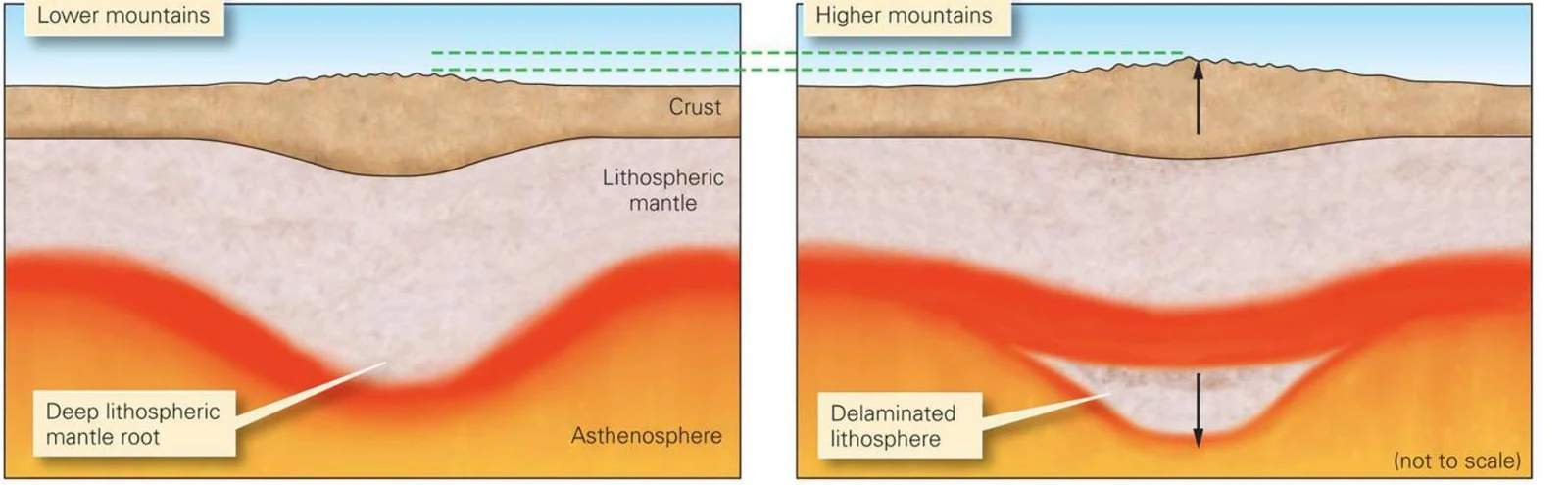
An alternative way for mountains to rise is through delamination. This occurs when the dense lithospheric "root" beneath a mountain range breaks off and sinks into the mantle. The loss of this heavy mass causes the remaining crust to rise isostatically.
This diagram illustrates the geological processes involved in mountain formation, contrasting lower mountains with a deep lithospheric mantle root and higher mountains with delaminated lithosphere.
Exhumation and Rebound
The removal of weight—either through the erosion of surface rocks or the removal of a load—causes the crust to "rebound" upward.
Exhumation is a positive feedback process: as erosion removes surface material, isostatic rebounding pushes deeply buried rocks toward the surface. This cycle explains the geological transition from high, jagged peaks like the modern Himalayas to the older, lower, and more eroded Appalachians.
Keep reading for free.
Create an account to finish this reading and make it part of your study routine.