


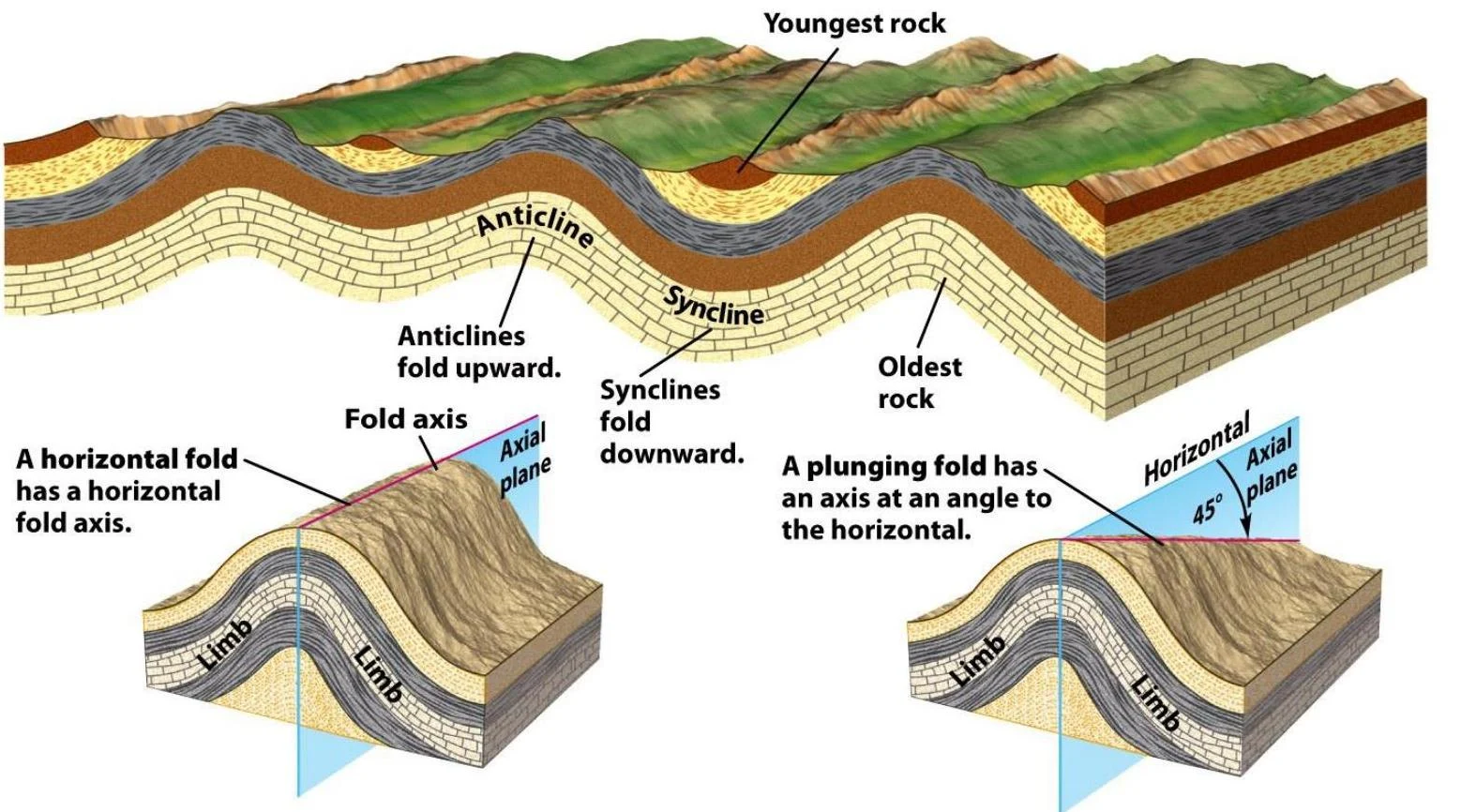
Geological structures are the physical manifestations of the immense forces acting upon the Earth's crust. When rocks are subjected to stress, they undergo deformation, which can result in the breaking of the rock (brittle deformation) or the bending of the rock (ductile deformation). While faults represent the brittle response to stress, folds represent the ductile response, where originally flat or planar rock layers are bent or curved into complex shapes.
Stress, Strain, and the Nature of Deformation
To understand why a rock folds rather than breaks, we must distinguish between force, stress, and strain. Force is an interaction that tends to change the motion of an object, measured in Newtons (N). However, in geology, we focus on stress, which is the force applied per unit area (N/m² or Pascals).

The type of stress determines the type of deformation:
- Compression: Pushing rocks together.
- Tension: Pulling rocks apart.
- Shearing: Forces acting in opposite directions parallel to a surface.
- Confining: Pressure applied from all sides.
Strain is the actual change in shape or volume resulting from that stress. Whether a rock undergoes brittle deformation (fracturing into joints or faults) or ductile deformation (folding) depends on several factors: temperature, pressure, the rate of deformation, and the rock's composition. Generally, higher temperatures, higher pressures, and slower deformation rates favor ductile folding.

Keep reading for free.
Create an account to finish this reading and make it part of your study routine.
Continue reading freeAlready have an account? Log in
Updated