


How do you think, feel, or move? Every thought and action is the result of a sophisticated communication network within your nervous system. This communication does not happen through continuous electrical wires, but rather through a series of rapid conversions between electrical and chemical signals. This process, known as synaptic transmission, allows neurons to pass information to one another with incredible precision and flexibility.
The Anatomy of a Synapse
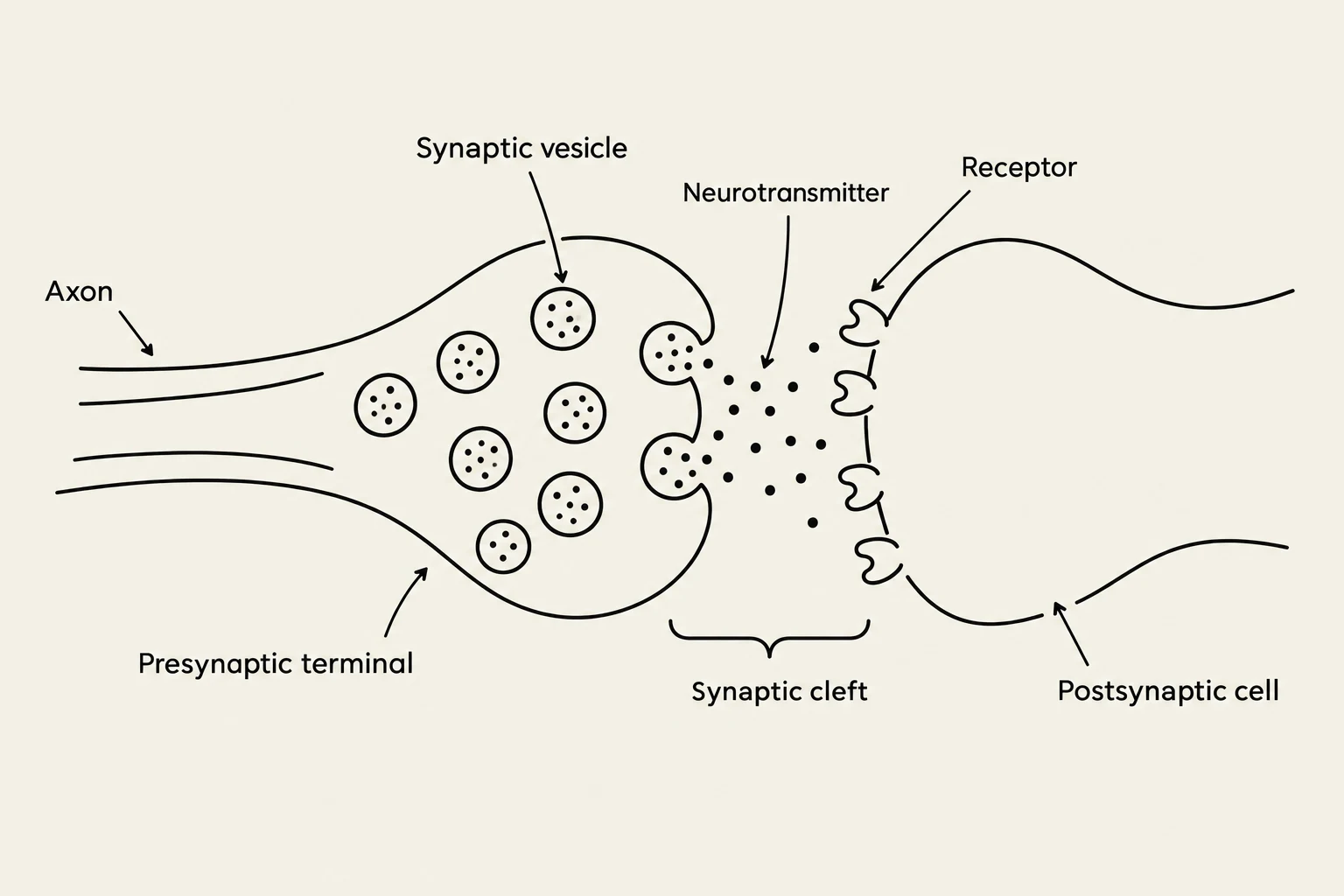
To understand how signals travel, we must first look at the physical structure of the connection point between two cells, known as the synapse. A synapse consists of three primary components:
- The Presynaptic Cell: This is the transmitting neuron that sends the signal.
- The Postsynaptic Cell: This is the target cell receiving the signal. Depending on the circuit, this could be another neuron, a muscle cell, or a gland.
- The Synaptic Cleft: The two cells do not actually touch. They are separated by a microscopic gap called the synaptic cleft, which typically measures approximately .
Because the cleft is a physical barrier, the electrical signal (the action potential) cannot simply jump from one cell to the next. Instead, it must be converted into a chemical message.
From Electricity to Chemistry: The Release Mechanism
The transmission process begins when an electrical impulse, called an action potential, travels down the axon of the presynaptic neuron and reaches the nerve terminal.
The arrival of this electrical charge triggers a crucial change in the membrane of the presynaptic terminal: the opening of voltage-gated channels. Because the concentration of calcium ions () is more than 1000 times higher outside the cell than inside, these ions rush into the terminal following their electrochemical gradient.
Keep reading for free.
Create an account to finish this reading and make it part of your study routine.
Continue reading freeAlready have an account? Log in
Updated