An explanation of how sunlight, particularly UV radiation, affects the skin, the body's natural defenses like melanin, and the role of Sun Protection Factor (SPF) in sunscreens. It also covers the link between UV exposure and skin cancer, including melanoma.
Protecting our skin from the sun is more than just a matter of comfort; it is a critical biological necessity. Our skin is constantly bombarded by electromagnetic energy known as sunlight. While some wavelengths are visible to our eyes, others fall into the ultraviolet (UV) spectrum, which possesses enough energy to damage the fundamental building blocks of our cells: proteins and nucleic acids. Understanding how our bodies defend themselves and how we can use external tools to enhance that defense is essential for preventing long-term health complications.
The Nature of UV Light
Sunlight is a form of electromagnetic radiation that travels in both wave-like and particle-like forms. The energy carried by this light is inversely related to its wavelength: the shorter the wavelength, the higher the energy of the wave.
Ultraviolet (UV) light is categorized into three main types based on wavelength:
UVA (400–320 nm): These waves penetrate into the deeper layers of the skin and can contribute to cancer development.
UVB (320–290 nm): These are the primary cause of sunburns.
UVC (290–200 nm): While these possess the highest energy, they are largely absorbed by the ozone layer in our atmosphere, preventing them from reaching our skin.
The electromagnetic spectrum illustrates the range of electromagnetic radiation, ordered by wavelength and energy. It includes gamma rays, X-rays, ultraviolet, visible light, infrared, microwaves, and radio waves, with shorter wavelengths corresponding to higher energy and longer wavelengths to lower energy.
Biological Defense: Melanocytes and Melanin
Our bodies possess an innate, biological defense mechanism to mitigate UV damage. Within the skin, specialized cells called melanocytes are responsible for producing a pigment known as melanin.
As we are exposed to UV radiation, melanin accumulates within these cells, resulting in what we recognize as a tan. While this pigment serves as a natural sunscreen, its protective capacity is quite limited—roughly equivalent to an SPF of 2. Because this natural barrier is so weak, it is often insufficient to prevent UV light from damaging skin and eye tissues.
Understanding Sun Protection Factor (SPF)
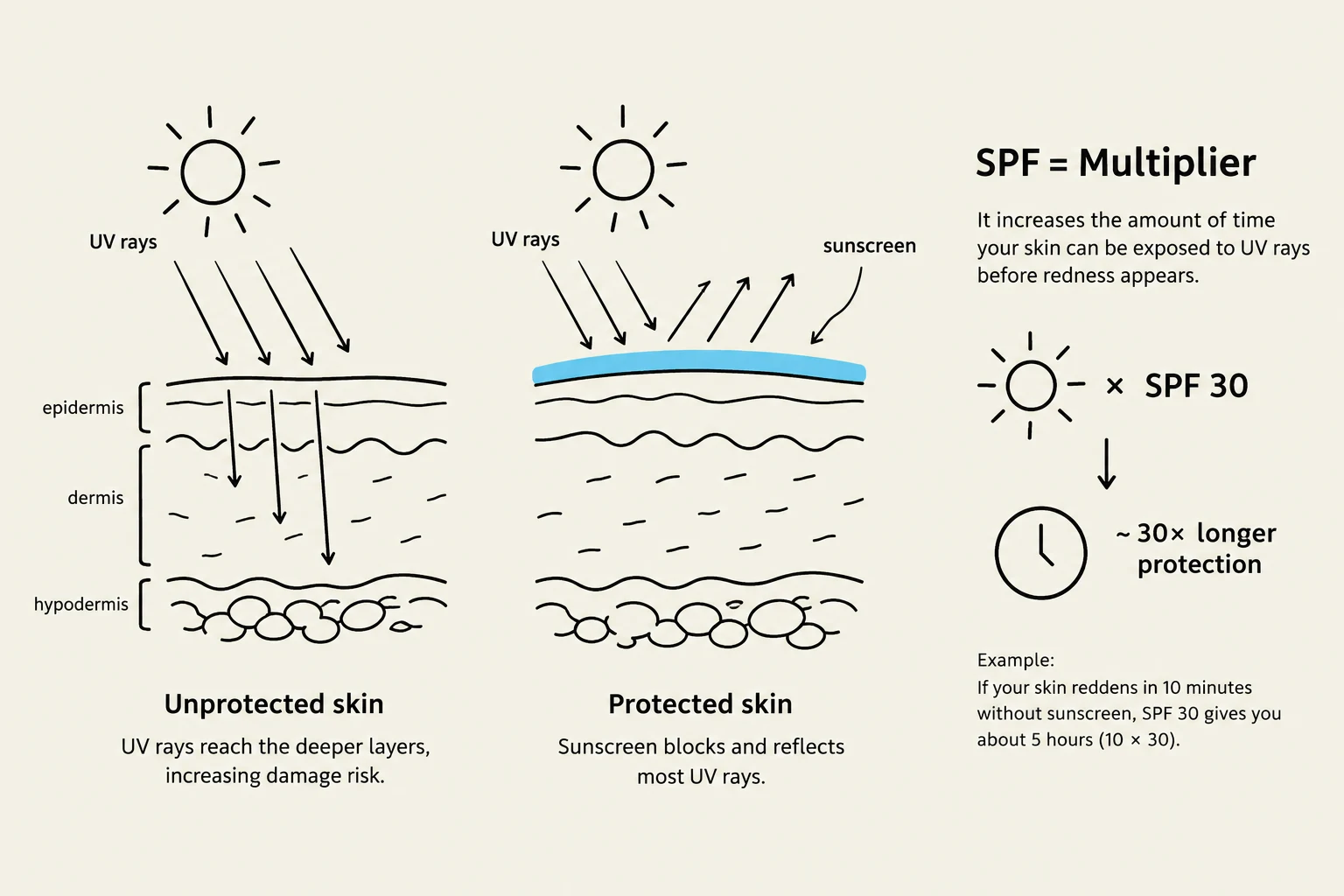
Because biological defenses are limited, we use topical sunscreens to provide additional protection. These products are rated by their Sun Protection Factor (SPF). The SPF is a metric that indicates how much longer a person can remain in the sun with sunscreen compared to how long they would last without it.
To calculate your estimated protection time, you can use the following formula:
Total Protected Time=Unprotected Burn Time×SPF
Worked Examples
To better understand how SPF works in practice, consider these two scenarios:
Scenario A: High Sensitivity
If an individual typically burns after only 20 minutes of exposure, applying an SPF 30 sunscreen would mathematically extend their protection as follows:
Total Protected Time=20×30=600 minutes
This provides approximately 10 hours of protection.
Scenario B: Low Sensitivity
If an individual's baseline burn time is 5 minutes, applying an SPF 25 sunscreen would result in:
Total Protected Time=5×25=125 minutes
This provides roughly 2 hours and 5 minutes of protection.
Exam Tip: Remember that SPF is a multiplier of your unprotected time. If your skin is very sensitive (short burn time), even a high SPF will result in a much shorter total protection window than someone with more resilient skin.
Diagram illustrating how sunscreen protects the skin from UV rays and how SPF (Sun Protection Factor) acts as a multiplier for protection duration.
When Protection Fails: Melanoma and Skin Cancer
When UV radiation penetrates the skin, it can cause mutations in our DNA. Over time, the accumulation of these mutations can disrupt the cell cycle. Specifically, mutations can cause proto-oncogenes (which regulate cell growth) to become hyperactive oncogenes, or they can cause tumor suppressors to lose their functionality.
If these mutations lead to uncontrolled cell growth, a malignant tumor may form—a mass of abnormal cells that can spread to other parts of the body. While some tumors are benign (non-cancerous), others are malignant and constitute skin cancer.
One of the most serious forms of skin cancer is melanoma, which specifically originates in the melanocyte cells. Melanoma is most common in individuals aged 25 to 29.
Identifying Melanoma
It is vital to monitor skin changes. Common physical indicators of melanoma include:
Spots that are significantly larger than typical moles.
Spots with jagged or irregular edges.
Raised, dark spots on the skin.
Comparison of benign moles and malignant melanoma, highlighting key visual differences in shape, color, and growth patterns.
By utilizing SPF and understanding our biological limits, we can significantly reduce the risk of DNA mutation and the development of life-threatening skin cancers.
Keep reading for free.
Create an account to finish this reading and make it part of your study routine.