Suicide: Epidemiology, Risk Factors, and Clinical Assessment
A comprehensive overview of suicide, including its definition, epidemiology, multifactorial etiology, common risk factors, and clinical assessment frameworks like SADPERSONS and ISPATHWARM. It also covers verbal and non-verbal clues, lethality assessment, and nursing interventions.
Suicide is a critical public health issue that requires vigilant clinical observation and structured assessment. Understanding the distinction between different types of self-harm, the complex interplay of risk factors, and the subtle ways patients communicate distress is essential for any healthcare professional. This article provides a comprehensive overview of the epidemiology, etiology, and assessment frameworks used to identify and manage suicidal risk.
Defining Self-Harm and Suicidal Behavior
In clinical practice, it is vital to distinguish between different types of self-injurious actions. Suicide is defined as the act of taking one’s own life. Suicidal behavior refers to self-injurious actions that have a nonfatal outcome but where there is clear evidence of an intent to die.
It is equally important to differentiate these from nonsuicidal self-injury (NSSI). NSSI involves self-harming behaviors (such as cutting or burning) performed without the specific intent to die. While both require attention, the presence of suicidal intent fundamentally changes the level of immediate intervention required.
Epidemiology and Etiology
Epidemiology
Suicide is a major global health concern, accounting for approximately 1.5% of all deaths worldwide. In specific demographics, the impact is even more pronounced: it is the third leading cause of death for individuals aged 15–29. While rates vary, the highest observed rates are among the 50–54 age group. Statistics also suggest that suicide rates may be higher in indigenous populations and that official numbers may be underreported.
Etiology: The Multifactorial Nature of Suicide
The causes of suicide are rarely singular; instead, they arise from a complex interaction of several domains:
Biological Factors: These include genetic predispositions and familial influences. In mood disorders like Bipolar Disorder, neurobiological imbalances in neurotransmitters such as norepinephrine, dopamine, and serotonin play a significant role.
Psychosocial Factors: Economic stressors such as poverty, low income, and the burden of chronic illness are significant contributors.
Cultural and Societal Factors: Cultural views can influence perception; for example, historical views in ancient Japan or specific religious interpretations can shape how suicide is viewed. Societal factors, such as social isolation, also increase vulnerability.
Risk Factors
Identifying high-risk individuals is a cornerstone of prevention. A significant majority of those who die by suicide—approximately 90%—are experiencing depression, another mental illness, or substance abuse.
Specific clinical correlations include:
Depression and Bipolar Disorder: Approximately 15% of individuals with these conditions will die by suicide.
Schizophrenia: The risk of suicide is 50 times higher for individuals living with schizophrenia compared to the general population.
Environmental/Behavioral Risks: Factors such as bullying, pathological gambling, and incarceration are also recognized risk factors.
Clinical Note: It is worth noting that 83% of those who die by suicide had sought treatment within the previous year, and 45% had consulted a primary care physician in the month preceding their death. This highlights the importance of screening in primary care settings.
Clinical Assessment Frameworks
To ensure a thorough evaluation, clinicians often use mnemonic frameworks to categorize risk factors and symptoms.
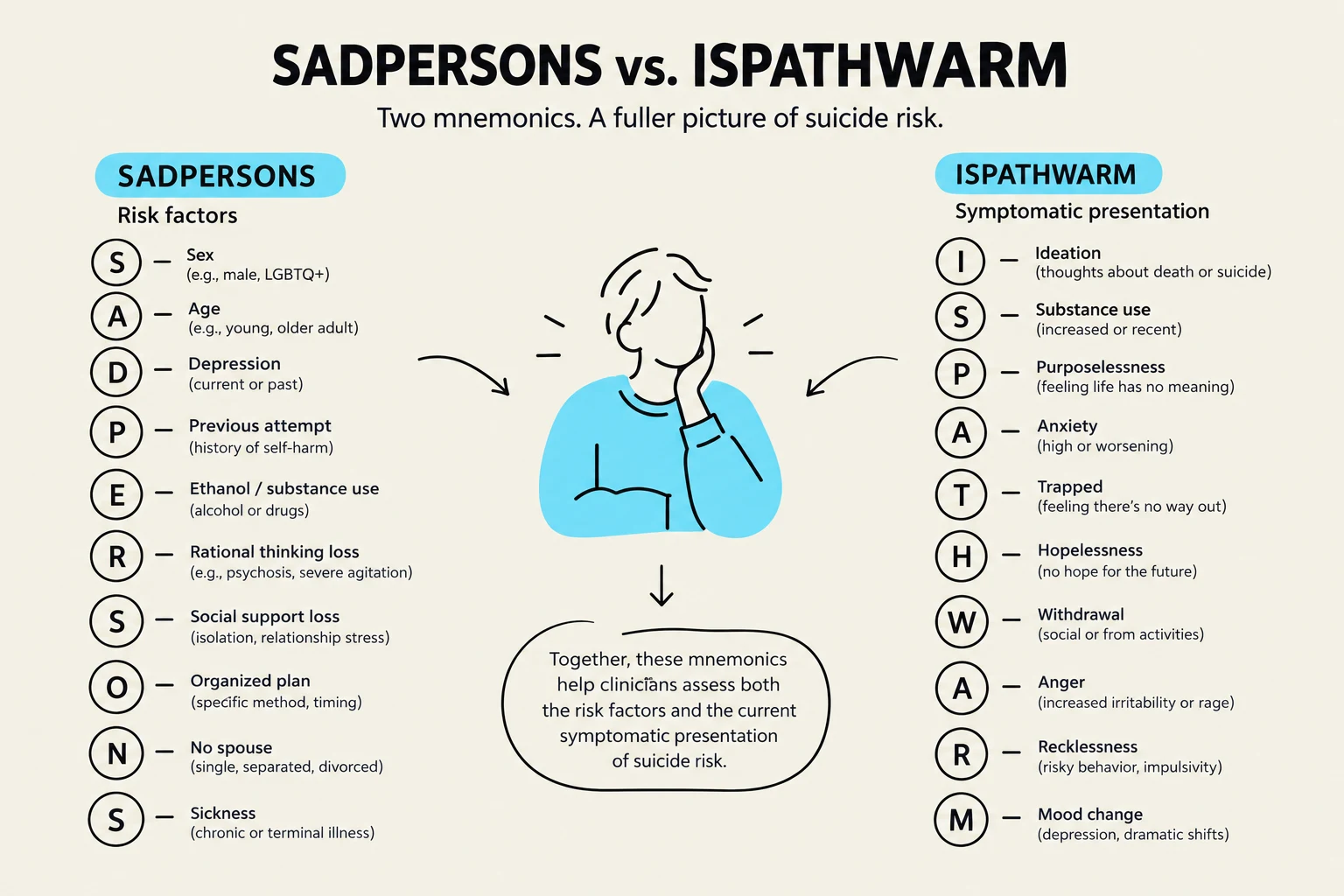
The SADPERSONS Mnemonic
This tool is used to screen for various demographic and clinical risk factors:
Sex
Age
Depression
Prior history of attempts
Ethanol (alcohol) abuse
Rational thinking loss
Support system loss
Organized plan
No significant other
Sickness or terminal illness
The ISPATHWARM Mnemonic
This framework helps clinicians identify active symptoms and behavioral indicators:
Ideation
Substance use
Purposelessness
Anxiety and agitation
Trapped
Hopelessness or helplessness
Withdrawal
Anger
Recklessness
Mood changes
This diagram illustrates two mnemonics, SADPERSONS and ISPATHWARM, used to assess suicide risk by outlining risk factors and symptomatic presentation.
Assessing Risk: Verbal and Non-Verbal Clues
Effective risk assessment requires looking beyond what a patient explicitly says. Clinicians must monitor both overt and covert statements.
Overt vs. Covert Statements
Overt Statements: These are direct expressions of suicidal intent or desire.
Examples: "I wish I were dead," "Life isn't worth living anymore," or "I can't take it anymore".
Covert Statements: These are indirect, subtle, or even seemingly "positive" statements that may actually signal a decision to end one's life.
Examples: "It's okay now, soon everything will be fine," "I won't be a problem much longer," or "Things will never work out".
Evaluating Lethality
When a patient expresses ideation, the clinician must assess the lethality of the plan by evaluating:
The presence of specific risk factors.
The degree of suicidal ideation.
The patient's intent to carry out the plan.
The availability of means (e.g., firearms, drugs, ropes).
The individual's level of hope for improvement.
Exam Tip: If a patient suddenly appears calm or "at peace" after a period of intense agitation or depression, do not mistake this for improvement. This can be a covert sign that they have finalized a plan to end their life.
Nursing Interventions and Management
Interventions are categorized into three levels: Primary (prevention and education), Secondary (treatment of acute crisis in hospitals or clinics), and Tertiary (postvention, which involves supporting survivors and families after a suicide has occurred).
Clinical Nursing Strategies
When managing a patient at risk, nurses should:
Communicate Directly: Do not avoid the topic of suicide; deal with it directly and calmly.
Promote Safety: Reduce withdrawal by seeking out the person, and promote feelings of self-worth by identifying positives in their life.
Provide Support: Encourage the expression of feelings, help with problem-solving, and convey that the current crisis is temporary and help is available.
Environmental Safety: In acute settings, implement suicide precautions and monitor for the ability to control behavior.
Keep reading for free.
Create an account to finish this reading and make it part of your study routine.