


The human nervous system is a highly specialized and complex network responsible for the control, integration, and coordination of nearly all bodily activities. From the simple reflex of pulling a hand away from a hot stove to the complex cognitive processes required for language and problem-solving, the nervous system serves as the body's primary communication highway. To understand how this system works, we must examine its two main divisions, the specialized cells that power it, and the protective mechanisms that keep it functioning safely.
The Two Main Divisions: CNS and PNS
The nervous system is anatomically divided into two primary components: the Central Nervous System (CNS) and the Peripheral Nervous System (PNS).
The Central Nervous System (CNS)
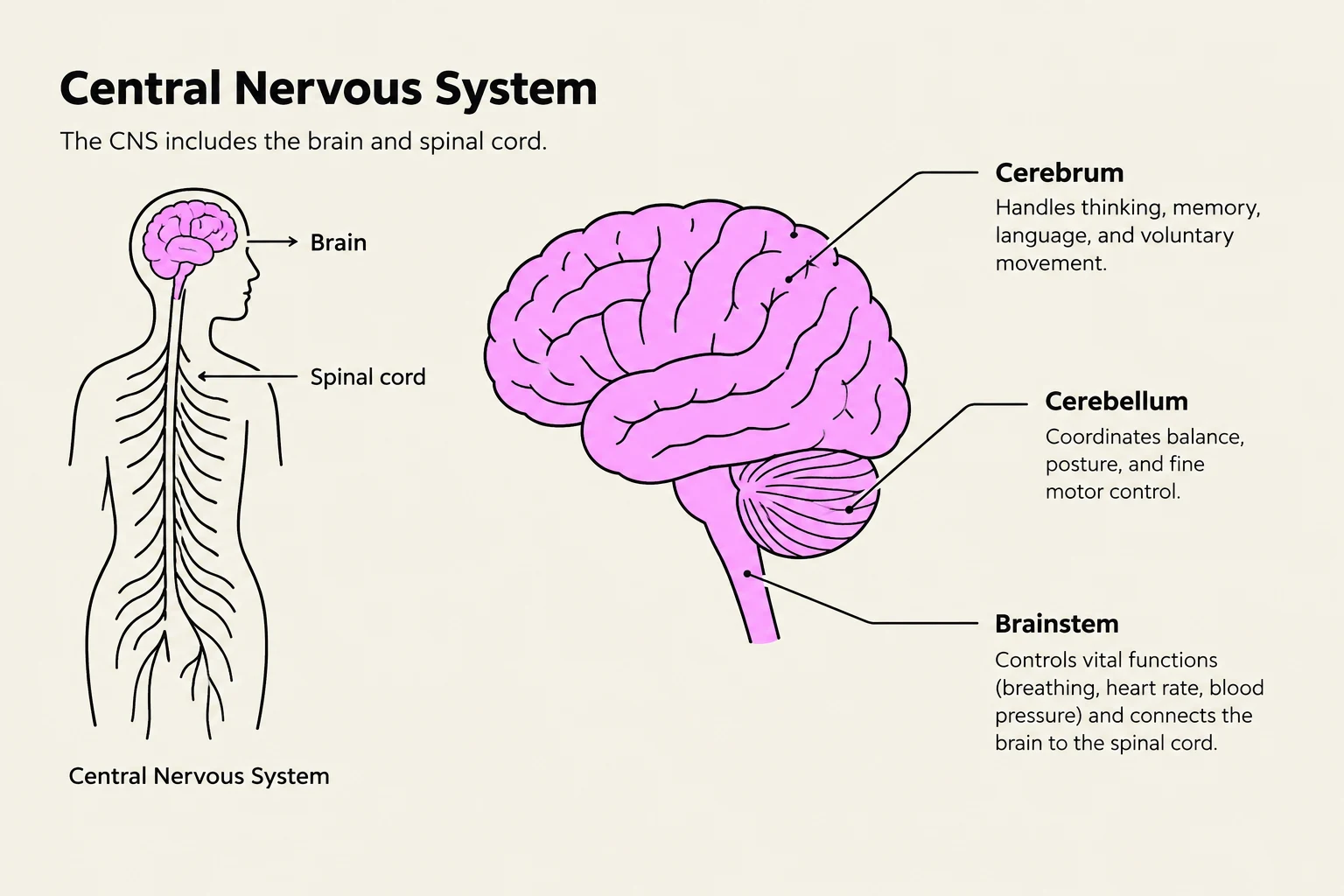
The CNS acts as the "command center" for the body and consists of the brain and the spinal cord.
- The Brain: The brain is the most complex organ, composed of the cerebral hemispheres, the cerebellum, and the brainstem.
- Cerebrum: This is the largest part of the brain, divided into right and left hemispheres. It contains specialized lobes: the frontal lobe (cognitive function, memory, and voluntary motor movement), the temporal lobe (speech integration and auditory data), the parietal lobe (sensory cortex and spatial information), and the occipital lobe (visual processing).
- Cerebellum: Located beneath the cerebrum, it is responsible for coordinating voluntary movement and maintaining equilibrium and trunk stability.
- Brainstem: This includes the midbrain, pons, and medulla. The medulla is particularly critical as it contains vital centers for respiratory, vasomotor, and heart functions.
- The Spinal Cord: Continuous with the brainstem, the spinal cord serves as the conduit between the brain and the rest of the body. A cross-section reveals a central core of gray matter surrounded by white matter. The white matter contains ascending tracts, which carry sensory information upward to the CNS, and descending tracts, which carry motor impulses downward to influence muscle movement.
Keep reading for free.
Create an account to finish this reading and make it part of your study routine.
Continue reading freeAlready have an account? Log in
Updated