An overview of nucleotides, their chemical composition including nitrogenous bases, pentose sugars, and phosphate groups, and their crucial roles in DNA, RNA, energy transfer, and cell signaling.
Nucleotides are the fundamental organic building blocks of life. As the structural units of nucleic acids, they provide the chemical framework necessary for storing genetic information and executing the complex processes of protein synthesis and energy metabolism. Understanding their composition and the specific covalent bonds that hold them together is essential for grasping how biological information is preserved and transmitted across generations.
The Chemical Architecture of a Nucleotide
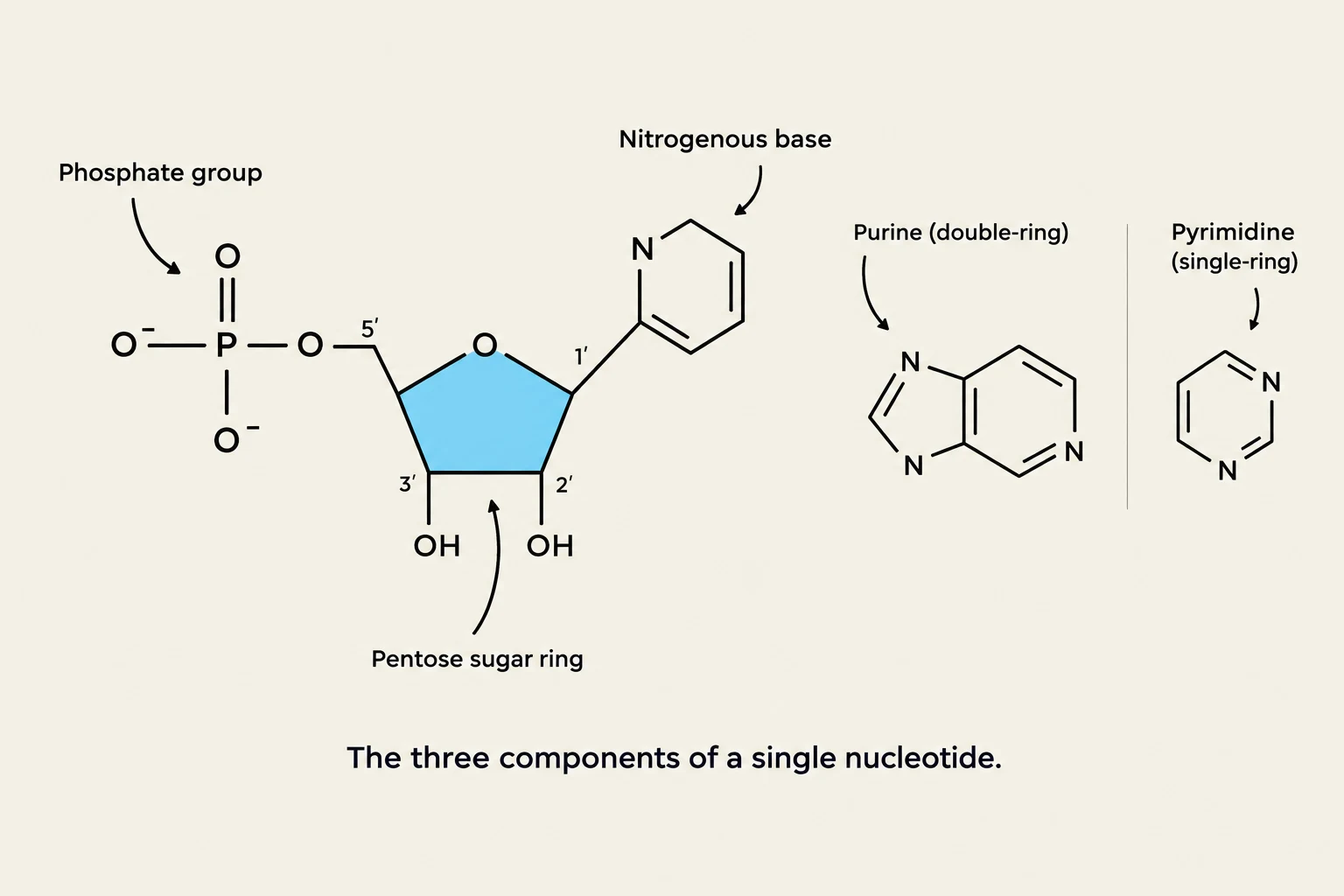
Diagram illustrating the three components of a nucleotide: a phosphate group, a pentose sugar ring, and a nitrogenous base, with examples of purine and pyrimidine structures.
A single nucleotide is composed of three distinct, covalently joined components: a nitrogenous base, a pentose sugar, and a phosphate group.
1. The Nitrogenous Base
The nitrogenous bases are heterocyclic compounds that serve as the "letters" of the genetic code. They are categorized into two structural groups:
Purines: These consist of a double-ring structure. The two major purines found in both DNA and RNA are adenine (A) and guanine (G).
Pyrimidines: These consist of a single-ring structure. The major pyrimidines include cytosine (C), which is common to both DNA and RNA, as well as thymine (T) (found in DNA) and uracil (U) (found in RNA).
2. The Pentose Sugar
The central sugar component is a five-carbon ring known as a pentose. The type of sugar present determines whether the nucleotide belongs to a DNA or RNA chain:
Ribose: Found in ribonucleotides (the units of RNA).
Deoxyribose: Found in deoxyribonucleotides (the units of DNA).
3. The Phosphate Group
The phosphate group is attached to the sugar to complete the nucleotide structure. In a long chain of nucleic acids (a polynucleotide), these phosphate groups act as "bridges".
Structural Connection Tip:
Pay close attention to the specific carbon numbering. The nitrogenous base is attached to the $1'$ carbon of the pentose via an N−β-glycosyl bond. This bond forms at the N−1 position for pyrimidines and the N−9 position for purines through a condensation reaction involving the removal of water. The phosphate group is subsequently esterified to the $5'$ carbon of the sugar.
Functions in Genetic Information
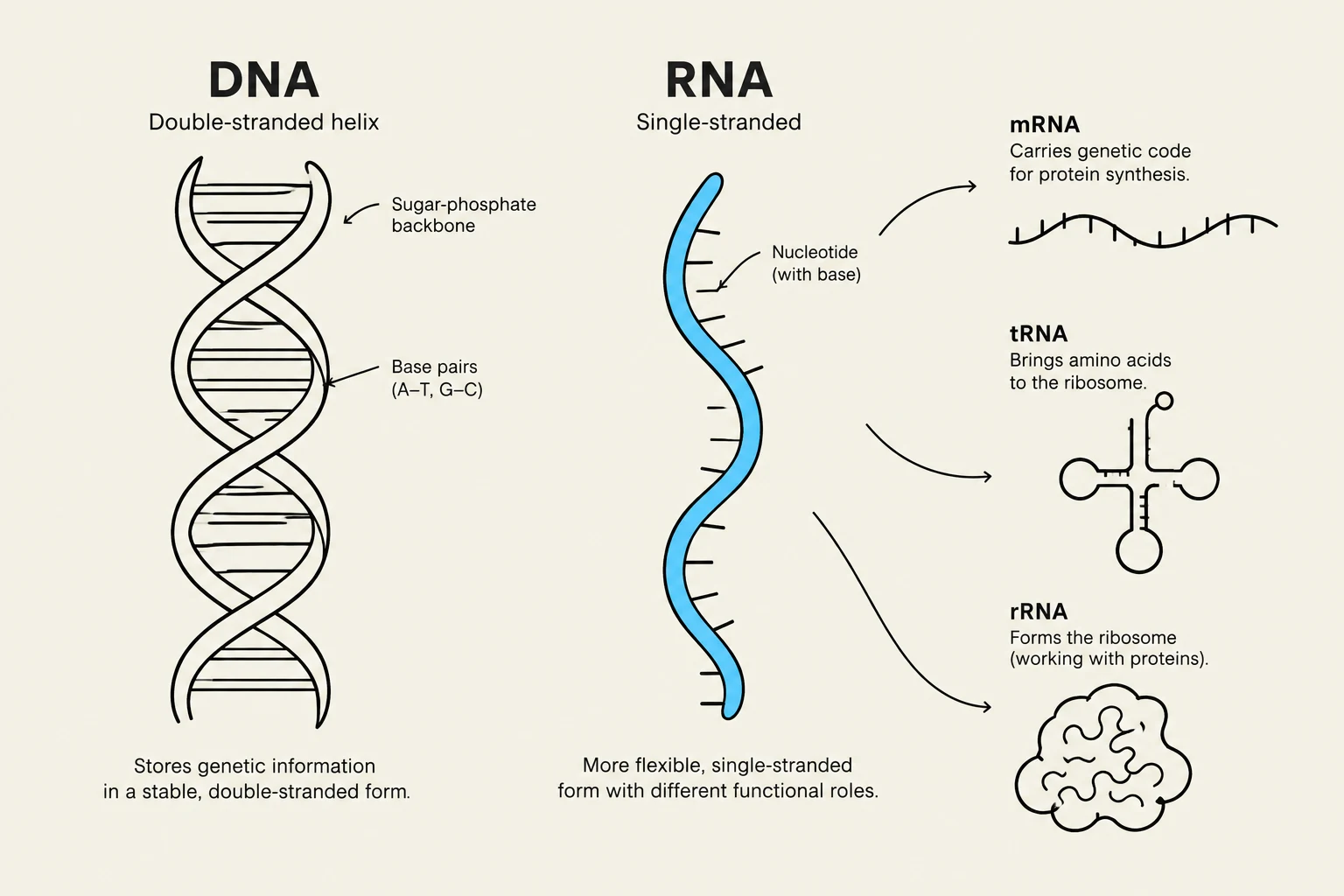
This illustration depicts the structures of DNA and RNA, including their components and functions in protein synthesis.
Nucleotides organize into long polymers called nucleic acids, which serve two primary roles in the cell: storage and expression.
DNA: The Genetic Blueprint
Deoxyribonucleic acid (DNA) is responsible for storing the genes that encode proteins or RNA molecules. Its primary biological role is to transmit this genetic data to future generations.
RNA: The Molecular Machinery
Ribonucleic acid (RNA) is more versatile in its functional forms, facilitating the translation of genetic code into functional proteins:
Messenger RNA (mRNA): Carries the genetic instructions from the DNA in the nucleus to the ribosomes.
Transfer RNA (tRNA): Acts as an adapter by transporting specific amino acids to the ribosome according to the sequence provided by the mRNA.
Ribosomal RNA (rRNA): Provides the structural framework for ribosomes. Interestingly, some rRNA molecules exhibit catalytic activity and are referred to as ribozymes.
Beyond Genetics: Energy and Regulation
Nucleotides are not limited to the nucleus; they are active participants in cellular metabolism and signaling.
Energy Transfer: Nucleotides serve as the primary carriers of chemical energy within the cell. For example, Adenosine triphosphate (ATP) is a critical energy currency.
Metabolic Regulation and Cofactors: Many essential enzyme cofactors are composed of adenine nucleotides, such as Nicotinamide adenine dinucleotide (NAD+) and Flavin adenine dinucleotide (FAD).
Cell Signaling: Certain nucleotides act as regulatory molecules or second messengers, such as cyclic AMP (cAMP) and cyclic GMP (cGMP).
Stability and Chemical Modifications
The chemical structure of nucleotides makes them susceptible to various modifications and damage, which can have significant biological consequences.
Hydrolysis and Stability
The covalent backbone of nucleic acids is subject to slow, non-enzymatic hydrolysis of the phosphodiester bonds. RNA is significantly less stable than DNA under alkaline conditions because the $2'$ hydroxyl group in ribose acts as a nucleophile, facilitating the breakdown of the chain. DNA, lacking this $2'$ hydroxyl group, remains more stable.
Damage and Mutations
Several factors can alter the structure of nucleotides:
UV Light: Can induce the formation of cyclobutane pyrimidine dimers, most commonly between adjacent thymidine residues.
Deamination: The loss of an amino group from a base (often accelerated by nitrous acid) can change the base's identity.
Alkylation: Chemical agents can add alkyl groups to bases, such as methylating guanine, which prevents proper base-pairing.
Clinical Note:
Permanent changes in the genetic information caused by these structural alterations are known as mutations. The accumulation of such mutations is closely linked to the processes of aging and carcinogenesis.
Keep reading for free.
Create an account to finish this reading and make it part of your study routine.