An overview of hair, including its composition, the structure and function of hair follicles, different types of hair, and common clinical considerations related to hair loss and growth.
Hair, also known as pili, is a vital component of the integumentary system. While often viewed through a purely aesthetic lens, hair serves several critical biological functions, including protecting the scalp from physical trauma, preventing heat loss, shielding the skin from harmful sunlight, and acting as a sensory tool to detect insects or movement on the skin. Specialized hairs, such as eyelashes, protect the eyes, while nose hairs act as filters for inhaled particles.
The Composition of Hair
Unlike the skin, which is composed of soft keratin, hair is made of dead, keratinized cells containing hard keratin. Hard keratin is significantly tougher and more durable than the soft keratin found in the epidermis, which is why hair cells do not flake off easily.
The structure of a hair is divided into two primary regions based on its location relative to the scalp:
Root: The portion located within the scalp, where the process of keratinization is actively occurring.
Shaft: The portion that extends above the scalp, where keratinization is already complete.
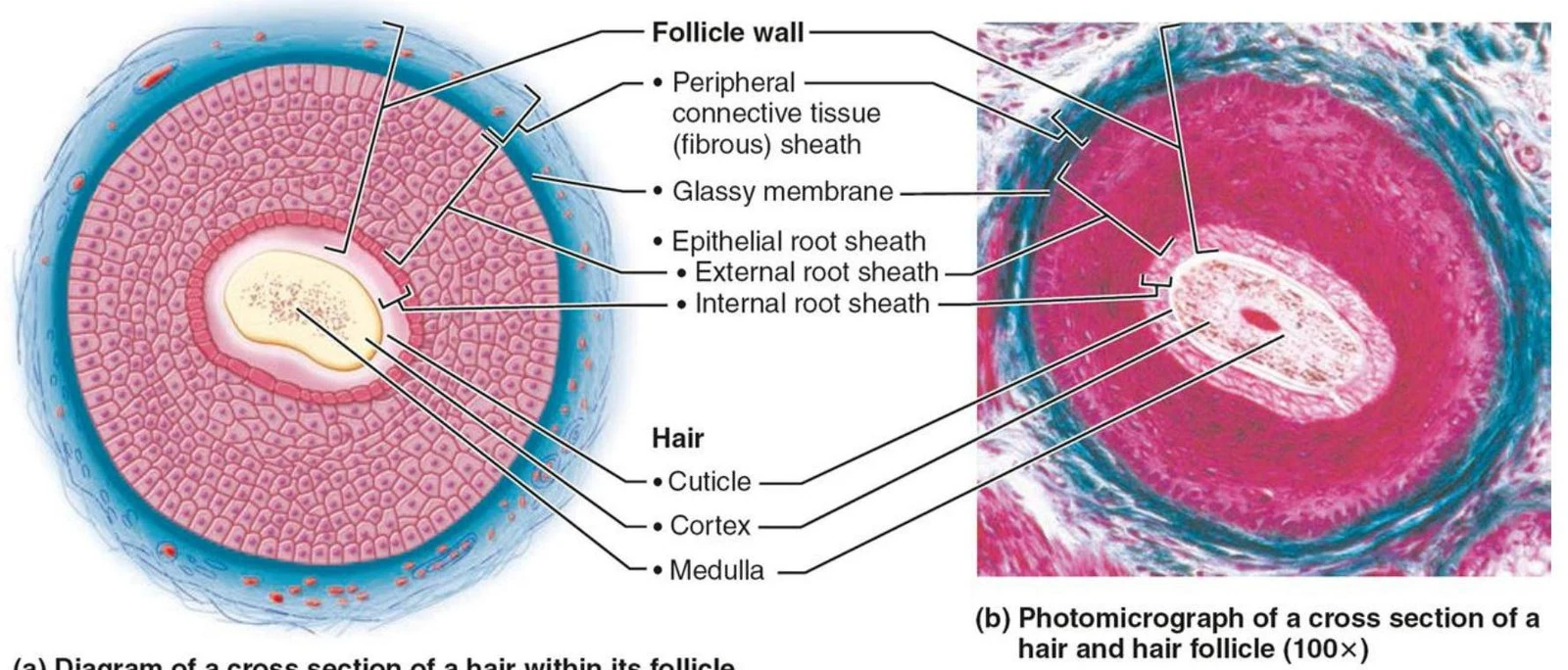
If we examine a cross-section of the hair shaft, we can identify three distinct layers:
Medulla: The central core consisting of large cells and air spaces.
Cortex: Several layers of flattened cells that surround the medulla.
Cuticle: The outermost layer, composed of overlapping single cells.
Diagram and photomicrograph illustrating the cross-section of a hair and its follicle, labeling key structures such as the follicle wall, root sheath layers, and hair components (cuticle, cortex, medulla).Figure 5.6a, b Structure of a hair and hair follicle.
Hair Color and Pigmentation
The color of your hair is determined by melanocytes located within the hair follicles. These cells produce various forms of melanin (such as yellow, rust, brown, and black) which combine to create the full spectrum of hair colors. For example, red hair is characterized by the presence of an additional pigment called pheomelanin. As humans age, melanin production may decrease; when this happens, air bubbles may replace the melanin in the shaft, resulting in gray or white hair.
The Hair Follicle
The hair follicle is the living structure that produces the hair, extending from the epidermal surface down into the dermis or even the subcutaneous tissue.
Diagram and photomicrograph illustrating the longitudinal view of a hair bulb within its follicle, detailing structures like the follicle wall, root sheath, hair root components (cuticle, cortex, medulla), hair matrix, hair papilla, melanocyte, and surrounding subcutaneous adipose tissue.Figures 5.6c, d Structure of a hair and hair follicle.
Several key components work together within the follicle to ensure hair growth and sensory function:
Hair Bulb: The expanded, deep end of the follicle.
Hair Matrix: Located within the bulb, this is the actively dividing area that produces new hair cells. As the matrix creates new cells, it pushes the older, keratinizing cells upward.
Hair Papilla: A piece of dermal tissue found at the base of the bulb. It contains a knot of capillaries that supply the essential nutrients required for hair growth.
Arrector Pili: A small band of smooth muscle attached to the follicle. When this muscle contracts, it pulls the hair upright, causing "goose bumps".
Hair Follicle Receptor (Root Hair Plexus): A network of sensory nerve endings that wrap around the hair bulb. This allows the hair to function as a highly sensitive touch receptor.
Exam Tip: Remember that if the hair papilla is destroyed by trauma, the follicle will permanently stop producing hair because the nutrient supply is lost.
Types of Hair and Growth Cycles
Not all hair on the human body is the same. We categorize hair into two main types based on its characteristics:
Vellus Hair: The pale, fine, and short body hair typically found on children and adult females.
Terminal Hair: The coarse, long hair found on the scalp and eyebrows. At puberty, terminal hair begins to appear in the axillary (underarm) and pubic regions of both sexes, and on the face and neck of males.
Hair growth is not constant; follicles undergo cycles between active and resting phases. On average, hair grows about 2 mm per week. The length a person's hair can reach depends on the lifespan of the follicle; for instance, scalp follicles last an average of four years, allowing for long hair, whereas eyebrow follicles only last a few months.
Clinical Considerations
Various physiological and genetic factors can lead to changes in hair density and distribution.
Hirsutism
Hirsutism is a condition in which females develop coarse, terminal hair in a masculine distribution. This can be caused by the production of small amounts of androgens (male sex hormones) due to conditions like polycystic ovary syndrome, or by tumors on the ovaries or adrenal glands that cause abnormally high androgen production.
Hair Thinning and Baldness
Hair density often changes with age. While hair grows fastest between the teenage years and the 40s, shedding can begin to outpace replacement after age 40.
Male pattern baldness is a specific type of true baldness that is genetically determined and influenced by male sex hormones (androgens). In this condition, hair follicles respond to androgens by experiencing decreasing growth cycles.
Telogen Effluvium
Telogen effluvium (TE) is characterized by abrupt hair thinning. This occurs when an abundance of hair follicles enter the "resting phase" of the growth cycle at the same time. Common triggers include:
Severe emotional stress or surgery.
Hormonal changes, such as those occurring during childbirth.
Nutritional deficiencies, particularly in proteins or minerals.
Low thyroid hormone levels or certain drugs (e.g., antidepressants or chemotherapy).
Keep reading for free.
Create an account to finish this reading and make it part of your study routine.