Cellular membranes are dynamic structures composed of a phospholipid bilayer and proteins, crucial for cell integrity, transport, and communication. This content explains the fluid mosaic model, selective permeability, and the impact of environmental stress on membranes.
Cellular membranes are much more than simple boundaries; they are dynamic, highly organized structures that serve as the gatekeepers of life. Typically only 6–10 nm thick, these membranes separate the internal environment of a cell or organelle from the external world. By doing so, they organize myriad chemical reactions, maintain cellular integrity, and facilitate essential communication with the surrounding environment. To understand how a cell survives and responds to its environment, one must first understand the elegant architecture of the membrane.
The Phospholipid Bilayer: The Structural Foundation
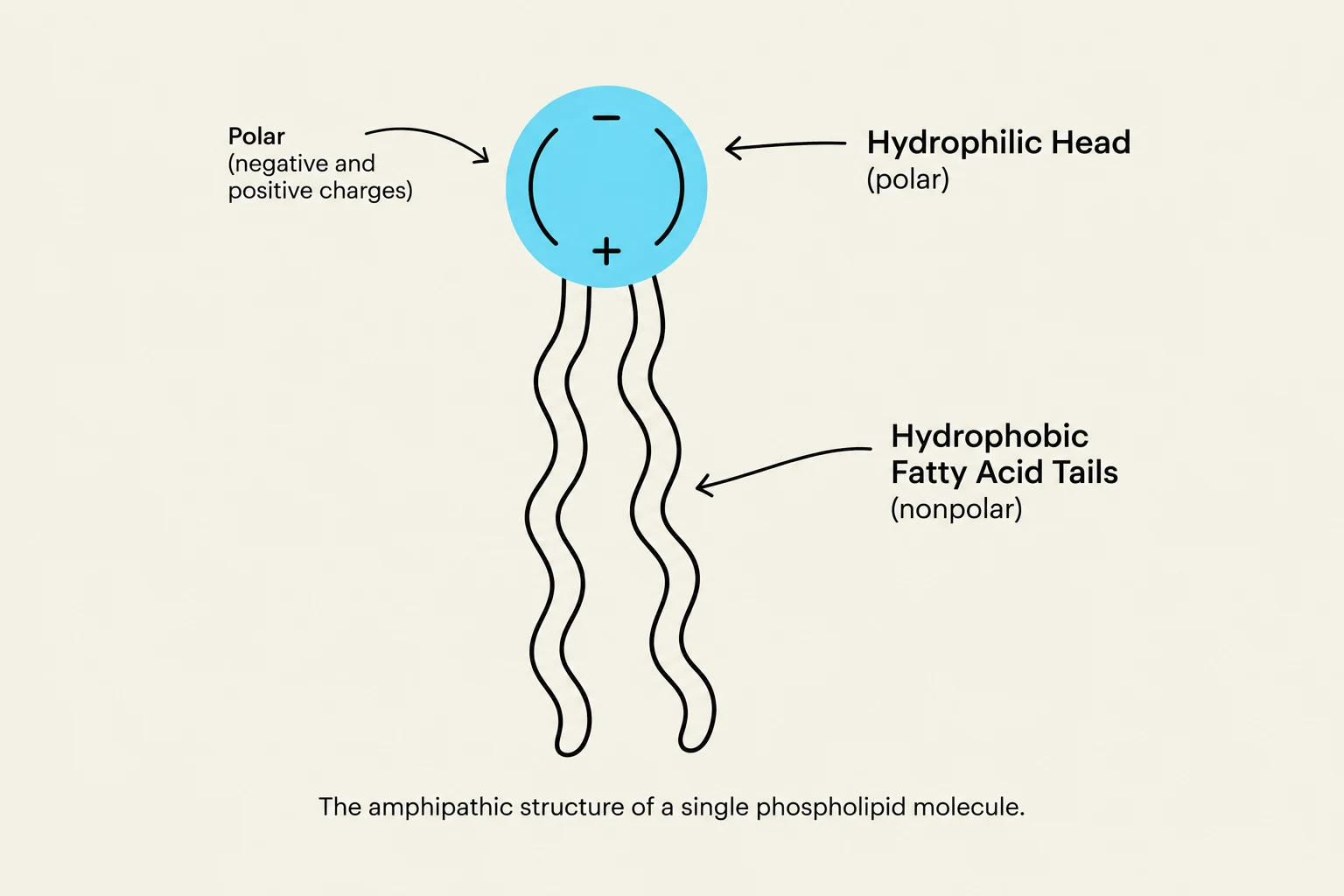
The amphipathic structure of a single phospholipid molecule, showing its hydrophilic head and hydrophobic fatty acid tails.
The primary structural component of any biological membrane is the phospholipid bilayer. This bilayer is formed by molecules known as phospholipids, which are characterized as being amphipathic. An amphipathic molecule is one that possesses two distinct affinities: it has both a hydrophilic ("water-loving") region and a hydrophobic ("water-fearing") region.
In a phospholipid molecule:
The phosphate group and the glycerol backbone are polar and hydrophilic.
The two fatty acid chains are nonpolar and hydrophobic.
When these molecules are placed in an aqueous (water-based) environment, they spontaneously self-assemble into a double-layered sheet. In this arrangement, the hydrophobic tails point inward to form a central core, shielded from water, while the hydrophilic heads line the exterior surfaces to interact with the water on both sides. This specific arrangement creates a stable, self-repairing barrier that effectively resists the penetration of most hydrophilic substances.
Study Tip: Remember that "amphipathic" is the key term for membrane structure. If a question asks why phospholipids form a bilayer, the answer lies in their dual nature: the desire of the heads to touch water and the desire of the tails to avoid it.
The Fluid Mosaic Model
The fluid mosaic model of the cellular membrane, illustrating the phospholipid bilayer, integral and peripheral proteins, and carbohydrate chains.
While the phospholipid bilayer provides the foundation, the membrane is not a static, rigid wall. Instead, scientists describe it using the fluid mosaic model. This model characterizes the membrane as a dynamic structure where various components move freely within the lipid bilayer, much like tiles floating in a pool.
The "mosaic" aspect of the membrane comes from several key components:
Membrane Proteins
Thousands of proteins are either embedded within or attached to the bilayer. These proteins are not fixed in position; they move about freely and can be densely packed or sparse depending on the specific membrane. They serve several vital roles:
Transport: Acting as pores or channels to move ions and molecules.
Enzymatic Activity: Providing surfaces for specific chemical reactions.
Signaling: Functioning as receptors that detect hormones or signals from other cells.
Carbohydrate Chains
Often bound to either proteins or lipids, these strings of sugar molecules act as distinctive molecular tags. These tags are essential for cell identification, allowing the body to recognize "self" versus "non-self" (such as bacteria or foreign tissue).
Selective Permeability and Transport
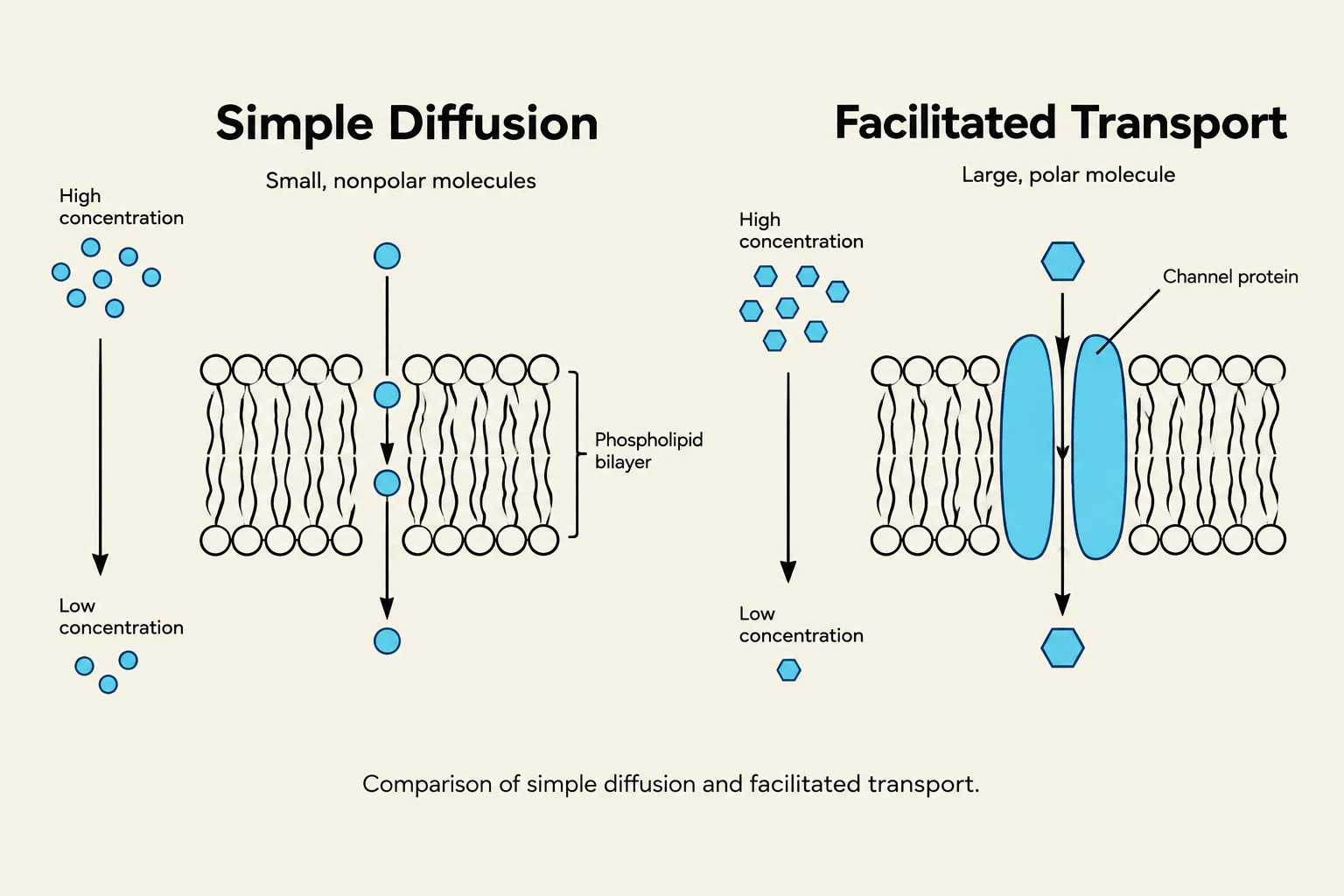
Comparison of simple diffusion and facilitated transport across a cell membrane.
One of the most critical functions of the membrane is selective permeability—the ability to regulate which substances enter or exit the cell. The membrane does not allow everything to pass through equally; instead, it acts as a filter based on the physical and chemical properties of a solute.
The permeability of a molecule is determined by:
Size: Smaller molecules generally move more easily.
Charge: Ions (charged particles) face significant resistance from the hydrophobic core.
Polarity: Polar molecules struggle to pass through the nonpolar lipid center.
Lipid Solubility: Molecules that can dissolve in lipids pass through more readily.
Passive vs. Active Transport
Because of this selective barrier, cells must utilize different methods to move materials:
Simple Diffusion: This is a form of passive transport where small, uncharged, nonpolar, and lipid-soluble molecules pass directly through the hydrophobic lipid core of the membrane. This process requires no energy because molecules move down their concentration gradient.
Facilitated Transport: Because ions and polar molecules cannot easily cross the lipid core, the membrane utilizes specialized membrane proteins to act as pores or channels, facilitating their passage.
Active Transport: In some cases, cells must move substances against their concentration gradient, a process that requires the expenditure of energy.
Membrane Integrity and Environmental Stress
The physical and chemical integrity of the membrane is crucial for cell survival. Because the membrane is a delicate balance of molecular interactions, it is highly sensitive to environmental stressors.
Temperature Stress
Extreme temperatures can compromise the membrane's ability to act as a barrier:
High Temperatures: Can cause violent molecular collisions that degrade the membrane structure.
Freezing Temperatures: Can cause water to crystallize into ice. As ice forms, it expands, which can physically rupture the membrane.
Chemical Stress
Organic solvents, such as acetone or methanol, can also be destructive because they dissolve lipids. If the lipid component of the bilayer is dissolved, the membrane loses its integrity, allowing internal cellular contents to leak out into the surrounding environment.
Experimental Note: In laboratory settings, scientists often use beet (Beta vulgaris) cells to study these effects. Beet cells contain a red pigment called betacyanin stored in their vacuoles. If the membrane is damaged by heat, cold, or solvents, the red pigment leaks out, allowing researchers to quantify the level of membrane damage by measuring the color of the surrounding water.
Keep reading for free.
Create an account to finish this reading and make it part of your study routine.