The world of plants is incredibly diverse, but perhaps the most recognizable and economically significant group is the angiosperms, commonly known as flowering plants. From the wheat and rice that sustain human civilizations to the colorful roses in a garden, angiosperms have mastered the art of reproduction through specialized structures: the flower. Understanding how a flower is built and how it functions is essential to understanding the life cycles of the plants that provide our food, medicine, and oxygen.
The Anatomy of a Flower
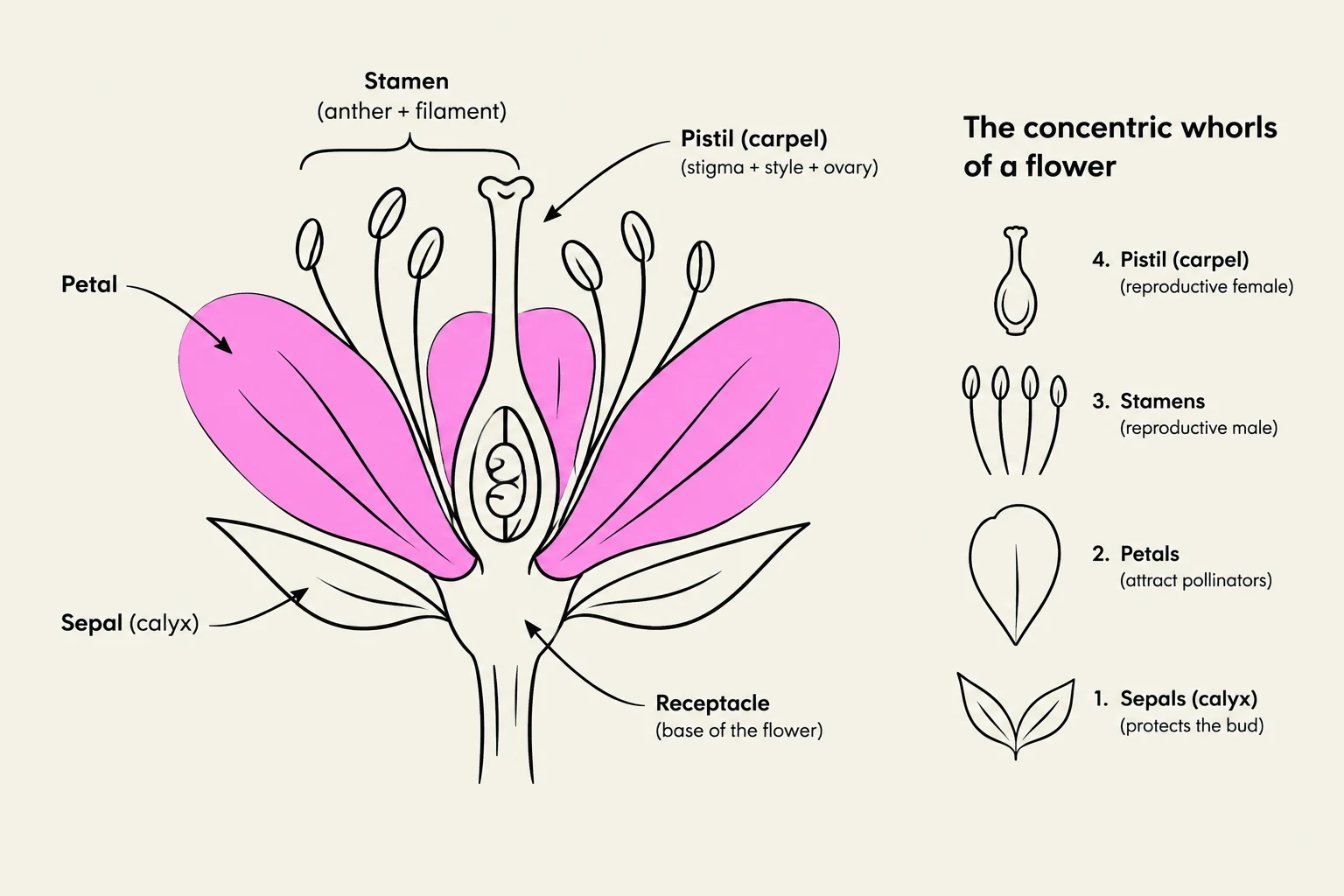
A flower is essentially a modified branch that has evolved to facilitate sexual reproduction. Rather than having leaves scattered randomly, the flower organizes its specialized appendages, known as floral organs, into concentric circles called whorls. These whorls are all attached to a thickened base of the stem called the receptacle.
The arrangement of these organs follows a specific order from the outermost layer to the innermost reproductive center:
The Protective and Attractive Layers (The Perianth)
The first two whorls are primarily involved in protecting the developing flower and attracting pollinators.
Sepals: These are the outermost, often leaf-like structures that protect the flower while it is still in the bud stage. The collective term for all the sepals of a flower is the calyx.
Petals: Located just inside the sepals, petals are often brightly colored and scented to attract animals like bees, birds, or bats. The collective term for all the petals is the corolla.
When studying a flower, you may hear the term perianth, which refers to the combined structure of the calyx and the corolla.
Diagram illustrating the parts of a flower, including the pistil, stamens, petals, sepal, and receptacle, along with a breakdown of the concentric whorls.
The Reproductive Organs
The inner two whorls are the functional "machinery" of sexual reproduction.
Stamens (The Androecium): This is the male reproductive whorl. A typical stamen consists of two parts: the anther, which produces pollen, and the filament, a stalk that supports the anther.
Carpels (The Gynoecium): This is the female reproductive whorl. A carpel is composed of three main parts: the stigma (the receptive tip for pollen), the style (the tube connecting the stigma to the ovary), and the ovary. Inside the ovary are one or more ovules, which contain the female gametes.
Exam Tip: If a question asks for the collective term of the male parts, look for androecium. If it asks for the female parts, look for gynoecium.
Classification: Monocots vs. Dicots
Not all flowers look the same. Botanists categorize angiosperms into two major groups based on the number of floral parts they possess:
Monocots: These plants typically have floral parts in multiples of three (e.g., 3, 6, or 9 petals/sepals). Examples include lilies, grasses, and orchids.
Dicots: These plants typically have floral parts in multiples of four or five. Examples include roses, geraniums, and most broadleaved trees.
Pollination Strategies
For reproduction to be successful, pollen must travel from the anther of one flower to the stigma of another. This process is called pollination.
Types of Pollination
Self-pollination: Occurs when pollen is transferred within the same individual plant.
Cross-pollination: Occurs when pollen is transferred between different individual plants. This is biologically advantageous because it helps prevent the detrimental effects of in-breeding.
Methods of Transfer
Plants have evolved distinct morphologies to suit their specific pollination methods:
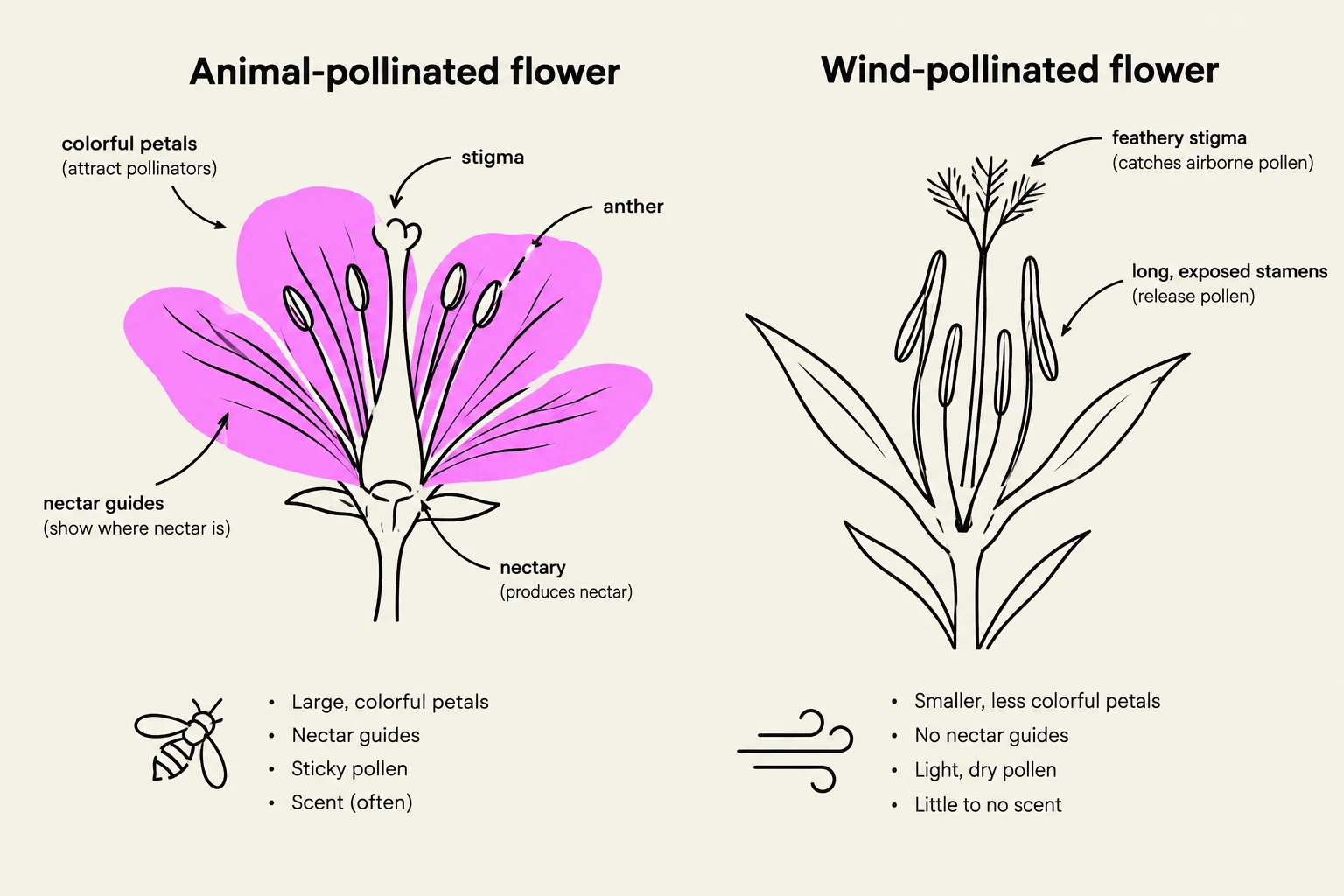
Animal Pollination: These flowers are "showy." They use bright colors, pleasant scents, and nectar to entice animals. Many even feature nectar guides—patterns on the petals that act like landing lights to direct pollinators toward the nectar reward.
Wind Pollination: These flowers are much more "modest." They are often small, inconspicuous, and lack colorful petals. To maximize success, they produce copious amounts of lightweight, dry pollen, have long filaments so anthers can hang free in the wind, and possess feathery stigmas to better trap passing pollen grains.
Diagram comparing the characteristics of animal-pollinated and wind-pollinated flowers, including their reproductive parts and adaptations for pollen dispersal.
From Flower to Fruit
Once pollination and fertilization occur, the flower undergoes a dramatic transformation. The zygote develops into an embryo, and the primary endosperm nucleus becomes the endosperm—a nutritive tissue that feeds the growing embryo.
The final stage of this process involves the development of the fruit. The ovary expands to become the fruit, which serves to protect the seeds and aid in their dispersal. Fruits are categorized based on how they release their seeds:
Dehiscent fruits: These split open naturally when they reach maturity.
Indehiscent fruits: These do not split open at maturity.
Common examples of fruits include the tomato (botanically a berry), apples (pomes), and citrus fruits (hesperidium).
The Biological Foundation: Meristems and Tissues
To understand how these complex structures like flowers and fruits grow, we must look at the cellular level. Plant growth is driven by meristems, which function much like animal "stem cells" by being sites of active cell division.
Apical Meristems: Located at the tips of roots and shoots, these are responsible for primary growth (lengthening the plant).
Lateral Meristems: Found in the vascular and cork cambium, these are responsible for secondary growth (increasing the thickness or girth of the plant).
As cells divide in the meristems, they differentiate into permanent tissues specialized for specific roles:
Dermal Tissue: The plant's "skin." It includes the epidermal tissue on the surface and the peridermal tissue (bark) found in woody plants. A key feature here is the stomata—pores regulated by guard cells that balance the intake of CO2 with the release of water vapor.
Ground Tissue: The "filler" and functional tissue, consisting of parenchyma (storage/photosynthesis), collenchyma (support), and sclerenchyma (structural support).
Vascular Tissue: The plant's transport system, consisting of xylem (which conducts water and minerals upward) and phloem (which conducts organic solutes like sugars in all directions).
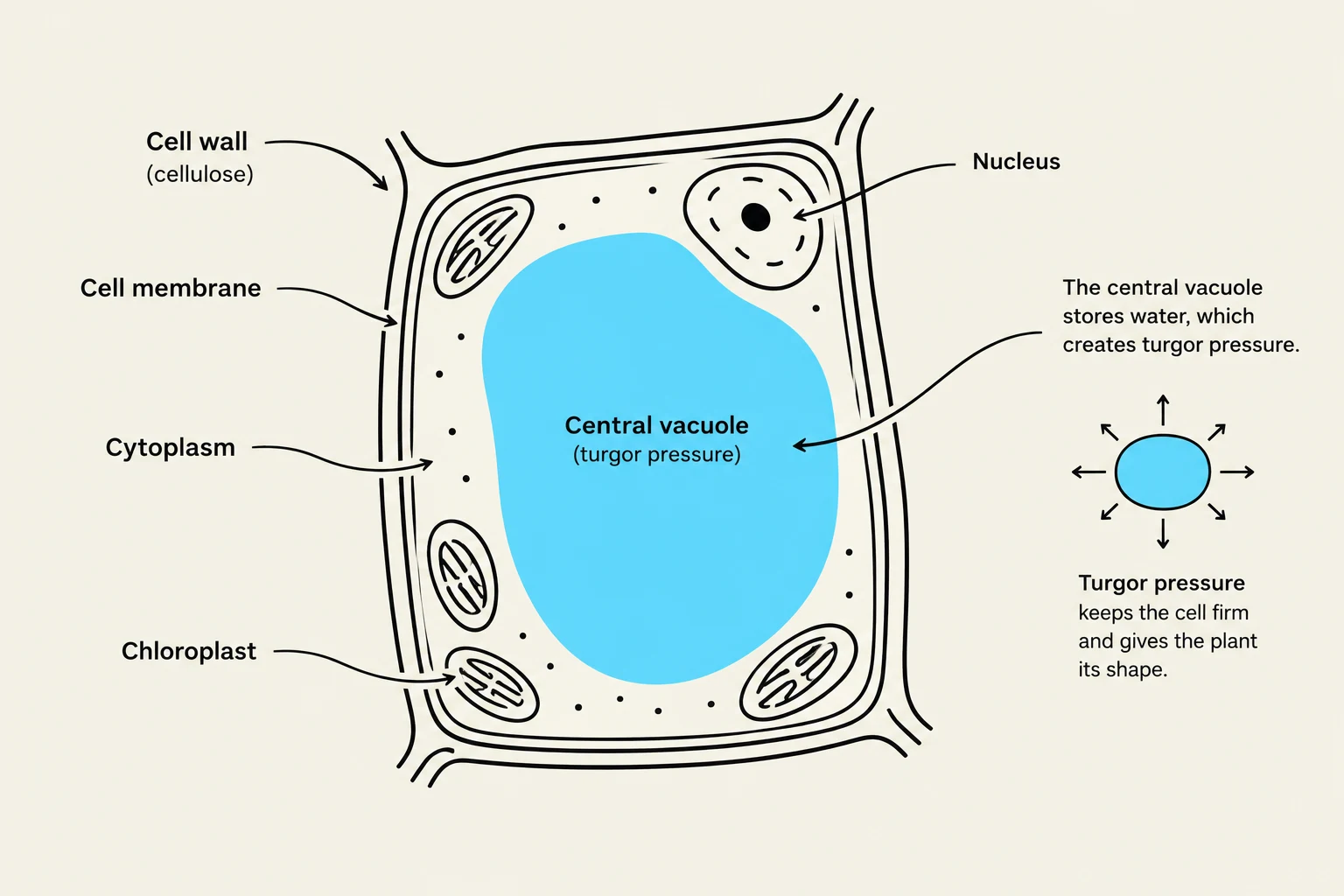
Diagram illustrating the structure of a plant cell, highlighting the cell wall, cell membrane, cytoplasm, chloroplasts, nucleus, and central vacuole. It also explains the concept of turgor pressure generated by the central vacuole, which maintains the cell's firmness and shape.
Summary Table: Floral Organ Comparison
Whorl
Collective Term
Primary Function
Sepals
Calyx
Protection of the bud
Petals
Corolla
Attracting pollinators
Stamens
Androecium
Male reproduction (pollen production)
Carpels
Gynoecium
Female reproduction (ovule production)
Keep reading for free.
Create an account to finish this reading and make it part of your study routine.