An overview of monosaccharides, the simplest form of carbohydrates, detailing their chemical structure, classification based on carbonyl position and carbon number, isomerism, and their role in forming disaccharides and polysaccharides.
Carbohydrates are essential organic molecules composed primarily of carbon, hydrogen, and oxygen. They serve a wide variety of biological roles, ranging from providing immediate fuel for cells to forming rigid structural components in cell walls. At the most fundamental level, these carbohydrates are built from simple sugar monomers known as monosaccharides.
The Chemistry of Monosaccharides
Monosaccharides are the simplest form of carbohydrates and cannot be hydrolyzed into smaller sugar units. Most common monosaccharides, such as the hexose glucose, follow the chemical formula C6H12O6, though some variations exist, such as the five-carbon 2-deoxyribose (C5H10O4).
The chemical behavior and solubility of these sugars are driven by two key functional groups:
Hydroxyl group ($-OH$): This group is polar due to the electronegative oxygen atom, making the molecule hydrophilic (water-loving) and allowing it to dissolve easily in aqueous environments.
Carbonyl group (C=O): This is a carbon-oxygen double bond that is also polar. The position of this group within the carbon chain is a primary method for classifying sugars.
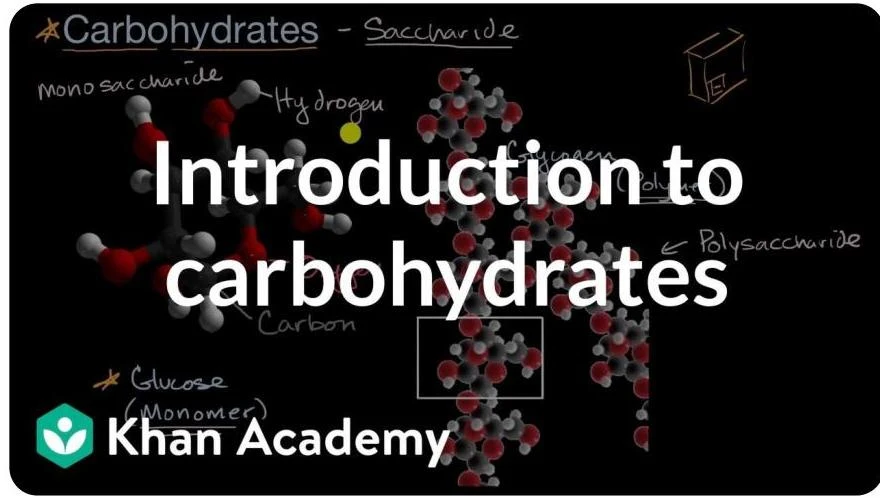
An introduction to carbohydrates, illustrating molecular structures of monosaccharides and polysaccharides.
Classification of Monosaccharides
Biochemists classify monosaccharides based on two main structural criteria: the position of the carbonyl group and the total number of carbon atoms.
1. Carbonyl Position
The location of the C=O bond determines whether a sugar is an aldose or a ketose:
Aldose: The carbonyl group is located at the end of the carbon chain (forming an aldehyde group). An example is glucose.
Ketose: The carbonyl group is located within the carbon chain (forming a ketone group). An example is fructose.
2. Carbon Number
Sugars are also named according to how many carbon atoms they contain:
Triose: 3 carbons.
Pentose: 5 carbons (e.g., ribose and deoxyribose).
Hexose: 6 carbons (e.g., glucose, galactose, and fructose).
Sugar
Formula
Class
Key structural clue
Glucose
C6H12O6
Aldohexose
Aldehyde at C1
Galactose
C6H12O6
Aldohexose
C4 orientation differs from glucose
Fructose
C6H12O6
Ketohexose
Ketone at C2
Ribose
C5H10O5
Aldopentose
OH at C2
2-Deoxyribose
C5H10O4
Deoxy aldopentose
H instead of OH at C2
Isomerism: Same Formula, Different Shapes
One of the most important concepts in carbohydrate chemistry is isomerism. Isomers are molecules that share the same molecular formula but have different structural arrangements.
Structural Isomers
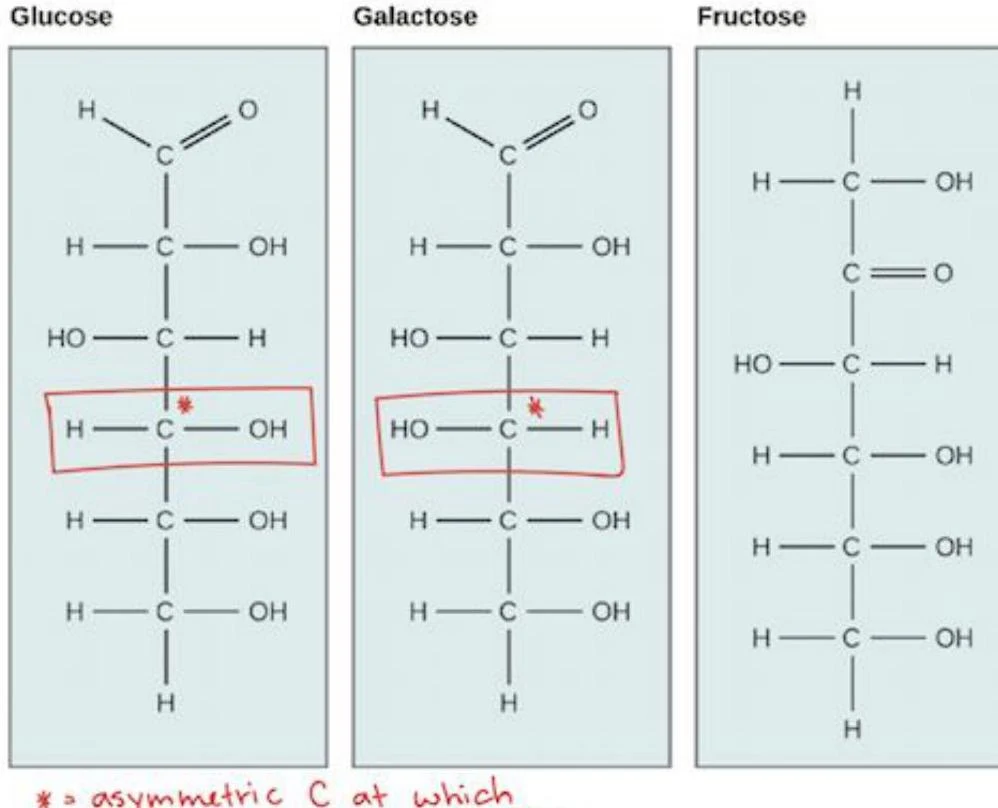
Structural (or constitutional) isomers have different bonding arrangements. For example, glucose and fructose are structural isomers because glucose is an aldose (carbonyl at the end) while fructose is a ketose (carbonyl in the middle).
Comparison of the chemical structures of glucose, galactose, and fructose, highlighting asymmetric carbons.
Stereoisomers
Stereoisomers have the same connectivity but differ in the spatial orientation of atoms around a specific carbon atom. Glucose and galactose are stereoisomers (specifically C4 epimers); they differ only in the orientation of the hydroxyl group at the fourth carbon.
Exam Tip: Even though these differences are microscopic, they are biologically massive. Enzymes are highly specific and can distinguish between these subtle spatial differences, meaning an enzyme that breaks down glucose might not work on galactose.
Ring Formation and Anomers
In aqueous (water-based) environments, monosaccharides do not typically stay in their linear "Fischer projection" forms. Instead, they undergo a structural transformation to form cyclic ring structures.
When a hexose like glucose forms a ring, the carbon that was originally the carbonyl carbon becomes the anomeric carbon. This creates two distinct versions of the sugar, known as anomers, based on the orientation of the hydroxyl ($-OH$) group on that first carbon:
Alpha (α) glucose: The hydroxyl group on carbon 1 points below the ring.
Beta (β) glucose: The hydroxyl group on carbon 1 points above the ring.
This distinction is critical because the orientation of these bonds dictates the properties of the larger polymers (complex carbohydrates) that form. For instance, α-glucose linkages form energy-storage molecules like starch and glycogen, whereas β-glucose linkages form the strong structural fibers of cellulose.
From Monomers to Polymers
Monosaccharides can be linked together to form more complex molecules. When two monosaccharides join via a covalent bond, they form a disaccharide. This process is called dehydration synthesis because it releases a molecule of water as the bond forms.
Sugar+Sugar→Disaccharide+H2O
Common disaccharides include:
Maltose: Glucose + Glucose.
Lactose: Glucose + Galactose.
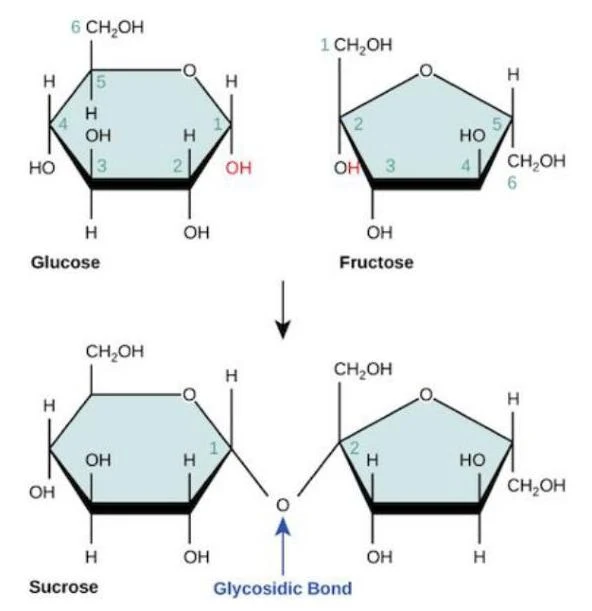
Sucrose: Glucose + Fructose.
When many monosaccharides are linked together in long chains, they form polysaccharides (complex carbohydrates). These large molecules serve as the primary way organisms store energy (like starch in plants or glycogen in animals) or build structures (like cellulose in plant cell walls or chitin in fungal walls).
Diagram showing the formation of sucrose from glucose and fructose through a glycosidic bond.
To break these bonds and release the sugars, the cell performs hydrolysis, which is the addition of a water molecule to break the glycosidic linkage.
Keep reading for free.
Create an account to finish this reading and make it part of your study routine.