This article explores the hierarchy of strategy, the connection between logistics and other functional areas, and the frameworks used to measure financial and strategic success in logistics management.
In the modern business landscape, logistics is no longer just about moving boxes from point A to point B. It is a critical driver of organizational success that directly impacts the bottom line. To be effective, logistics managers must move beyond operational tasks and understand how their decisions influence a company's strategic financial outcomes. This article explores the hierarchy of strategy, the connection between logistics and other functional areas, and the frameworks used to measure financial and strategic success.
The Hierarchy of Strategy
This diagram illustrates the top-down hierarchy of organizational strategy, starting with business strategy, then functional strategy, and finally core competency.
To understand logistics, one must first understand where it sits within the organizational structure. Strategy operates on a "top-down" model, moving from broad corporate goals to specific departmental actions.
Business Strategy
At the highest level is the Business Strategy. This defines the firm's targeted customers and establishes the time frames and performance objectives for the entire organization. A business might choose one of three generic strategies to compete in the market:
Cost Leadership: Aiming to be the low-cost producer in an industry for a specific level of quality.
Differentiation: Offering unique attributes that customers value and perceive as distinct from competitors.
Focus: Concentrating efforts on a narrowly defined market segment to achieve either cost leadership or differentiation.
Functional Strategy and Core Competency
The business strategy is then translated into a Functional Strategy. This level turns broad goals into specific actions for departments such as marketing, finance, and the supply chain.
When a functional strategy is executed exceptionally well, it can lead to a Core Competency. This is an organizational strength or ability developed over a long period that customers find valuable and competitors find difficult or impossible to copy.
Defining Logistics Strategy
A Logistics Strategy is a specific type of functional strategy. According to the ASCM Dictionary, it is a functional strategy for the logistics elements of a business—including warehousing, information systems, and transportation—that is aligned with the overall business strategy.
The primary objectives of a logistics strategy are:
To help management choose the right mix of structural and infrastructural elements based on customer-valued performance dimensions and trade-offs.
To ensure that all logistics choices are strategically aligned with the firm's business strategy.
To support the development of core competencies within the firm's supply chains.
Structural vs. Infrastructural Decisions
This diagram illustrates the distinction between structural logistics decisions, which involve physical assets like warehouses and delivery trucks, and infrastructural logistics decisions, which pertain to processes and people, such as planning, sourcing, delivery, and organizational structure.
To implement a logistics strategy, managers must make two types of decisions:
Decision Category
Examples
Structural Decisions
Facilities: Size, location, and specialization of warehouses or distribution hubs. Technology: Material handling equipment, transportation equipment, and information systems.
Infrastructural Decisions
Organization: The logistics organizational structure. Sourcing/Purchasing: Sourcing strategies and supplier selection. Planning and Control: Forecasting and inventory management.
Exam Tip: If a question asks about "physical" assets like buildings or trucks, think Structural. If it asks about "process" or "people" elements like forecasting or organizational structure, think Infrastructural.
Cross-Functional Influences on Logistics
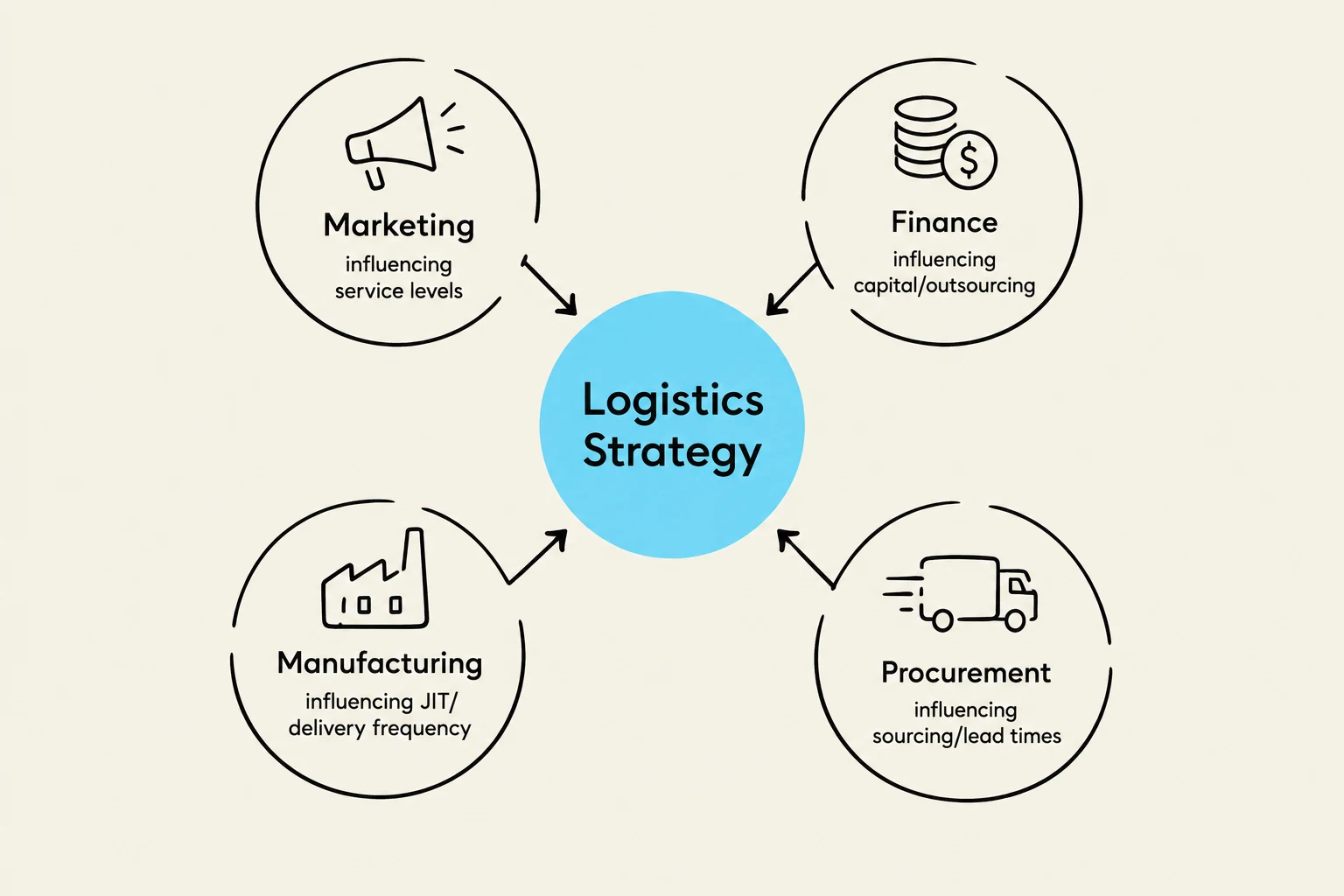
A diagram illustrating the key components of a logistics strategy, including Marketing, Finance, Manufacturing, and Procurement, and their influence on various aspects of business operations.
Logistics does not exist in a vacuum. Its strategy is heavily influenced by the decisions made in other functional areas.
Marketing Influence: Marketing decisions regarding product availability, desired customer service levels, and packaging design directly dictate how logistics must operate.
Finance Influence: Financial constraints and goals, such as required rates of return, can dictate whether a company manages its own warehouse or outsources to a third-party provider.
Manufacturing Influence: If manufacturing implements a Just-in-Time (JIT) system, logistics must adapt its warehousing, transportation, and inventory management to support frequent, smaller deliveries.
Procurement Influence: A decision to shift from domestic to global sourcing will fundamentally change logistics requirements, likely requiring new modes of transportation and longer lead times.
Connecting Strategy to Financial Performance
Logistics managers face a significant challenge: they must communicate how logistics capabilities provide value and support corporate success in tangible financial terms.
While specific mathematical models like the Strategic Profit Model and the Balanced Scorecard are essential tools for this connection, the fundamental goal remains the same: ensuring that every logistics activity—from a truck route to a warehouse location—is contributing to the organization's financial health and strategic positioning.
Key Takeaway for Managers: To succeed, you must bridge the gap between operational excellence (doing things right) and strategic alignment (doing the right things for the company's financial goals).
Keep reading for free.
Create an account to finish this reading and make it part of your study routine.