In the study of chemistry, understanding how matter interacts and how gases behave is fundamental. This article explores the mathematical relationship between the quantities of reactants and products in chemical reactions—known as stoichiometry—and the physical laws that govern the behavior of gases under varying conditions of pressure, volume, and temperature.
The Fundamentals of Gas Laws
Gases do not behave like solids or liquids; they are highly compressible and their properties change significantly with environmental shifts. To describe these changes, chemists use several empirical laws that relate pressure (P), volume (V), temperature (T), and the number of moles (n).
Key relationships include:
Boyle’s Law: Describes the inverse relationship between pressure and volume when temperature is constant (V=kP−1).
Charles’ Law: Describes the direct relationship between volume and temperature when pressure is constant ($V = bT$).
Avogadro’s Law: States that volume is directly proportional to the number of moles at constant pressure and temperature ($V = an$).
The most powerful tool in this toolkit is the Ideal Gas Law, which combines these relationships into a single equation:
$PV = nRT$
In this equation, R represents the Universal Gas Constant. Because R is a constant, its value depends on the units you choose for pressure and volume.
Exam Tip: Always check your units for R before starting a calculation. If your pressure is in atmospheres (atm), use R=0.082057K⋅molL⋅atm. If your pressure is in kilopascals (kPa), use R=8.3145K⋅molL⋅kPa.
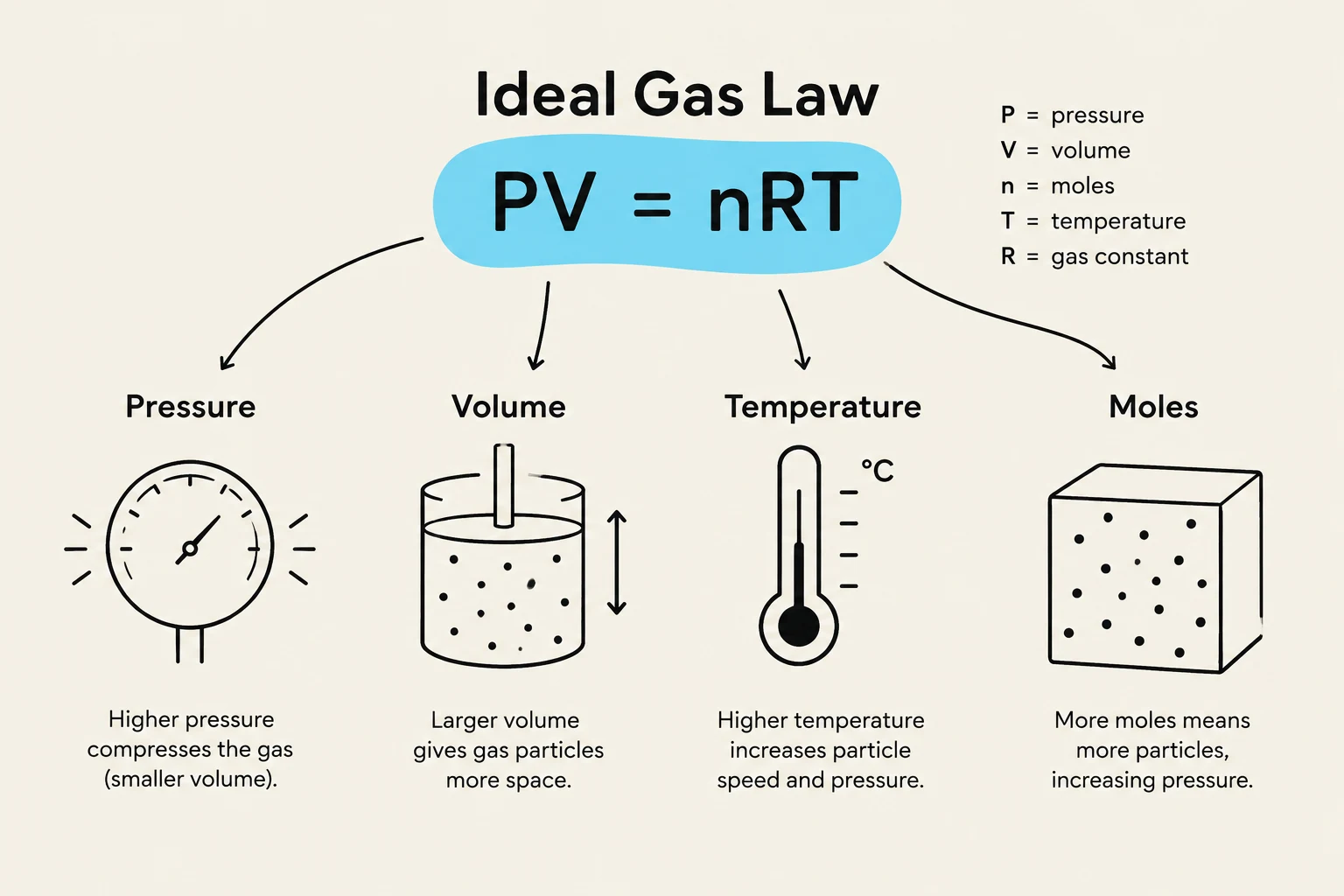
The Ideal Gas Law, PV=nRT, relates pressure, volume, moles, and temperature of a gas. Higher pressure compresses gas, larger volume gives particles more space, higher temperature increases particle speed and pressure, and more moles mean more particles, increasing pressure.
Units of Measurement
To use these laws correctly, you must master specific units:
Temperature: Must always be converted to Kelvin (K) for gas law calculations.
Pressure: Commonly measured in Atmospheres (atm) or Kilopascals (kPa).
Volume: Typically expressed in Liters (L) or cubic decimeters (dm3).
Standard Conditions: STP and SATP
When chemists discuss gas behavior, they often refer to "standard" conditions to ensure consistency in experiments and data reporting.
Standard Temperature and Pressure (STP) is defined by:
Temperature: 0∘C (which is 273.15 K).
Pressure: 1 atm or 101.3 kPa.
At STP, one mole of any ideal gas occupies a volume of exactly 22.414 L.
Standard Ambient Temperature and Pressure (SATP) is a different convention often used in laboratory settings, typically referring to:
Temperature: 25∘C (298.15 K).
Pressure: 1 atm (101.3 kPa).
Gas Density and Molarity
Beyond simple volume, we can use the Ideal Gas Law to determine the density of a gas or its concentration in a solution.
Gas Density
Density (d) is defined as mass divided by volume. By rearranging the Ideal Gas Law using molar mass (M), we can derive a formula for gas density:
Density=RTPM
This shows that the density of a gas is directly proportional to its molar mass and the pressure, but inversely proportional to its temperature.
Molarity
In liquid chemistry, we often deal with Molarity (M), which is the concentration of a solute in a solution. It is calculated as:
Molarity=Volume of solution in Litersmoles of solute
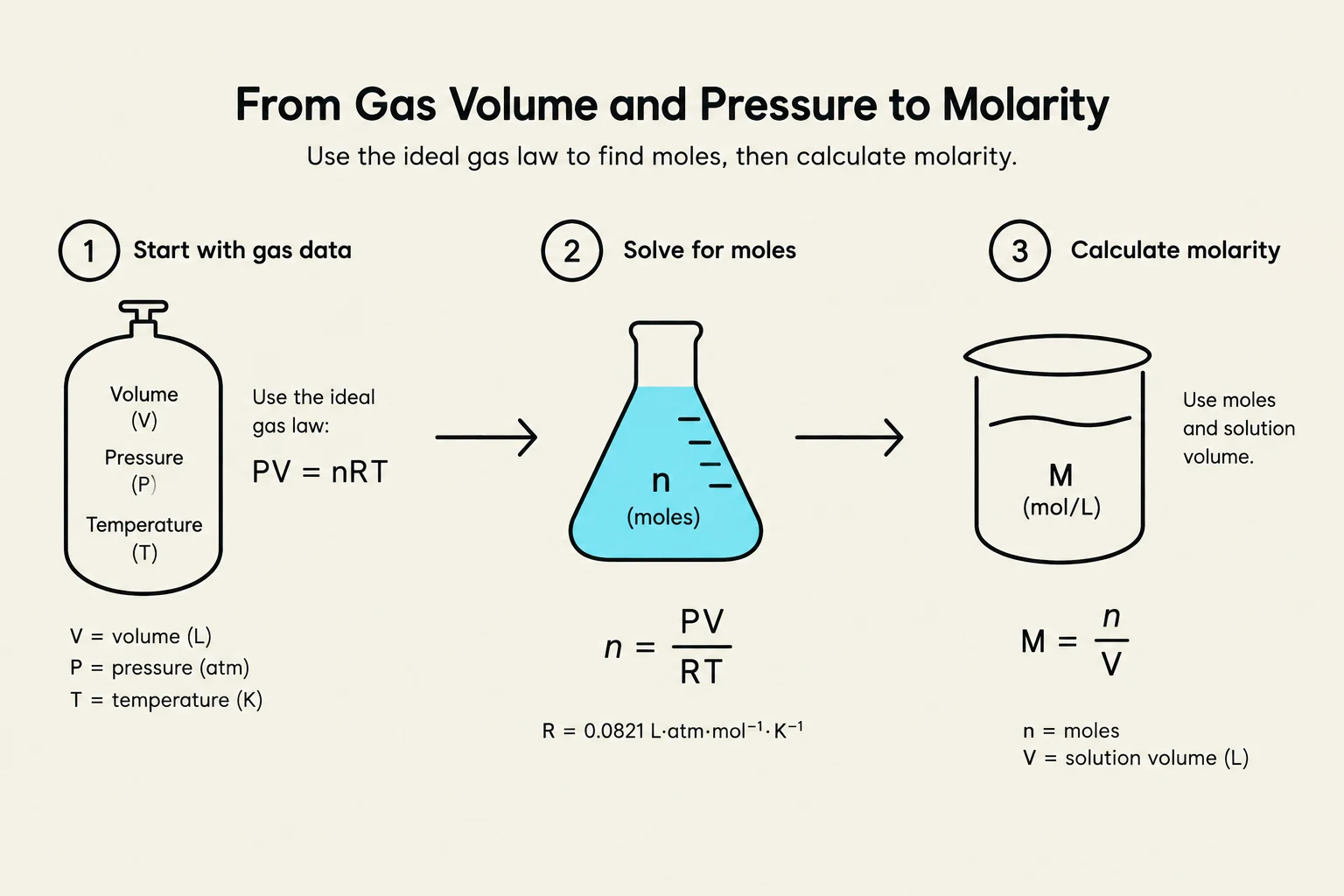
If you are given a gas and asked to find its concentration when dissolved in a specific volume of water, you must first use the Ideal Gas Law to find the number of moles (n) of that gas.
This diagram illustrates the process of calculating molarity from gas volume and pressure using the ideal gas law. It shows three steps: starting with gas data, solving for moles, and finally calculating molarity.
Reaction Stoichiometry with Gases
Stoichiometry is the calculation of relative quantities of reactants and products in a chemical reaction. When gases are involved, the process often requires a two-step approach:
Use the Ideal Gas Law to convert the given gas properties (Volume, Pressure, Temperature) into moles (n).
Use the stoichiometric coefficients from the balanced chemical equation to relate those moles to the desired product.
Worked Example: Limiting Reactant and Gas Stoichiometry
Problem: A 190.0 g sample of Fe3O4 reacts with 3.00 L of O2 at 1.50 atm and 35.0∘C to produce Fe2O3. Determine the maximum amount of Fe2O3 that could be produced.
Step 1: Convert O2 gas to moles
Using $PV = nRT$, where T=35.0+273.15=308.15 K and R=0.082 L⋅atm/(K⋅mol):
nO2=RTPV=(0.082)(308.0 K)(1.50 atm)(3.0 L)≈0.18 moles of O2(Note: The specific calculation in the source uses a slightly different rounding/constant approach to reach 0.18 moles).
Step 2: Use Stoichiometry
Based on the balanced equation (where 4 moles of Fe3O4 react with 3 moles of O2 to produce 4 moles of Fe2O3), you would compare the moles of Fe3O4 and O2 to find the limiting reactant and then calculate the mass of Fe2O3 produced.
Keep reading for free.
Create an account to finish this reading and make it part of your study routine.