Stoichiometry and Combustion Reaction Calculations
Learn how to perform stoichiometry calculations, including balancing chemical equations, converting between mass and moles, and identifying limiting reactants in combustion reactions.
Chemistry is often described as the "building blocks" of science, and mastering the ability to predict how much of a substance will be produced from a given amount of starting material is a fundamental skill. This process, known as stoichiometry, relies on our ability to write balanced chemical equations and use them as mathematical maps to navigate between different quantities of reactants and products.
Understanding Chemical Reactions
Before performing calculations, we must understand the nature of the reaction taking place. One common type is the double replacement reaction, where two compounds exchange components. These reactions are often driven by the formation of a precipitate (a solid that settles out of a solution), a gas, or a neutralization.
To describe these reactions accurately, chemists use different levels of equations:
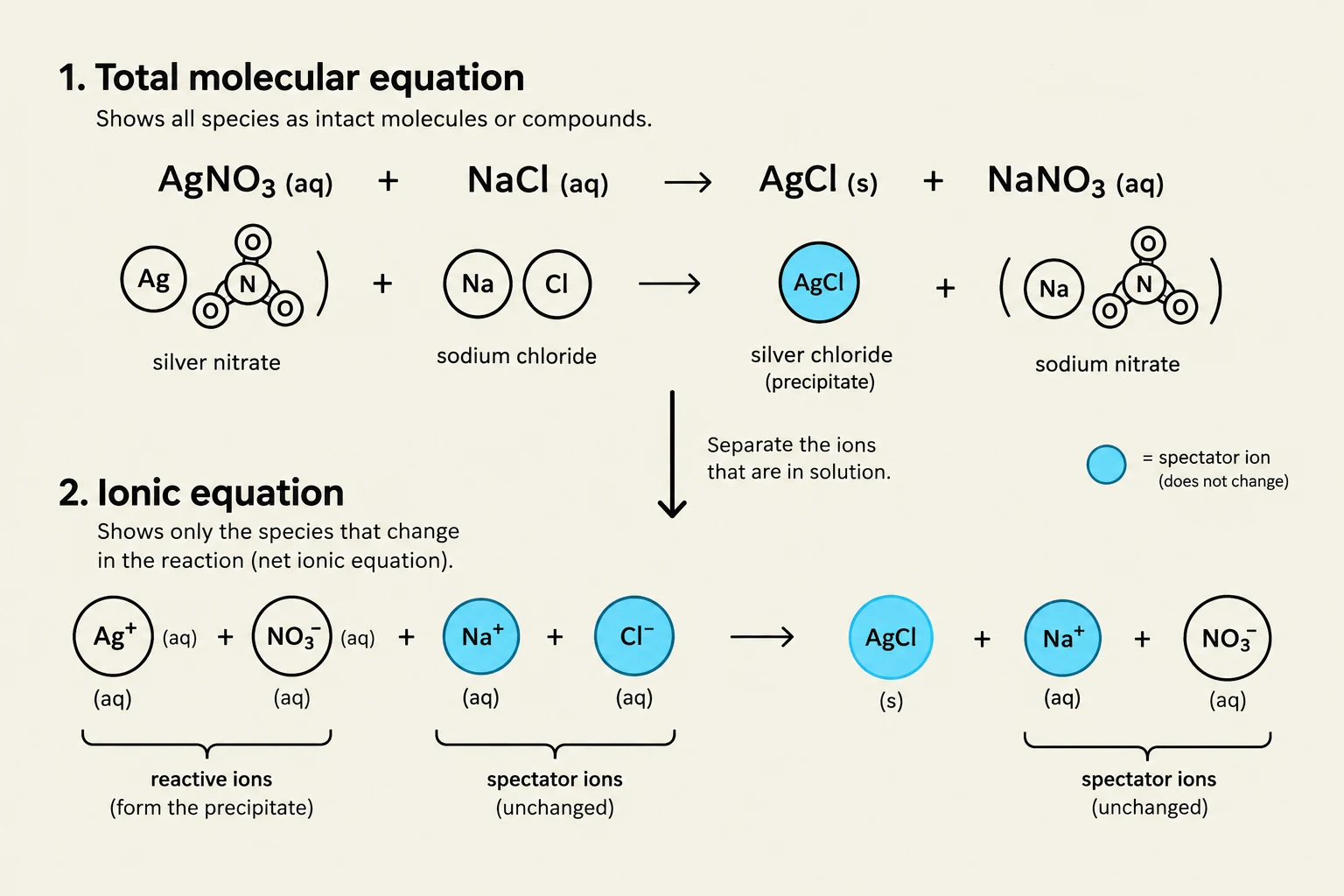
Total (Overall) Equation: Shows the molecular formulas of all reactants and products.
Ionic Equation: Shows which substances actually break apart into ions in water. For a substance to be written as ions, it must be aqueous (dissolved in water) and a strong electrolyte.
Net Ionic Equation: This is the most descriptive version. It removes "spectator ions"—ions that appear on both the reactant and product sides unchanged and do not participate in the actual chemical change.
Exam Tip: When writing ionic equations, remember that a substance only breaks into ions if it is both aqueous and a strong electrolyte. If a substance is a solid (precipitate), it stays together as a molecule in the equation.
This illustration shows the total molecular equation and the ionic equation for the reaction between silver nitrate and sodium chloride, resulting in the formation of silver chloride precipitate.
Stoichiometry in Combustion Reactions
A combustion reaction occurs when a fuel—often a hydrocarbon (a compound containing carbon and hydrogen)—reacts with oxygen (O2) to produce carbon dioxide (CO2) and water (H2O).
To solve stoichiometry problems involving combustion, you must follow a specific sequence of conversions. You cannot jump directly from the mass of one chemical to the mass of another; you must use the mole ratio provided by the balanced chemical equation as a bridge.
The Step-by-Step Conversion Process
If you are given the mass of a product and asked to find the mass of a reactant, follow these steps:
Balance the Equation: You cannot perform stoichiometry without a correct, balanced equation.
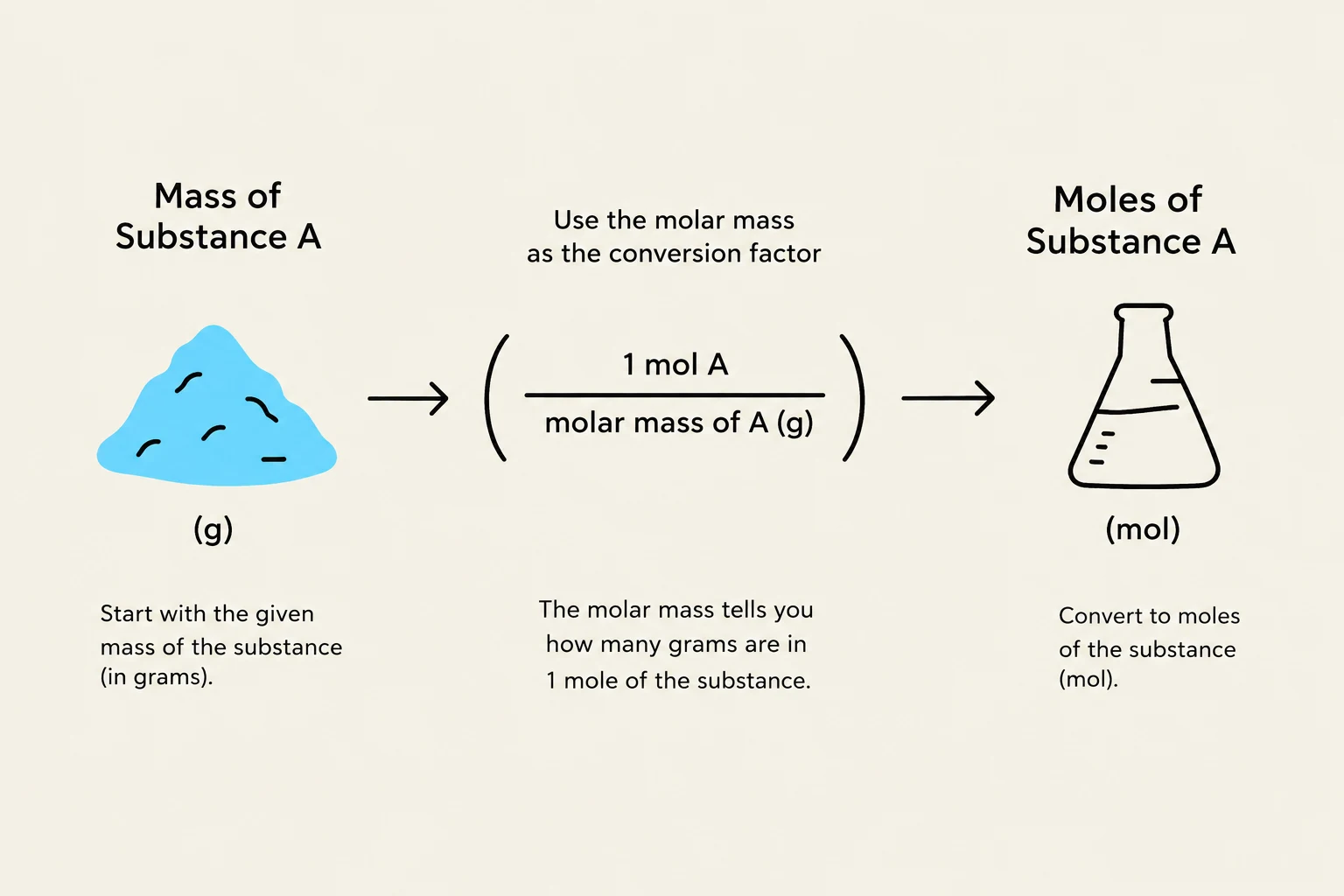
Convert Mass to Moles: Use the molar mass of the given substance to find the number of moles of molecules.
Use the Mole Ratio: Apply a conversion factor derived from the coefficients of the balanced equation to switch from the moles of the known substance to the moles of the unknown substance.
Convert Moles back to Mass: Use the molar mass of the target substance to find the final mass in grams.
Worked Example: Pinene Combustion
Problem: The odor of longleaf pine comes from the hydrocarbon pinene (C10H16). If 54.1 g of liquid water is produced through a combustion reaction, how many grams of liquid pinene did you start with?
Step 1: Balanced Equation
The skeleton reaction is C10H16+O2→CO2+H2O. After balancing:
C10H16+231O2→10CO2+8H2O
To avoid fractions, we can multiply everything by 2:
2C10H16+31O2→20CO2+16H2O
Step 2: The Calculation
We start with 54.1 g of H2O. We want to find grams of C10H16.
54.1 g H2O⋅(18.016 g H2O1 mol H2O)⋅(16 mol H2O2 mol C10H16)⋅(1 mol C10H16136.228 g C10H16)
Solving this yields approximately 51.1 g of pinene.
This diagram illustrates the conversion of mass of a substance in grams to moles using molar mass as a conversion factor.
Limiting Reactants
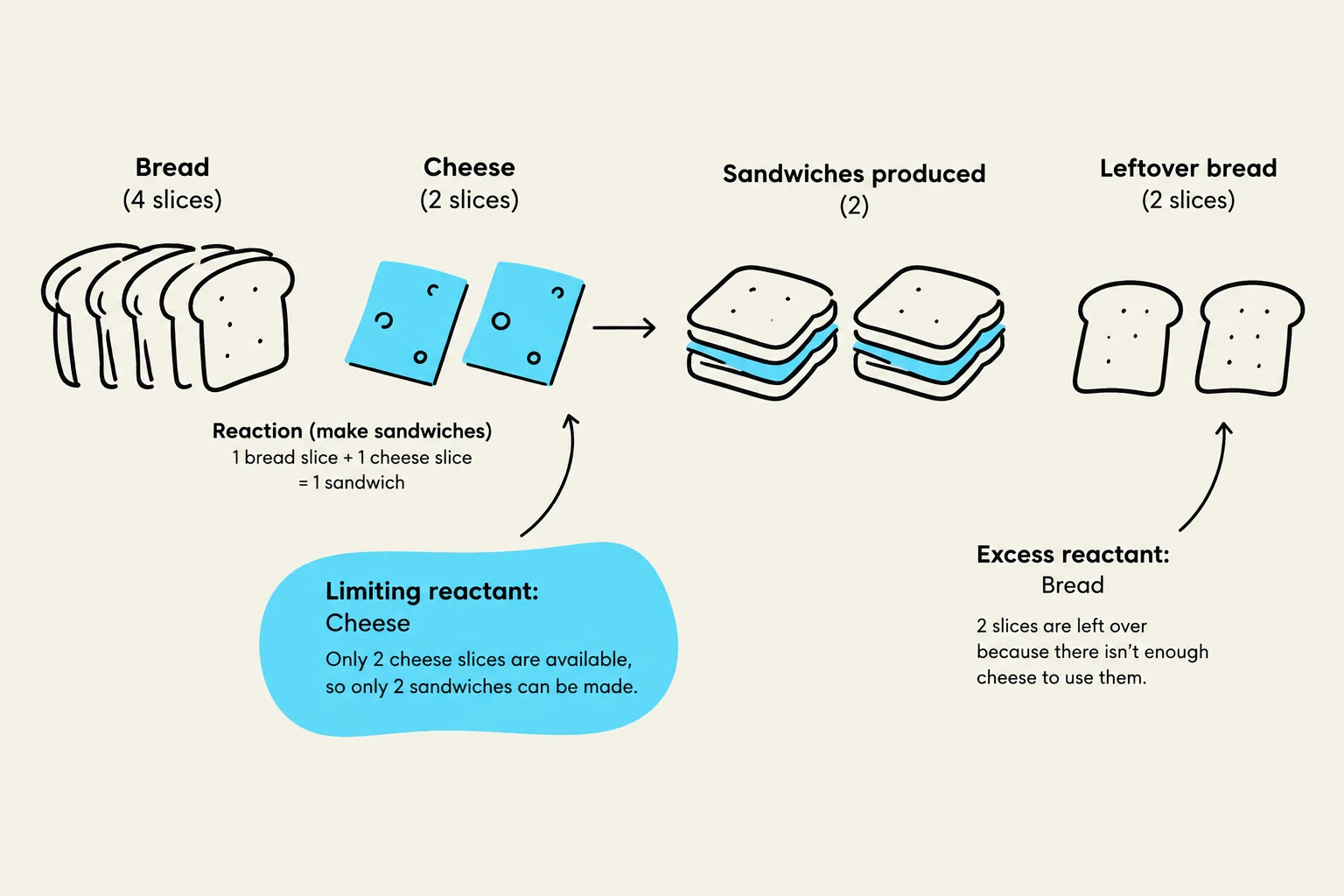
In many real-world scenarios, you aren't given an "unlimited" supply of one reactant. If you are given specific amounts for both reactants, one will run out before the other. This is known as the limiting reactant.
The limiting reactant is the substance that is completely consumed first. It "limits" how much product can be formed. The other reactant, which remains after the reaction stops, is called the excess reactant.
How to Identify the Limiting Reactant
To find the limiting reactant, you must calculate how much product each reactant could theoretically produce. The reactant that produces the smallest amount of product is your limiting reactant.
Exam Tip: If a problem provides you with the starting amounts of two different reactants, it is an "alarm bell" that you must check for a limiting reactant.
Worked Example: Iron Sulfide and Oxygen
Problem: What is the limiting reactant when 5.1 moles of FeS2 reacts with 5.1 moles of O2? How many moles of SO2 are produced?
Conclusion: Since the oxygen produces less SO2 (3.7 mol vs 10.2 mol), O2 is the limiting reactant.
This diagram illustrates the concept of limiting reactants in a chemical reaction, using the example of making sandwiches. It shows that with 4 slices of bread and 2 slices of cheese, and a reaction requiring 1 slice of bread and 1 slice of cheese per sandwich, only 2 sandwiches can be made because the cheese is the limiting reactant. This leaves 2 slices of bread as excess reactant.
Keep reading for free.
Create an account to finish this reading and make it part of your study routine.