Steady State and Non-Steady State Diffusion in Materials Science
Explores the fundamental principles of diffusion in materials science, covering mechanisms like vacancy and interstitial diffusion, Fick's laws, and the temperature dependence of diffusivity. Includes industrial applications.
Diffusion is a fundamental process in materials science where one type of atom is transported through the crystal structure of another. While it may seem like a slow process in solids due to strong atomic bonds, thermal atomic vibrations allow atoms to move, facilitating essential engineering processes such as doping silicon chips or hardening steel. Understanding how these atoms move requires a distinction between two primary conditions: steady state and non-steady state diffusion.
Mechanisms of Atomic Diffusion
Before diving into the mathematical laws, we must understand how atoms move through a solid lattice. There are two primary mechanisms:
Vacancy or Substitutional Diffusion: In this mechanism, an atom moves from its original position into an adjacent vacancy (an empty lattice site). This is often referred to as "self-diffusion" when the diffusing atom is the same species as the host lattice. For this to occur, the atom must possess enough energy to overcome the activation energy barrier, ΔE∗.
Interstitial Diffusion: Here, smaller atoms move from one interstitial site (the space between host atoms) to another. Because these atoms are much smaller than the host atoms, they do not require vacancies to move, as the interstitial spaces themselves act as intrinsic vacancies.
Exam Tip: Remember that interstitial diffusion is generally much faster than substitutional diffusion because the diffusing atoms are smaller and do not need to wait for a vacancy to become available.
This illustration depicts two types of atomic diffusion: substitutional diffusion, where an atom replaces a host atom in a vacancy, and interstitial diffusion, where an atom moves through the spaces between host atoms.
Steady State Diffusion and Fick's First Law
Steady state diffusion occurs when the concentration of solute atoms at any given plane in a system does not change over time. In this state, there is a constant net flow of atoms, but no chemical reaction is taking place.
The rate of this movement is described by Fick's First Law. To understand this law, we must define two key terms:
Flux (J): The net flow of atoms per unit area per unit time (measured in atoms/(m2⋅s)).
Concentration Gradient (dxdc): The change in concentration (c) over a specific distance (x).
Fick's First Law is expressed mathematically as:
J=−Ddxdc
Where D is the diffusivity (or diffusion coefficient). The negative sign is critical; it indicates that diffusion occurs from regions of high concentration to regions of low concentration, following the negative slope of the concentration gradient.
Non-Steady State Diffusion and Fick's Second Law
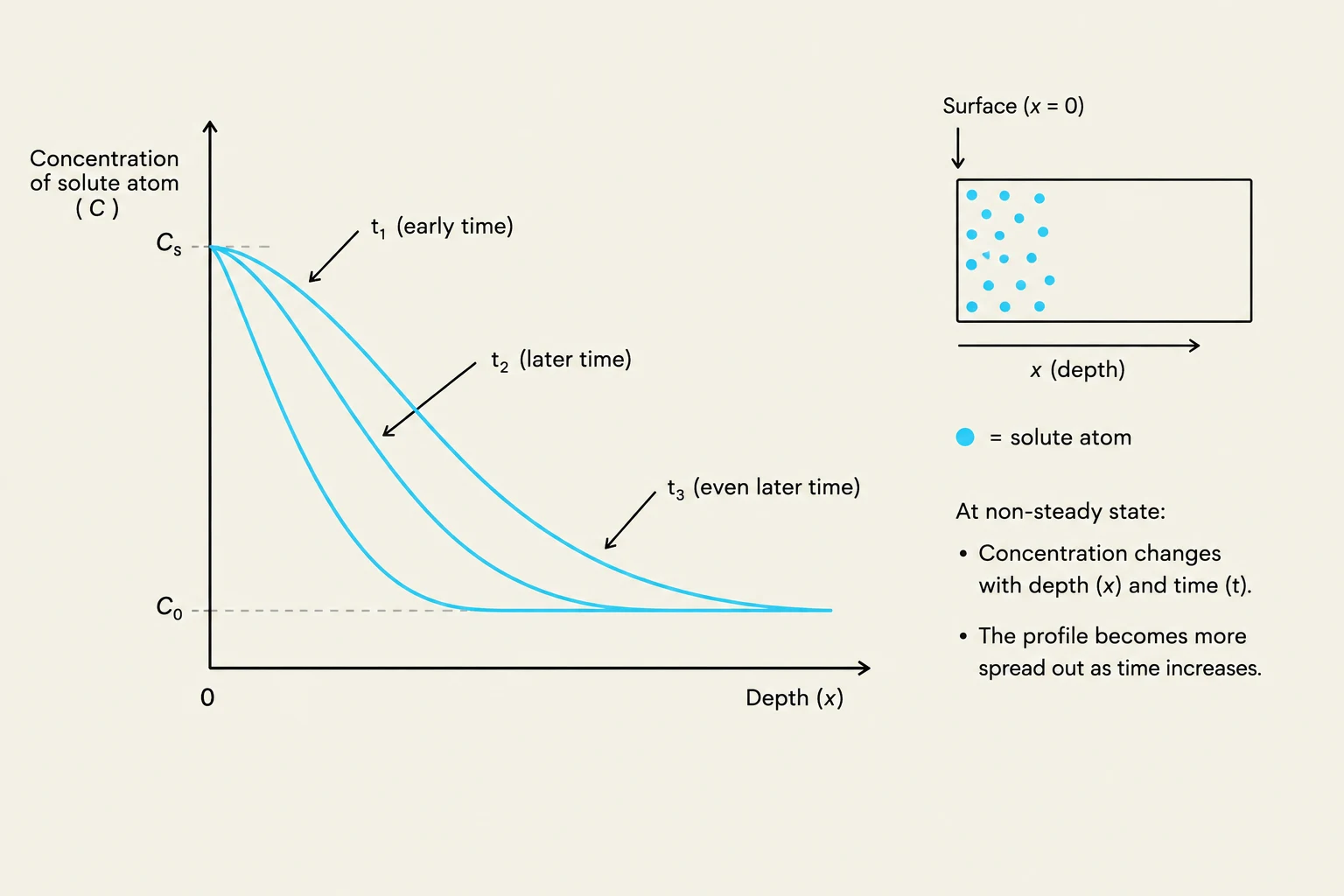
In many real-world applications, the concentration of solute atoms at a specific point does change over time. This is known as non-steady state diffusion. A classic example is when you expose a metal surface to a gas; the concentration of that gas deep within the metal will increase as time passes.
To model this, we use Fick's Second Law, which states that the rate of compositional change is proportional to the diffusivity times the rate of change of the concentration gradient:
∂t∂C=D∂x2∂2C
For a common case where a solid is exposed to a constant surface concentration (Cs), the solution to this equation is:
Cs−C0Cx−C0=1−erf(2Dtx)
Where:
Cx = Concentration at distance x from the surface.
C0 = Initial uniform concentration within the solid.
Cs = Constant surface concentration.
x = Distance from the surface.
t = Time.
erf = The error function.
This graph illustrates the diffusion of solute atoms into a material over time. The x-axis represents depth, and the y-axis represents the concentration of solute atoms. The curves show how the concentration profile changes at different time points (t1, t2, t3), indicating that the solute spreads out further into the material as time increases. The diagram on the right visually depicts solute atoms diffusing into a surface.
Temperature Dependence and Diffusivity
The diffusivity (D) is not a fixed constant; it is highly sensitive to several factors, most notably temperature. As temperature increases, atoms acquire more thermal energy, making it easier to overcome the activation energy (Q) required for movement.
The relationship between diffusivity and temperature follows the Arrhenius equation:
D=D0exp(−RTQ)
Or, in logarithmic form:
ln(D)=ln(D0)−RTQ
Where:
D0 = Proportionality constant.
Q = Activation energy (J/mol).
R = Molar gas constant (8.314 J/mol⋅K).
T = Absolute temperature in Kelvin (K).
Mathematical Tip: If you are given diffusivity values at two different temperatures, you can solve for both Q and D0 by setting up a system of two equations based on the Arrhenius relationship.
Industrial Applications
Diffusion is not just a theoretical concept; it is a cornerstone of modern manufacturing:
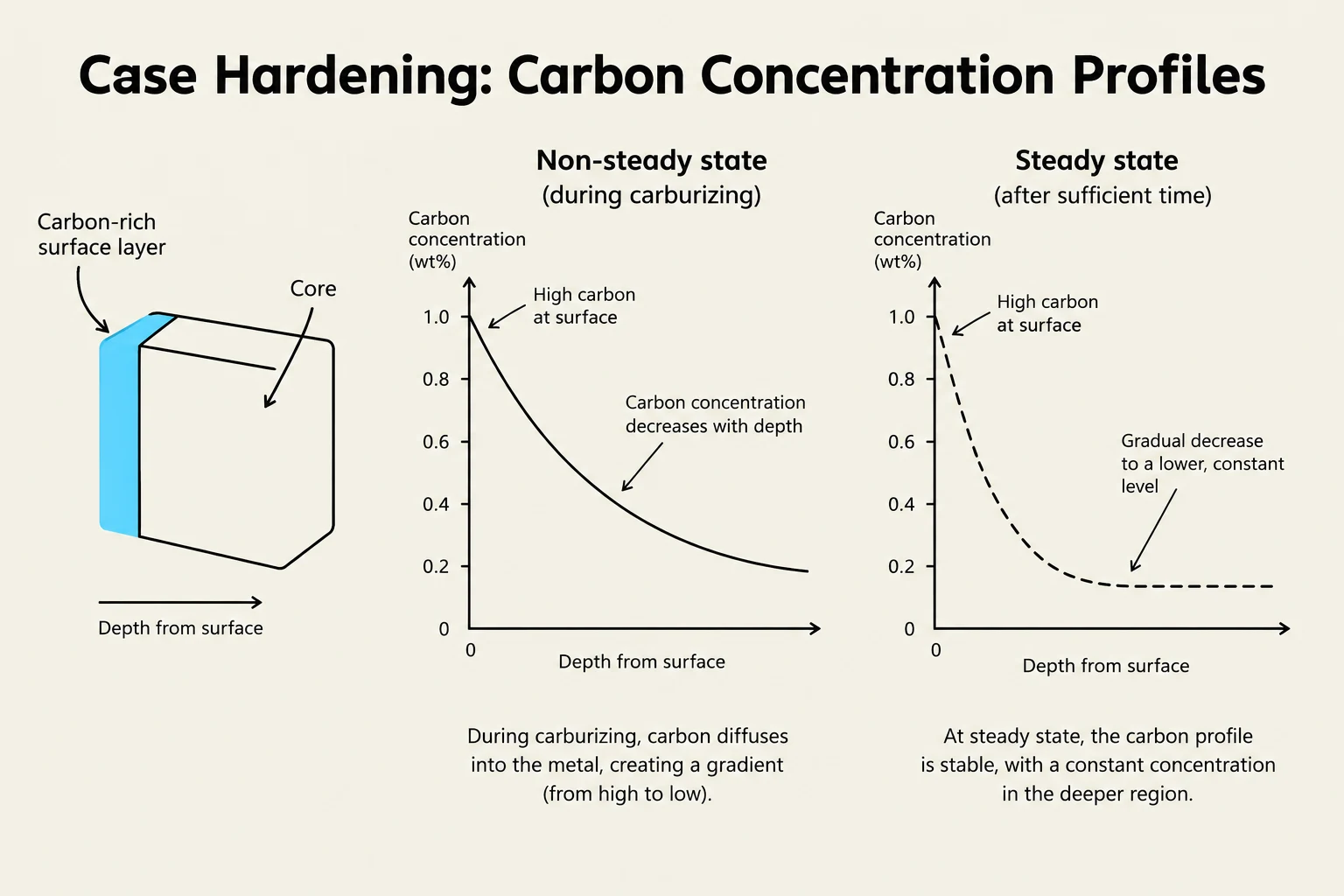
Case Hardening (Gas Carburization): To make steel parts (like gear teeth) resistant to wear, they are heated in a hydrocarbon gas atmosphere (e.g., CH4). Carbon atoms diffuse into the interstitial spaces of the iron surface, creating a hard "case" while maintaining a tough core.
Impurity Diffusion in Semiconductors: In the production of integrated circuits, silicon wafers are exposed to impurity vapors at high temperatures (e.g., 1100∘C). This allows engineers to precisely control the electrical characteristics of the silicon by diffusing impurities like phosphorus or aluminum into specific depths.
This illustration depicts carbon concentration profiles in a material undergoing case hardening. It shows the difference between non-steady state (during carburizing) and steady state conditions, illustrating how carbon concentration changes with depth from the surface.
Keep reading for free.
Create an account to finish this reading and make it part of your study routine.