An overview of the states of matter, phase transitions, and the fundamental gas laws (Boyle's, Charles's, Avogadro's) that describe the behavior of gases, including pressure units and the Ideal Gas Law.
Matter is the fundamental substance of the universe, and it exists in several distinct forms known as states. While we most commonly encounter solids, liquids, and gases, plasma is also a recognized state of matter. These states are differentiated by two main factors: the physical behavior of the substance and the strength of the interactions (intermolecular forces) between its constituent particles, such as atoms, molecules, or ions.
The States of Matter and Phase Changes
The transition between different states is driven by temperature and the strength of the forces holding particles together.
Solids: At low temperatures, the motion of molecules is greatly restricted.
Liquids: At temperatures between the freezing and boiling points, molecules possess limited movement.
Gases: At temperatures above the boiling point, molecules leave the liquid phase and become largely free to move around.
The specific temperatures at which these transitions occur are known as the melting and boiling points. These points are not arbitrary; they depend directly on the strength of the intermolecular forces within the substance.
Phase Transitions
When matter changes from one state to another, we use specific terminology:
Vaporisation: The conversion of a liquid into a gas.
Condensation: The conversion of a gas into a liquid.
Kinetic Molecular Theory and Gas Behavior
To understand why gases behave so differently from solids or liquids, we look to the Kinetic Molecular Theory. This theory suggests that at any temperature above absolute zero, atoms and molecules are in constant motion.
In a gas, the individual particles are free to move anywhere within their container because the forces between them are very weak. This freedom of movement leads to a defining characteristic of gases: pressure.
At the molecular level, pressure is the collective result of countless, never-ending collisions between molecules and the walls of their container.
A diagram illustrating random particle paths within a confined space.
Measuring Gas Pressure
Pressure (P) is defined as force per unit area. Because scientists work in different contexts, several units are used to express pressure:
Unit
Symbol/Description
Equivalence to 1 atm
Pascal
Pa (SI unit, 1 N m−2)
1 atm=1.013×10⁵ Pa
Atmosphere
atm
1 atm
Torr
torr
1 atm=760 torr
Millimeters of Mercury
mm Hg
1 atm=760 mm Hg
Bar
bar
1 bar=0.9872 atm
Atmospheric Pressure and the Barometer
We live at the bottom of a "sea" of air. The weight of this air pressing down on us is known as atmospheric pressure. To measure this, we use a device called a barometer.
In a mercury barometer, mercury flows out of a tube until the pressure exerted by the column of mercury standing in the dish is exactly equal to the pressure of the air pushing on the rest of the mercury's surface.
Exam Tip: Unit Conversions
Always check your units before starting a calculation. If a problem gives you pressure in torr but asks for an answer in atm, use the conversion factor 760 torr1 atm to ensure accuracy.
The Gas Laws
The behavior of an "ideal gas" can be described by several fundamental laws that relate pressure (P), volume (V), temperature (T), and the number of moles (n).
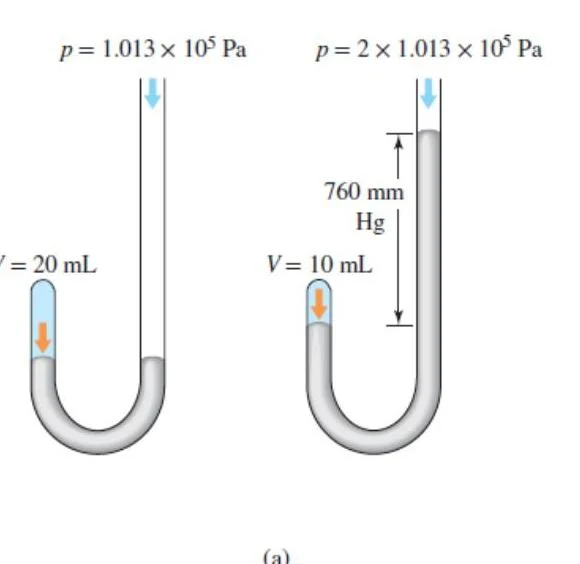
Boyle's Law: Pressure and Volume
Boyle's Law states that at a constant temperature and number of moles, pressure and volume are inversely proportional. This means if you double the pressure, the volume is halved.
P1×V1=P2×V2
Diagram illustrating the effect of pressure on the volume of a gas in a U-tube manometer.
Charles's Law: Volume and Temperature
Charles's Law states that volume is directly proportional to the absolute temperature (measured in Kelvin) when pressure and moles are constant.
T1V1=T2V2
Crucial Note: When using gas laws involving temperature, you must convert Celsius to Kelvin using the formula: T(K)=T(∘C)+273.15.
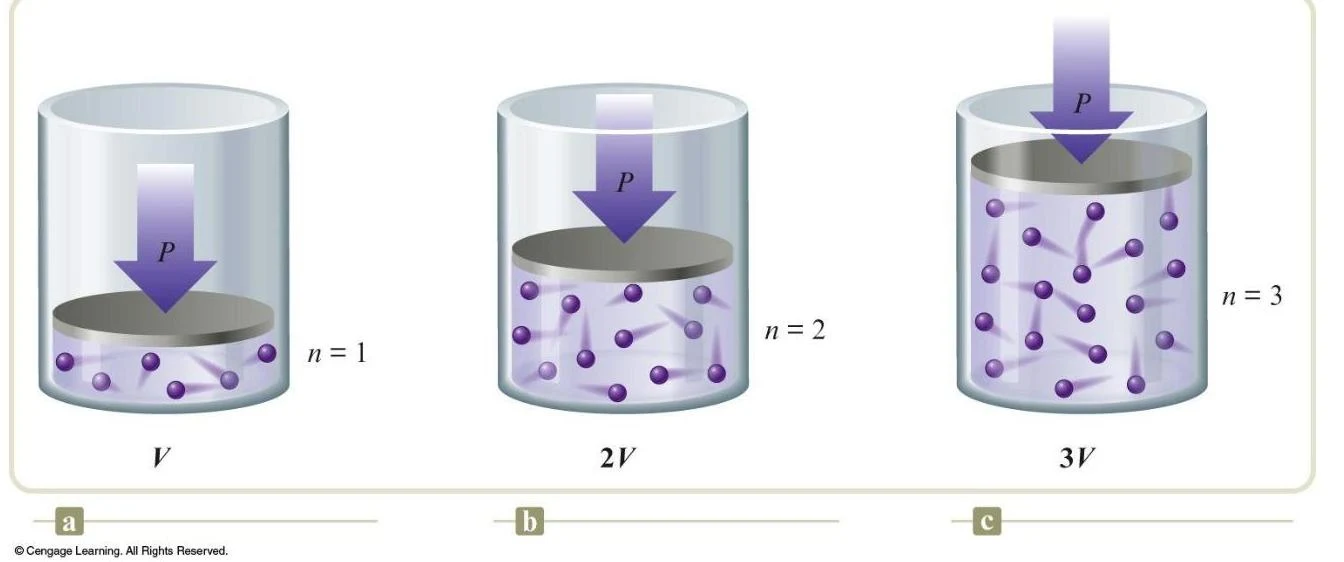
Avogadro's Law: Volume and Moles
Avogadro's Law states that gas volume is directly proportional to the amount of gas (moles) present, provided temperature and pressure remain constant.
n1V1=n2V2
This illustration shows three cylinders with pistons. Each cylinder contains gas particles. In the first cylinder, labeled V, there are few particles and the piston is at the top. In the second cylinder, labeled 2V, the piston is lower, compressing the gas, and there are more particles. In the third cylinder, labeled 3V, the piston is even lower, further compressing the gas, and there are the most particles. The letter P indicates pressure applied by the piston.
The Ideal Gas Equation
By combining these individual laws, we arrive at the Ideal Gas Law, which relates all four variables in a single equation:
$PV = nRT$
Where R is the universal gas constant. Depending on your units, R will vary:
R=0.08206 L⋅atm/(mol⋅K)
R=8.314 J/(mol⋅K)
Worked Example: Finding Moles
Problem: An automobile tire at 23∘C with an internal volume of 25.0 L is filled with air to a total pressure of 3.18 atm. Determine the number of moles of air in the tire.
Solution:
First, convert temperature to Kelvin: 23+273=296 K.
Rearrange the ideal gas law to solve for n:
n=RTPVn=(0.08206mol⋅KL⋅atm)(296 K)(3.18 atm)(25.0 L)n=3.27 mol
Gas Density
The density (ρ) of a gas—the mass divided by its volume—can also be derived from the ideal gas law. By substituting molar mass (M) into the equation, we find:
ρgas=Vm=RTPM
From this relationship, we can conclude that:
Gas density is proportional to pressure.
Gas density is inversely proportional to temperature.
Gas density is proportional to the molar mass of the gas.
A collection of hot air balloons ascend into a clear blue sky.
Keep reading for free.
Create an account to finish this reading and make it part of your study routine.