Standard Precautions in Healthcare: A Guide to Infection Control
This guide explains Standard Precautions, a fundamental infection control principle in healthcare. It covers hand hygiene, Personal Protective Equipment (PPE), transmission-based precautions, aseptic techniques, sharps safety, and recognizing infection cues to ensure client and clinician safety.
In the healthcare environment, the safety of both the clinician and the client relies on a fundamental principle: treating every individual as a potential source of infection. This approach is known as Standard Precautions. Rather than waiting for a confirmed diagnosis of a contagious disease, healthcare providers apply these universal measures to all clients, regardless of their known infection status. By anticipating exposure to blood, body fluids, secretions, excretions (excluding sweat), nonintact skin, and mucous membranes, nurses create a consistent barrier against the transmission of pathogens.
The Core Principles of Standard Precautions
Standard precautions are designed to break the "Chain of Infection". To understand why these precautions are necessary, one must recognize that an infectious agent requires a reservoir (like a person), a portal of exit (like a cough), a mode of transmission (like contact), and a portal of entry (like a broken wound) to spread.
The primary tools for implementing standard precautions include hand hygiene, the use of Personal Protective Equipment (PPE), and safe environmental practices.
Hand Hygiene: The First Line of Defense
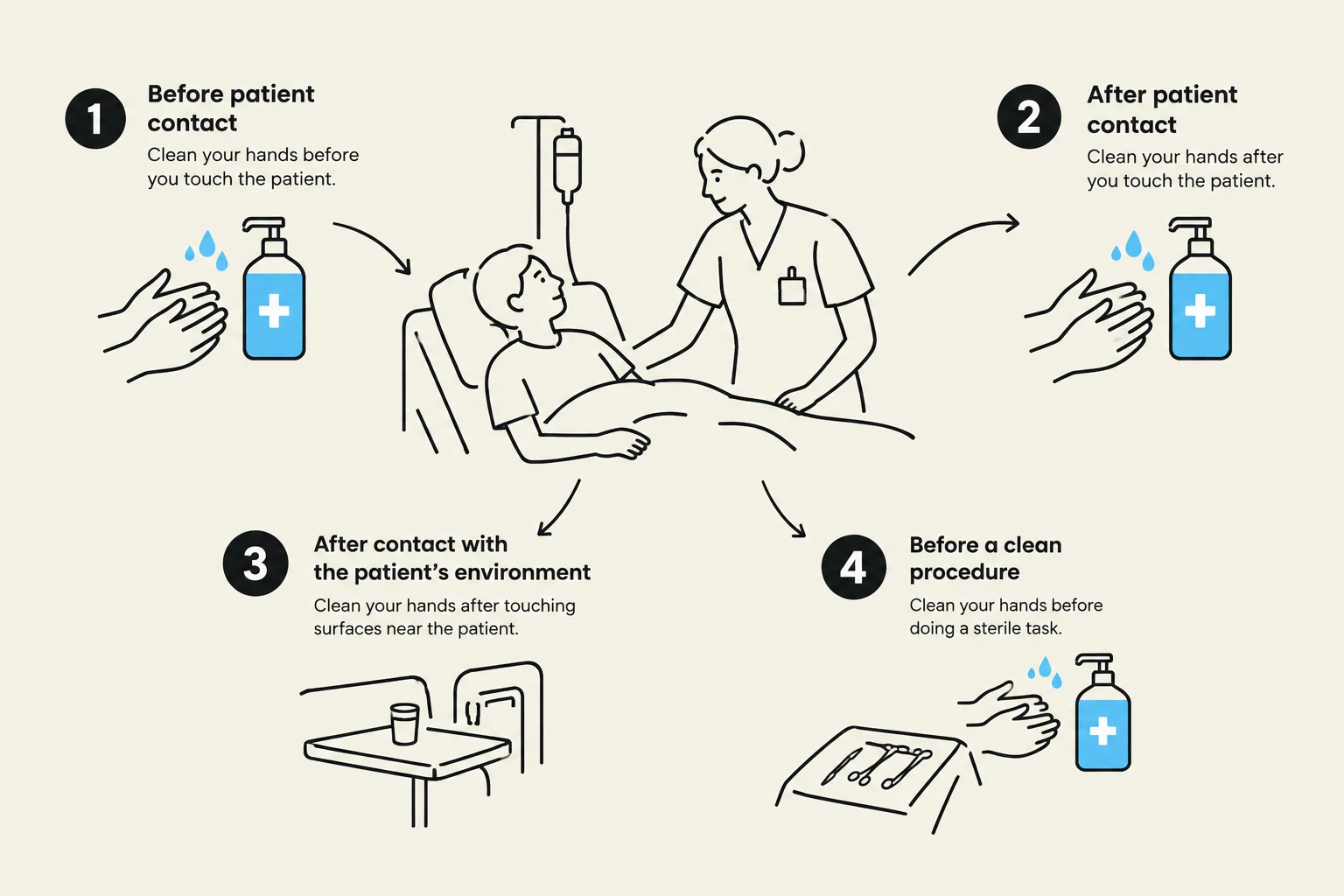
Hand hygiene is the most effective way to prevent the spread of microorganisms. Nurses must perform hand hygiene:
Before touching a client.
Before performing clean or aseptic tasks.
After any risk of body-fluid exposure.
After touching a client.
After touching the client’s immediate surroundings.
While alcohol-based hand sanitizers are generally preferred for speed and efficacy when hands are not visibly soiled, soap and water must be used when hands are visibly dirty or when caring for clients with specific organisms like C. difficile.
Exam Tip: Remember that gloves are not a substitute for hand hygiene. You must perform hand hygiene immediately after removing gloves.
This illustration outlines the recommended hand hygiene practices for healthcare professionals, emphasizing cleaning hands before and after patient contact, after touching the patient's environment, and before performing sterile procedures.
Personal Protective Equipment (PPE)
The choice of PPE depends entirely on the expected exposure during a task. Common items include:
Gloves: Protect hands from blood and body fluids.
Gowns: Protect skin and clothing from splashes or sprays.
Masks and Eye Protection: Protect the mucous membranes of the eyes, nose, and mouth.
When "donning" (putting on) PPE, the sequence often follows: gown, then mask/respirator, then eye protection, and finally gloves. When "doffing" (taking off), the most contaminated items—usually the gloves—are removed first to avoid contaminating the nurse's skin.
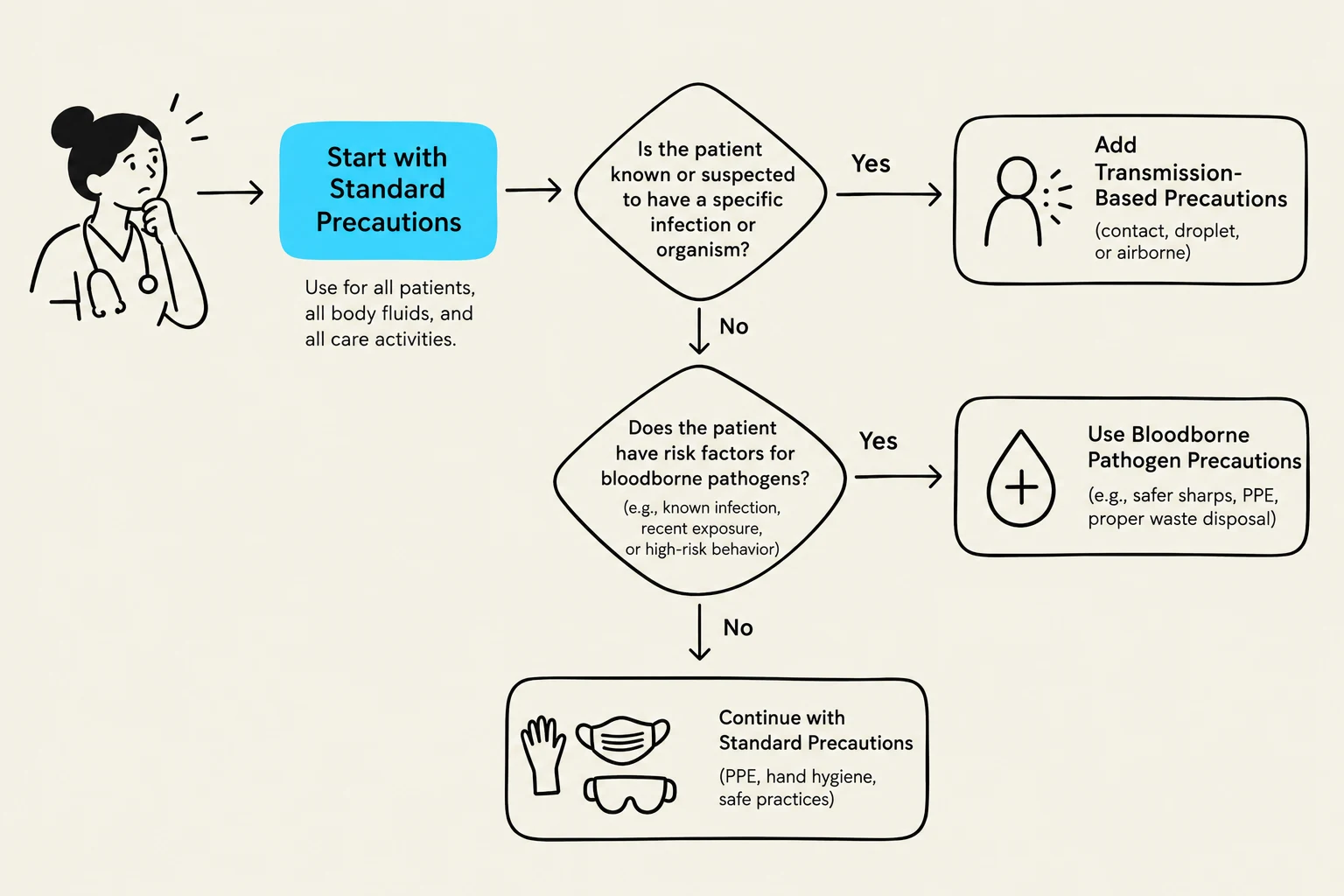
While standard precautions are used for everyone, certain diseases require additional, specific measures known as Transmission-Based Precautions. These are categorized by how the pathogen moves.
Precaution Type
Typical Spread
Common PPE / Approach
Examples
Contact
Direct touch or contaminated surfaces
Gown and gloves on entry; dedicated equipment
C. difficile, norovirus
Droplet
Large respiratory particles (short distance)
Surgical/procedure mask; eye protection
Influenza, Pertussis
Airborne
Small particles that remain suspended in air
Fit-tested N95 respirator; negative pressure room
Tuberculosis, Measles
Clinical Note: Always verify disease-specific protocols with your facility's policy. While core routes of transmission are standard, specific PPE requirements can vary by institution.
This flowchart outlines the steps for determining appropriate patient precautions in a healthcare setting, starting with standard precautions and progressing to transmission-based or bloodborne pathogen precautions based on patient risk factors and potential infections.
Maintaining Asepsis and Environmental Safety
Infection control is not limited to what the nurse wears; it extends to how they handle the environment and medical devices.
Medical vs. Surgical Asepsis
Nurses must distinguish between "clean" and "sterile" techniques:
Medical Asepsis (Clean Technique): Aims to reduce the number and spread of microorganisms (e.g., hand hygiene, routine cleaning).
Surgical Asepsis (Sterile Technique): Aims to eliminate all microorganisms, including spores. This is used for invasive procedures and sterile fields.
A sterile field is compromised if an item touches a non-sterile surface, falls below waist level, or becomes wet through "strike-through". If sterility is ever in doubt, treat the item as contaminated and replace it.
Sharps Safety and Device Care
To prevent needlestick injuries, sharps must be disposed of immediately in approved, puncture-resistant containers. Never recap a used needle using two hands; if necessary, use the "scoop" technique.
Furthermore, maintaining the integrity of invasive devices (like catheters or drains) is vital for preventing Healthcare-Associated Infections (HAIs). This includes:
Using aseptic technique for all invasive procedures.
Reviewing the necessity of lines and catheters regularly to support timely removal.
Keeping dressings clean, dry, and intact.
Recognizing Infection in the Client
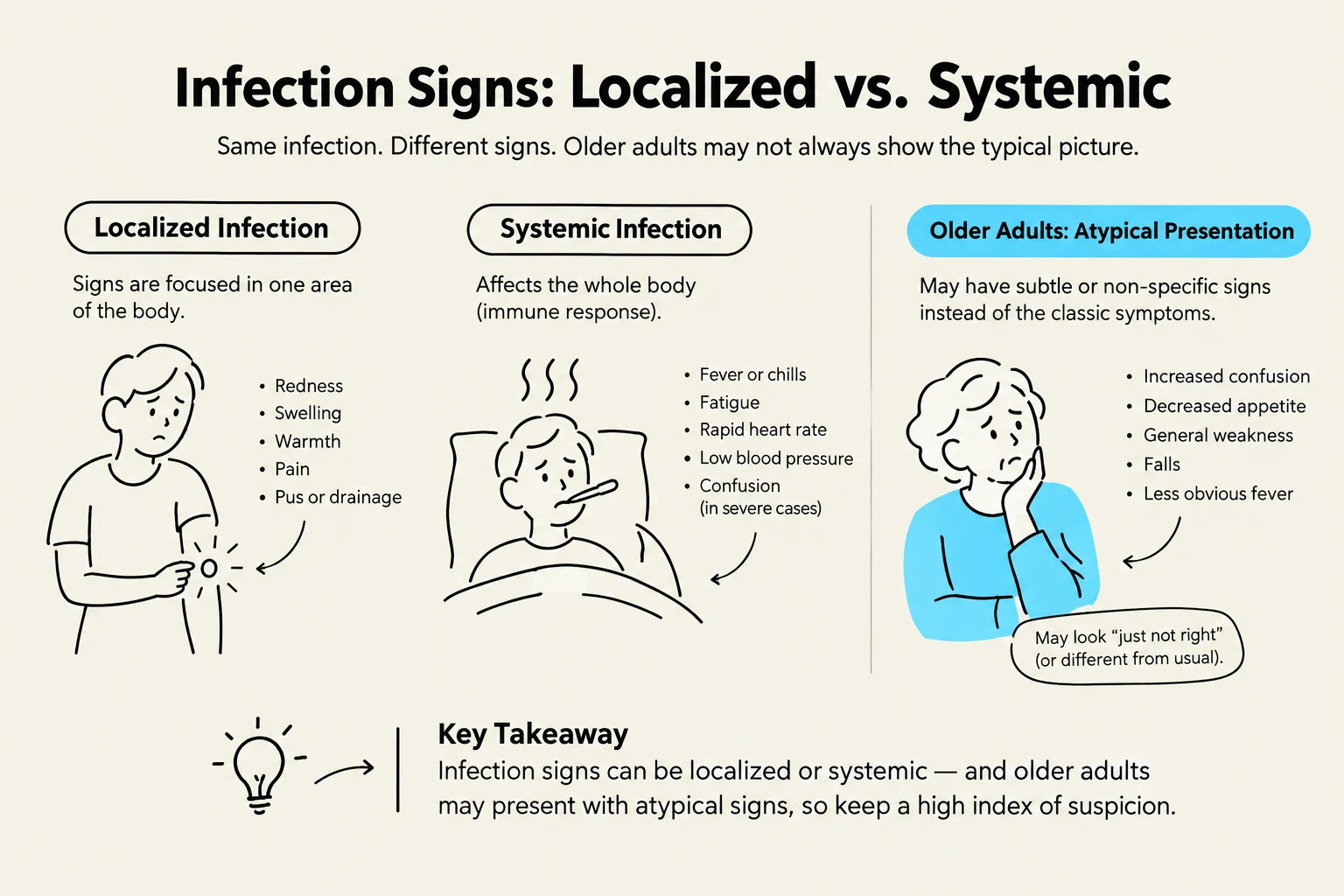
Part of applying standard precautions is being able to recognize when they may need to be escalated due to a client's changing condition. Nurses should monitor for "infection cues," which can be localized or systemic.
Localized Cues: Redness, warmth, swelling, pain, or purulent (pus-like) drainage at a specific site.
Systemic Cues: Fever, chills, new confusion (especially in older adults), or changes in vital signs.
This illustration differentiates between localized and systemic infections, detailing their respective signs and symptoms. It also highlights how older adults may exhibit atypical presentations of infections.
Clinical Judgment Reminder: In older adults or immunocompromised clients, the absence of a high fever does not rule out infection. Always assess for subtle or atypical signs, such as new confusion.
When an infection is suspected, the nurse must assess the client, trend the findings, implement appropriate precautions, and notify the clinician promptly.
Keep reading for free.
Create an account to finish this reading and make it part of your study routine.