Stability of Disubstituted Cyclohexane Stereoisomers
Explains constitutional isomers versus stereoisomers, the role of chair conformations and ring flips in determining stability, and analyzes the stability of 1,2-, 1,3-, and 1,4-disubstituted cyclohexanes based on substituent positions.
In organic chemistry, understanding the three-dimensional shape of molecules is essential for predicting how they behave and interact. When dealing with substituted cyclohexanes, we must look beyond simple two-dimensional drawings to understand how substituents occupy space. The stability of these molecules is not random; it is a direct consequence of how substituents are positioned relative to the ring and to each other within the molecule's preferred chair conformation.
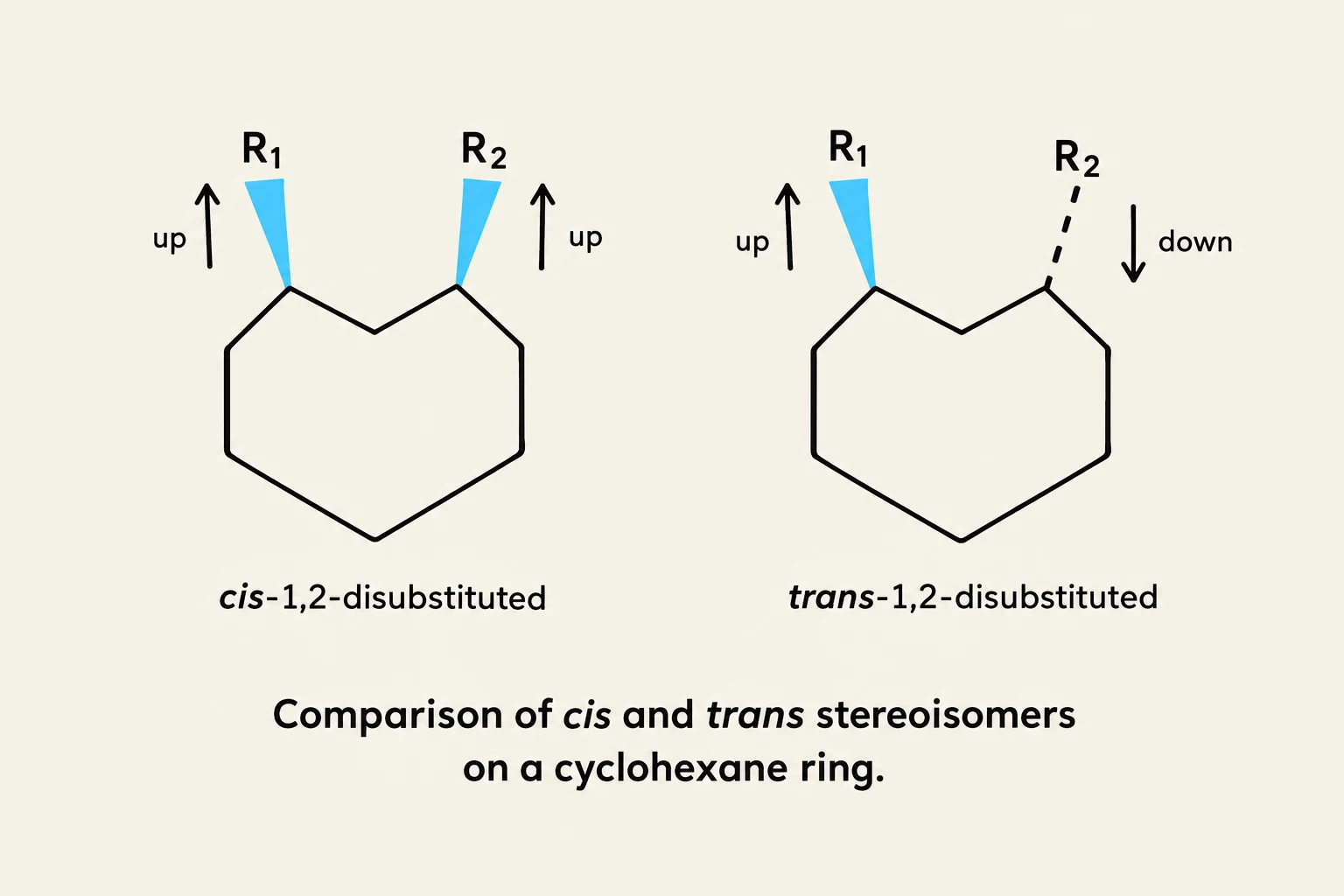
Comparison of cis and trans stereoisomers on a cyclohexane ring.
Constitutional Isomers vs. Stereoisomers
Before analyzing stability, it is crucial to distinguish between the two types of isomers found in substituted cyclic compounds:
Constitutional Isomers: These molecules have the same molecular formula but different "connections." This means the substituents are attached to different carbon atoms on the ring (for example, a 1,2-disubstituted isomer versus a 1,3-disubstituted isomer).
Stereoisomers: These molecules have the same connections (the same atoms are attached to the same carbons), but they differ in their spatial orientation.
Within stereoisomers, we specifically focus on cis-trans stereoisomers. In a cis isomer, both substituents point in the same direction (both "up" or both "down"). In a trans isomer, the substituents point in opposite directions (one "up" and one "down").
The Role of Chair Conformations and Ring Flips
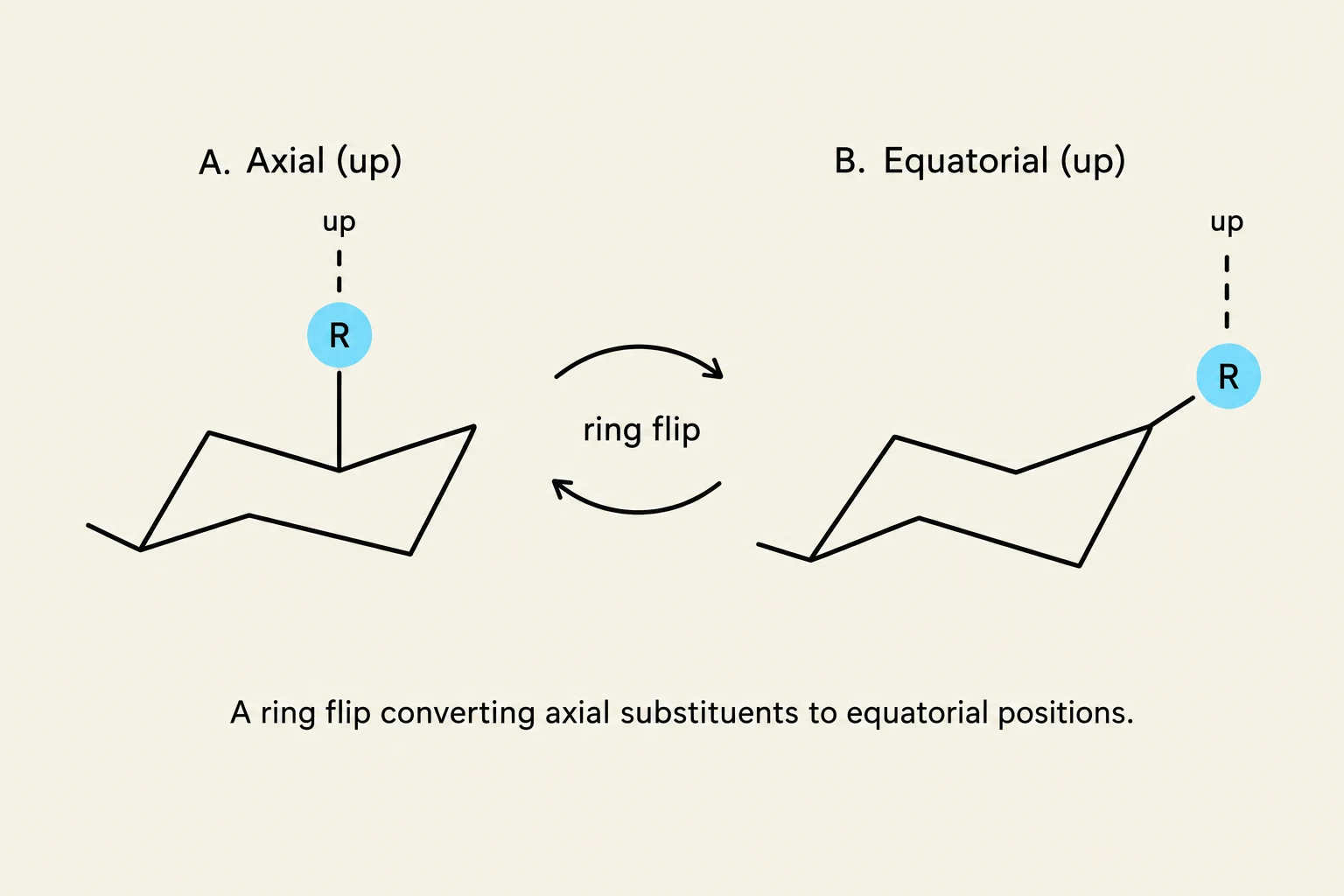
A diagram illustrating the ring flip in cyclohexane, showing the conversion of an axial substituent to an equatorial position.
Cyclohexane does not exist as a flat hexagon; instead, it adopts a chair conformation to minimize angle and torsional strain. In this conformation, the carbon atoms are arranged such that the substituents can occupy two distinct types of positions:
Equatorial Position: The substituent points outward around the "equator" of the ring.
Axial Position: The substituent points straight up or straight down, parallel to the axis of the ring.
A key concept in cyclohexane chemistry is the ring flip. During a ring flip, the entire molecule undergoes a conformational change where all substituents that were in axial positions become equatorial, and all equatorial substituents become axial. However, the "up/down" orientation of a group relative to the ring does not change during a flip; an "up" group remains "up," even if it moves from axial to equatorial.
The Golden Rule of Stability: The most stable conformation of a substituted cyclohexane is the one that minimizes strain by placing the maximum number of substituents in the equatorial position.
Analyzing Disubstituted Cyclohexane Stability
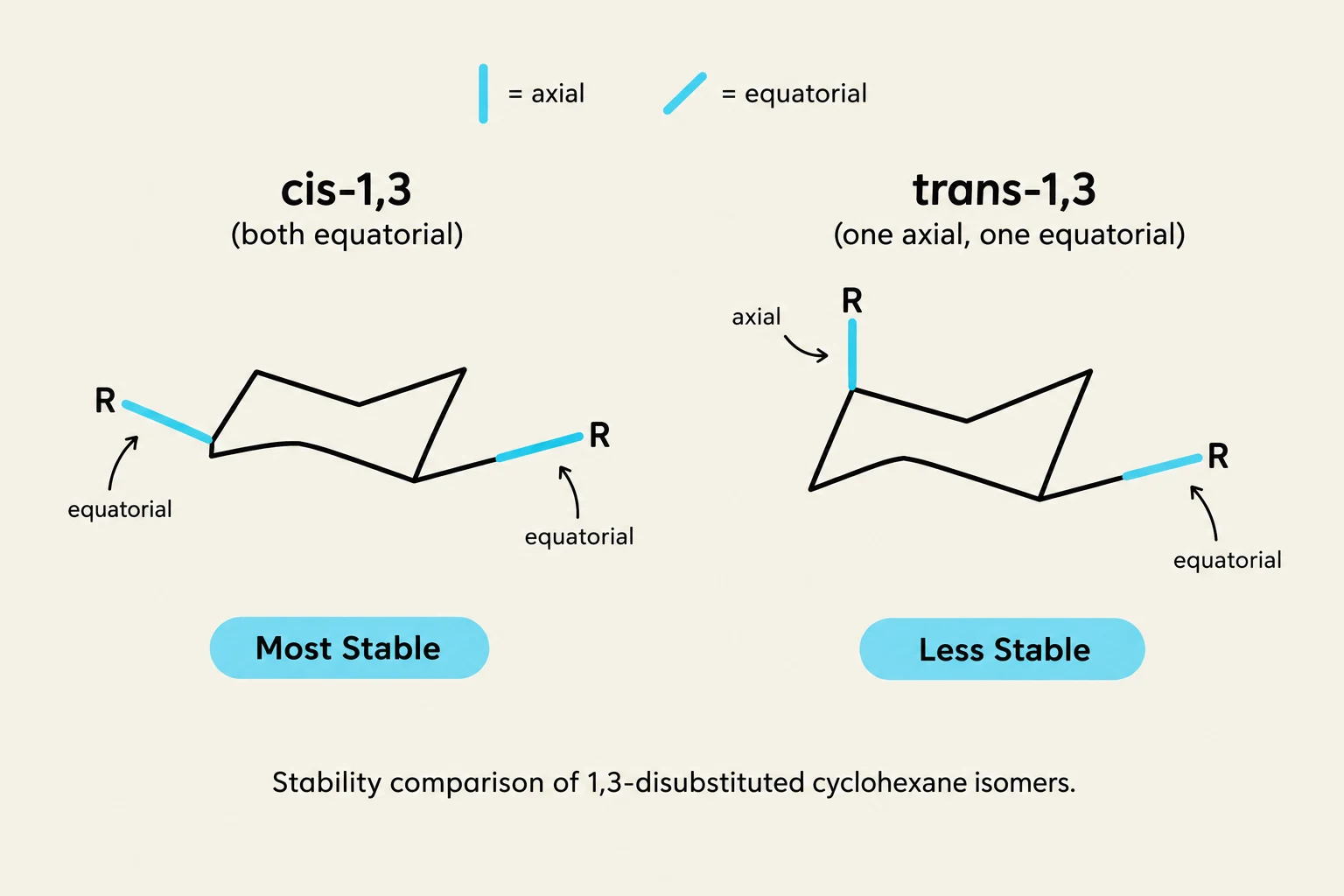
Stability comparison of cis-1,3 and trans-1,3 disubstituted cyclohexane isomers, illustrating axial and equatorial positions.
The stability of a disubstituted cyclohexane depends heavily on the relative positions (1,2, 1,3, or 1,4) of the two groups. We determine the most stable isomer by identifying which one can achieve a "diequatorial" conformation (both groups equatorial).
1,2-Disubstituted Cyclohexanes
For 1,2-disubstituted rings, the trans isomer is generally more stable than the cis isomer.
Trans-1,2: Can adopt a conformation where both groups are equatorial (diequatorial), which minimizes strain.
Cis-1,2: One group must be axial and the other must be equatorial (axial-equatorial), resulting in higher strain.
1,3-Disubstituted Cyclohexanes
In the 1,3-positioning, the trend reverses: the cis isomer is more stable than the trans isomer.
Cis-1,3: The most stable conformation allows both groups to occupy equatorial positions simultaneously.
Trans-1,3: One group is forced into an axial position, increasing the molecule's energy.
1,4-Disubstituted Cyclohexanes
Similar to the 1,2 pattern, the trans isomer is more stable.
Trans-1,4: Allows for a diequatorial arrangement.
Cis-1,4: Requires an axial-equatorial arrangement.
Predicting Stability in Highly Substituted Rings
The principles used for disubstituted rings can be extended to more complex molecules, such as trimethylcyclohexane (three methyl groups). To find the most stable arrangement for a highly substituted ring, follow these steps:
Maximize Equatorial Positions: Aim for the conformation with the fewest axial substituents.
Maximize Distance: Place substituents as far away from each other as possible.
Prioritize Large Groups: If two different groups are attached to the same carbon, the larger group must be placed in the equatorial position to minimize strain.
Worked Example: Trimethylcyclohexane
To find the most stable stereoisomer for trimethylcyclohexane, we look for the arrangement where all three methyl groups can be equatorial. This occurs when the methyl groups are placed at the 1, 3, and 5 positions.
img-0.jpegStep 1: Place the three groups as far away from each other as possible.
img-1.jpegStep 2: Attach the three methyl groups to the equatorial positions on carbons 1, 3, and 5 to achieve the most stable conformation.
Exam Tip: When asked to predict stability, always draw both possible chair conformations for a given stereoisomer. Compare the number of axial vs. equatorial groups in each. The isomer that can provide the most equatorial groups is your most stable candidate.
Keep reading for free.
Create an account to finish this reading and make it part of your study routine.