1. Light Source and Wavelength Selection
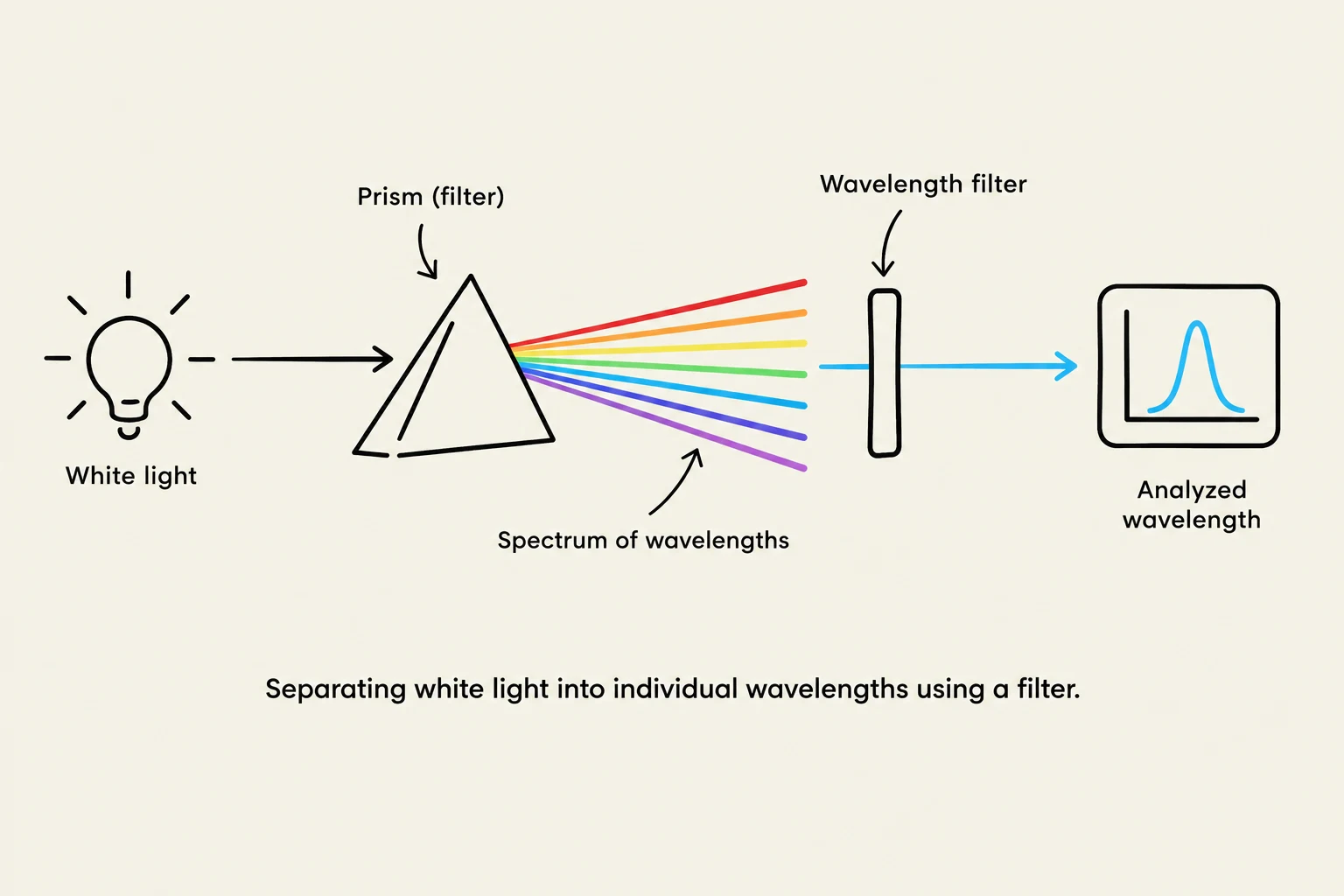
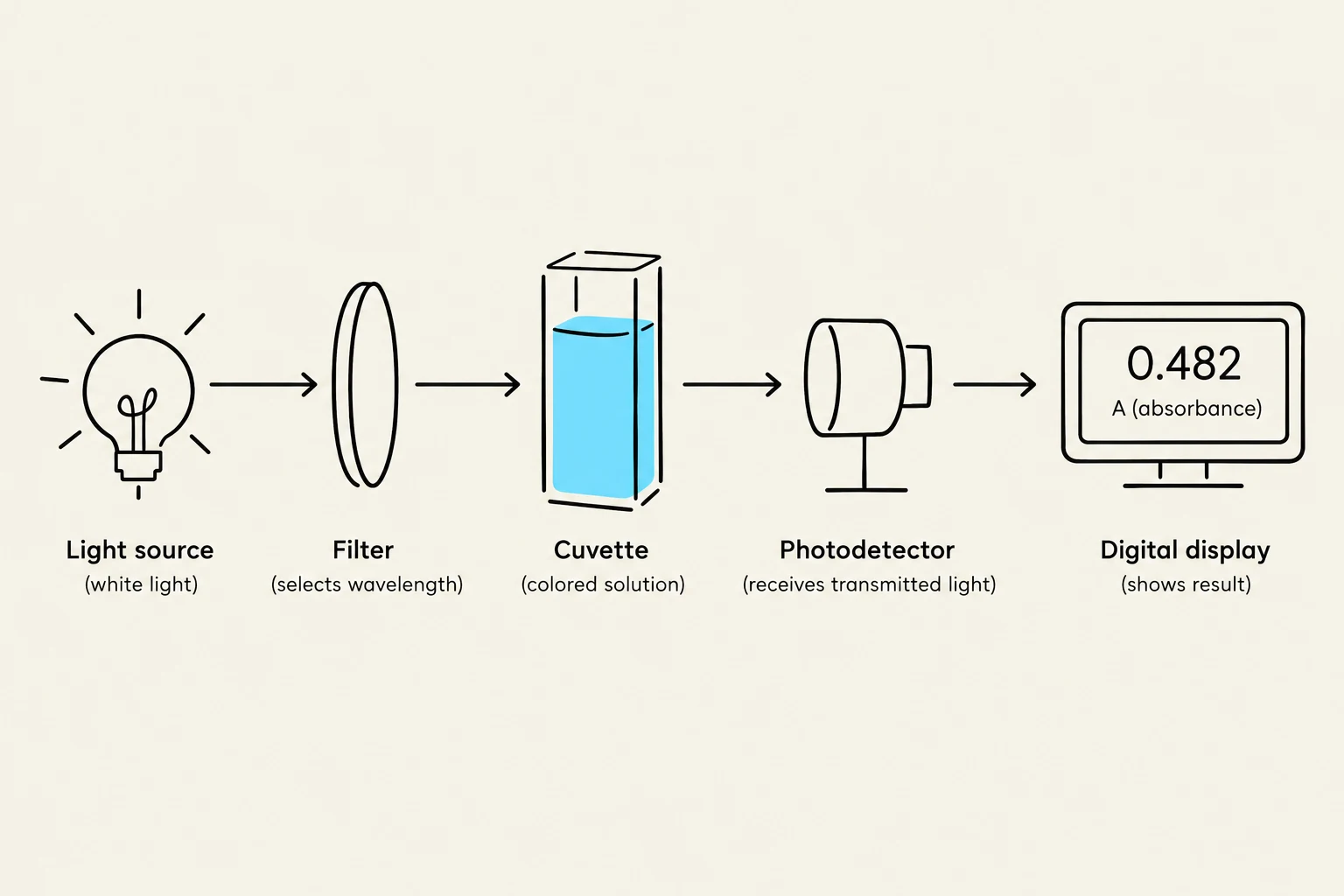
The process begins with a light source that produces white light, which is a combination of all visible wavelengths. To analyze a specific chemical, the instrument must isolate a single wavelength. This is done using a filter, which might be a prism that separates white light into a rainbow of colors or a series of colored glass plates.
2. The Sample and the Cuvette
The liquid sample is placed in a cuvette, a clear container made of glass or quartz. As the selected wavelength of light passes through the cuvette, it encounters the solute. The light is then either absorbed by the chemical or passes through the solution.
3. Calibration using a Blank
To ensure that the measurements are accurate, scientists use a blank. A blank is a cuvette containing only the solvent (usually distilled water) used to dissolve the chemical. By measuring the blank first, the instrument can be calibrated to "zero out" any light that might be absorbed by the solvent itself, ensuring that the final reading reflects only the solute being studied.
4. Detection and Conversion
Any light that is not absorbed exits the sample and hits a photodetector. This component converts the light energy into electrical energy. The magnitude of the electrical current produced is directly proportional to the amount of light that reached the detector.
Exam Tip: Always remember to recalibrate the instrument with a blank every time you change the wavelength. This re-establishes your point of reference and eliminates background interference.
Measuring Light: Transmittance vs. Absorbance
A spectrophotometer typically provides two different ways to view the data: transmittance and absorbance. While they are related, they represent different perspectives of the same event.
Transmittance (T)
Transmittance is the fraction of light that successfully passes through the sample. It is expressed as the ratio of the intensity of light exiting the sample to the intensity of light entering it. It is often expressed as a percentage:
T=IntensityentryIntensityexit
As the concentration of the solute increases, the amount of light passing through decreases, meaning transmittance decreases.
Absorbance (A)
Absorbance is the amount of radiation retained by the sample. Unlike transmittance, absorbance is a unitless ratio and is calculated as a logarithmic function of transmittance:
A=log10(T1)
As the concentration of the solute increases, the absorbance increases.
The Beer-Lambert Law and Concentration
The most powerful aspect of spectrophotometry is the mathematical relationship between light and concentration, known as the Beer-Lambert Law. This law states that absorbance is directly proportional to the concentration of the substance in the solution.
This direct relationship is incredibly convenient for scientists: if you see a twofold increase in absorbance, you can conclude there is a twofold increase in the concentration of the solute.
Practical Application: The Standard Curve
To find the concentration of an unknown solution, scientists follow a two-step process:
- Determine the Absorption Spectrum: This involves measuring the absorbance of a chemical across many different wavelengths to find its "peak absorbance" (the wavelength where it absorbs the most light).
- Build a Standard Curve: Scientists measure the absorbance of several "standard" solutions with known concentrations. They then plot these values on a graph, with concentration on the horizontal axis and absorbance on the vertical axis.
Because of the Beer-Lambert Law, this plot results in a straight line. Once this line is drawn, a scientist can measure the absorbance of an unknown sample and use the line to determine its exact concentration.
Note on Saturation: While the relationship is generally linear, extremely high concentrations of a solute can cause the relationship to become non-linear due to "saturation" effects.