Spanning Sets and Linear Combinations in Linear Algebra
Explore the fundamental concepts of linear combinations and spanning sets in linear algebra. Understand how these ideas connect to solving systems of linear equations and the geometric structure of R^n spaces, including linear independence, basis, and matrix subspaces.
In linear algebra, we often want to know if a specific collection of vectors can "build" a certain space or if some vectors in a set are simply redundant. To answer these questions, we rely on the fundamental concepts of linear combinations and spanning sets. These ideas provide the bridge between solving systems of linear equations and understanding the geometric structure of Rn spaces.
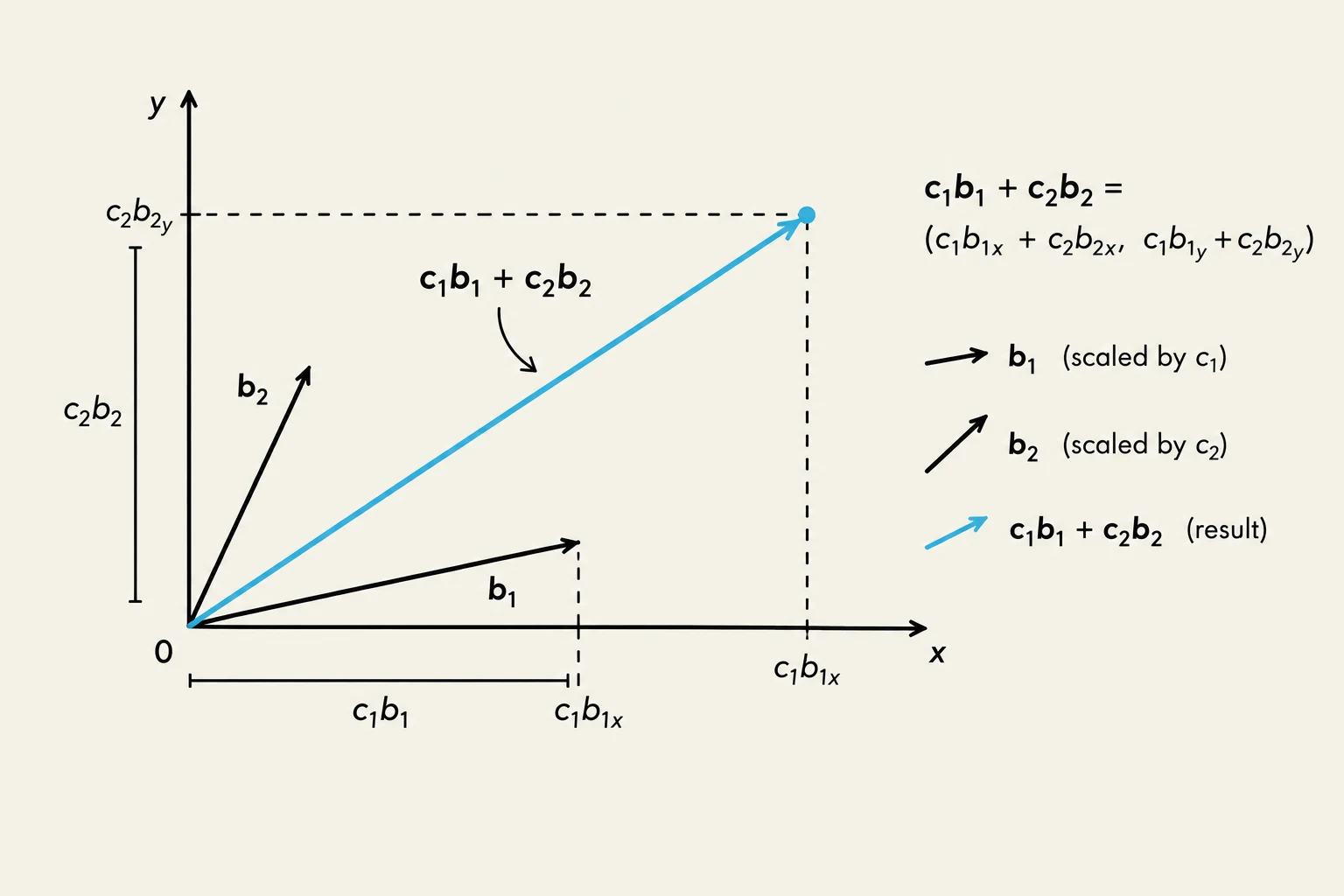
This diagram illustrates the vector addition of two scaled vectors, b1 and b2, resulting in a new vector c1b1 + c2b2. The components of the resultant vector are shown in relation to the components of the original vectors and their scaling factors.
Linear Combinations and the Span
A linear combination is the most basic way to construct new vectors from an existing set. If you have a collection of vectors S={b1,b2,…,bk}, a linear combination is formed by scaling each vector by a scalar ci and adding them together:
c1b1+c2b2+⋯+ckbk
Think of these scalars as "dials". By turning the dial for b1, you decide how much of that specific direction to include in your new vector.
The span of a set S is the collection of all possible linear combinations of those vectors. It is important to note that the span is a set of vectors, not a single value. Geometrically, if you have two vectors in R3 that are not pointing in the same direction, their span will be a 2D plane passing through the origin.
If the span of a set S covers every single vector in Rn, we say that S is a spanning set (or a generating set) for Rn.
The Connection to Linear Systems
There is a deep connection between spanning sets and solving linear systems $Ax = b$. To ask if a vector b is in the span of the columns of matrix A is exactly the same as asking if the system $Ax = b$ is consistent (has a solution). If you can find the scalars (the x values) that satisfy the equation, you have successfully expressed b as a linear combination of the columns.
Linear Independence and Redundancy
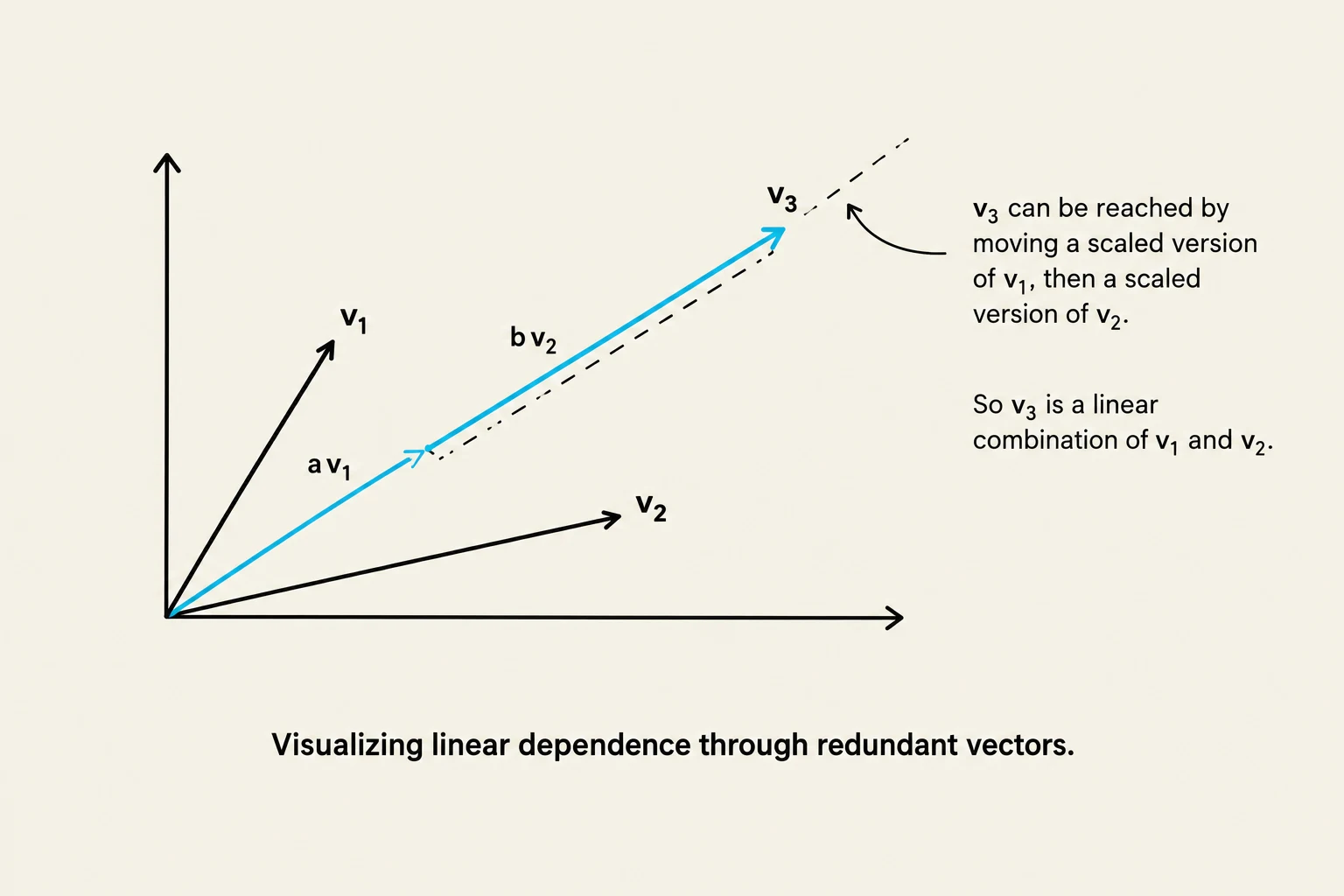
Visualizing linear dependence through redundant vectors.
While a spanning set tells us if we have enough vectors to cover a space, linear independence tells us if we have too many.
A set of vectors is linearly dependent if there is redundancy in the set—meaning at least one vector can be reconstructed using a linear combination of the others. Formally, a set is linearly dependent if there exist scalars c1,c2,…,ck, not all of which are zero, such that:
c1v1+c2v2+⋯+ckvk=0
Conversely, a set is linearly independent if the only way to reach the zero vector is to set all scalars to zero.
Exam Tip: The Two-Vector Shortcut
To quickly check if exactly two vectors are linearly independent, simply check if they are scalar multiples of one another. If one is not just a scaled version of the other (e.g., u=c⋅v), they are linearly independent and point in different directions.
Basis and Dimension
A basis is the "Goldilocks" set of linear algebra: it is a set of vectors that is just right. To qualify as a basis for a subspace, a set must satisfy two strict conditions:
They must span the subspace (they can build everything in the set).
They must be linearly independent (there is no redundancy).
If you are given a large spanning set and want to find a basis, you can simply "boil it down" by removing the redundant vectors until only the essential directions remain.
Standard Unit Vectors
In Rn, the most common basis is the standard basis, consisting of the standard unit vectors e1,e2,…,en. For example, in R3:
e1=100,e2=010,e3=001
These vectors lie along the coordinate axes and can be used to build any vector in the space through simple scaling.
Matrix Subspaces
Every matrix A is associated with three fundamental subspaces that describe its structure:
Row Space: The span of the rows of A. If two matrices are row equivalent (meaning one can be transformed into the other via row operations), they share the exact same row space. A practical way to find a basis for the row space is to take the non-zero rows of the reduced row echelon form (RREF) of the matrix.
Column Space: The span of the columns of A. While row operations change the column space, they do not change the row space.
Null Space: The set of all solutions to the homogeneous system $Ax = 0$. This set is always a subspace because it contains the zero vector and is closed under both vector addition and scalar multiplication.
Properties of Linear Systems
When dealing with a consistent system $Ax = b$, the number of solutions is strictly limited by the structure of the vectors:
Unique Solution: The system has exactly one point of intersection.
Infinitely Many Solutions: If there are at least two distinct solutions, there are automatically infinitely many. This happens because you can take the difference between two solutions (which will be a solution to the homogeneous system) and add any scalar multiple of it to your original solution, creating a line, plane, or hyperplane of solutions.
Keep reading for free.
Create an account to finish this reading and make it part of your study routine.