South African Financial Regulation: Twin Peaks Model and Key Authorities
An explanation of South Africa's Twin Peaks financial regulatory model, detailing the roles of the Financial Sector Conduct Authority (FSCA) and the Prudential Authority (PA), and the legislative framework governing Financial Service Providers (FSPs).
The South African financial services industry operates within a sophisticated regulatory environment designed to ensure stability, integrity, and the fair treatment of consumers. At the heart of this system is a structured approach to oversight that separates the monitoring of how companies behave from the monitoring of their financial health. This article explores the "Twin Peaks" model, the roles of the primary regulatory bodies, and the evolving legislative landscape that governs Financial Service Providers (FSPs).
The Twin Peaks Model and the FSRA
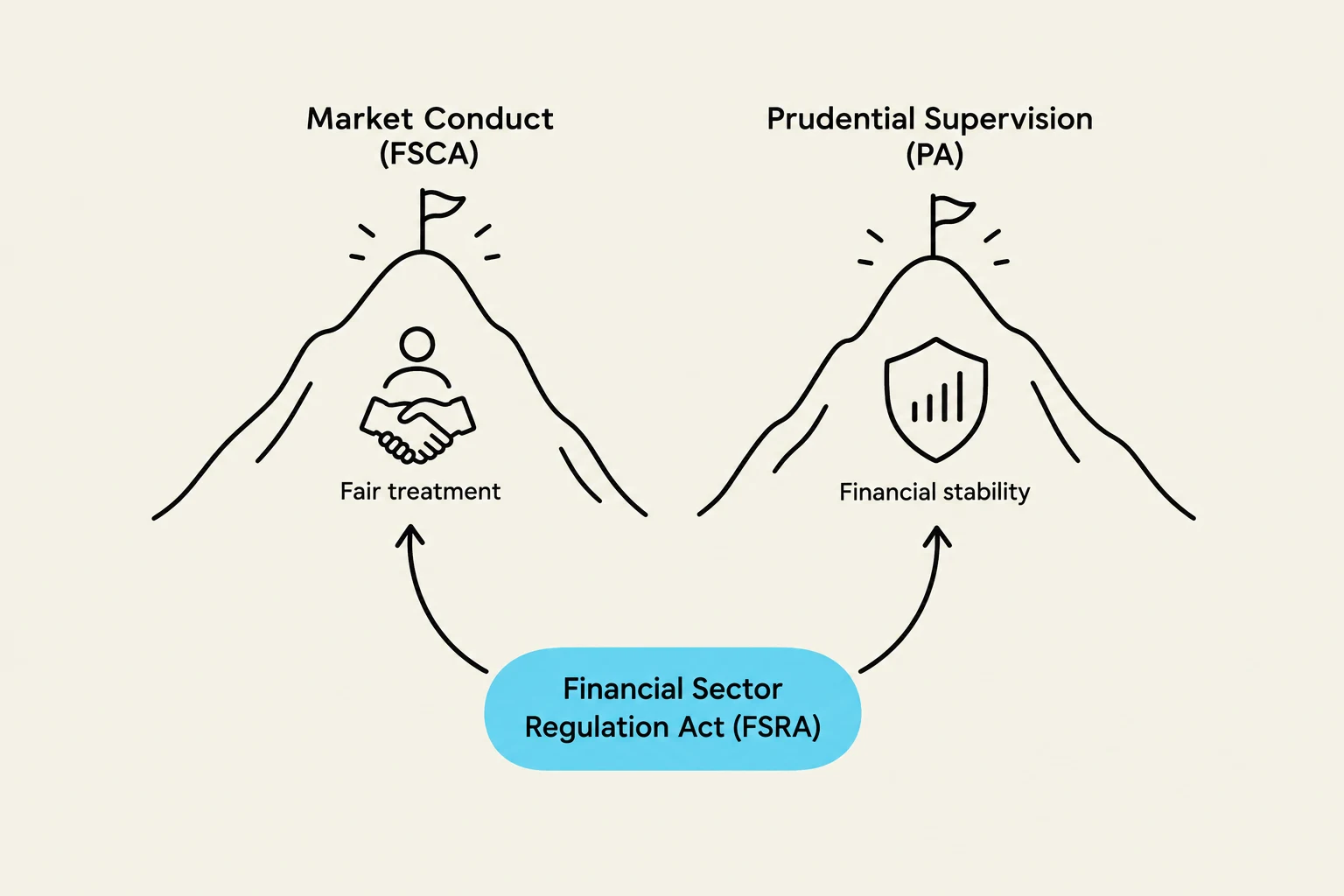
This diagram illustrates the dual objectives of financial sector regulation: Market Conduct (FSCA) aiming for fair treatment, and Prudential Supervision (PA) aiming for financial stability, both guided by the Financial Sector Regulation Act (FSRA).
Historically, financial regulation was often fragmented. To address this, South Africa implemented the Twin Peaks model, which is anchored by the Financial Sector Regulation Act (FSRA). The FSRA serves as the cornerstone of this approach, granting regulatory bodies the power to enforce appropriate regulations and make conduct standards.
The Twin Peaks model divides oversight into two distinct "peaks":
Market Conduct: Ensuring that financial institutions behave fairly toward their customers.
Prudential Supervision: Ensuring that financial institutions remain financially sound and capable of meeting their obligations.
By separating these functions, the regulator can focus intensely on consumer protection without being distracted by the complex mathematical modeling required for institutional solvency, and vice versa.
The Financial Sector Conduct Authority (FSCA)
The Financial Sector Conduct Authority (FSCA) is responsible for the "Market Conduct" peak. Formerly known as the Financial Services Board, the FSCA's primary mission is to oversee how financial institutions interact with the public.
Core Functions of the FSCA
The FSCA operates with several key objectives in mind:
Overseeing Market Conduct: Monitoring the behavior of financial institutions within the industry.
Promoting Fair Treatment: Ensuring that financial customers are treated equitably.
Financial Education: Promoting financial literacy to empower consumers.
Market Integrity: Enhancing the efficiency and overall integrity of financial markets.
To achieve these goals, the FSCA is organized into specialized core divisions:
Licensing and Business Centre: Manages the authorization and licensing of financial institutions.
Regulatory Policy Division: Handles frameworks, FinTech, and consumer education.
Conduct of Business Supervision Division: Supervises specific entities like banks, insurers, and financial advisors.
Market Integrity Supervision Division: Focuses on the health of the markets themselves.
Investigations and Enforcement Division: Handles complex cases and market abuse.
The Prudential Authority (PA)
While the FSCA watches how companies act, the Prudential Authority (PA) watches how companies are. Established under the FSRA, the PA focuses on the financial health and stability of banks and insurers.
The main objectives of the PA include:
Strengthening the safety, financial soundness, and integrity of institutions that provide financial products.
Protecting customers against the risk of institutional failure.
Assisting the South African Reserve Bank (SARB) in maintaining overall financial stability.
Financial Service Providers (FSPs) and Financial Products
Within this framework, the Financial Advisory and Intermediary Services (FAIS) Act defines the role players who provide services to the public.
Defining the FSP
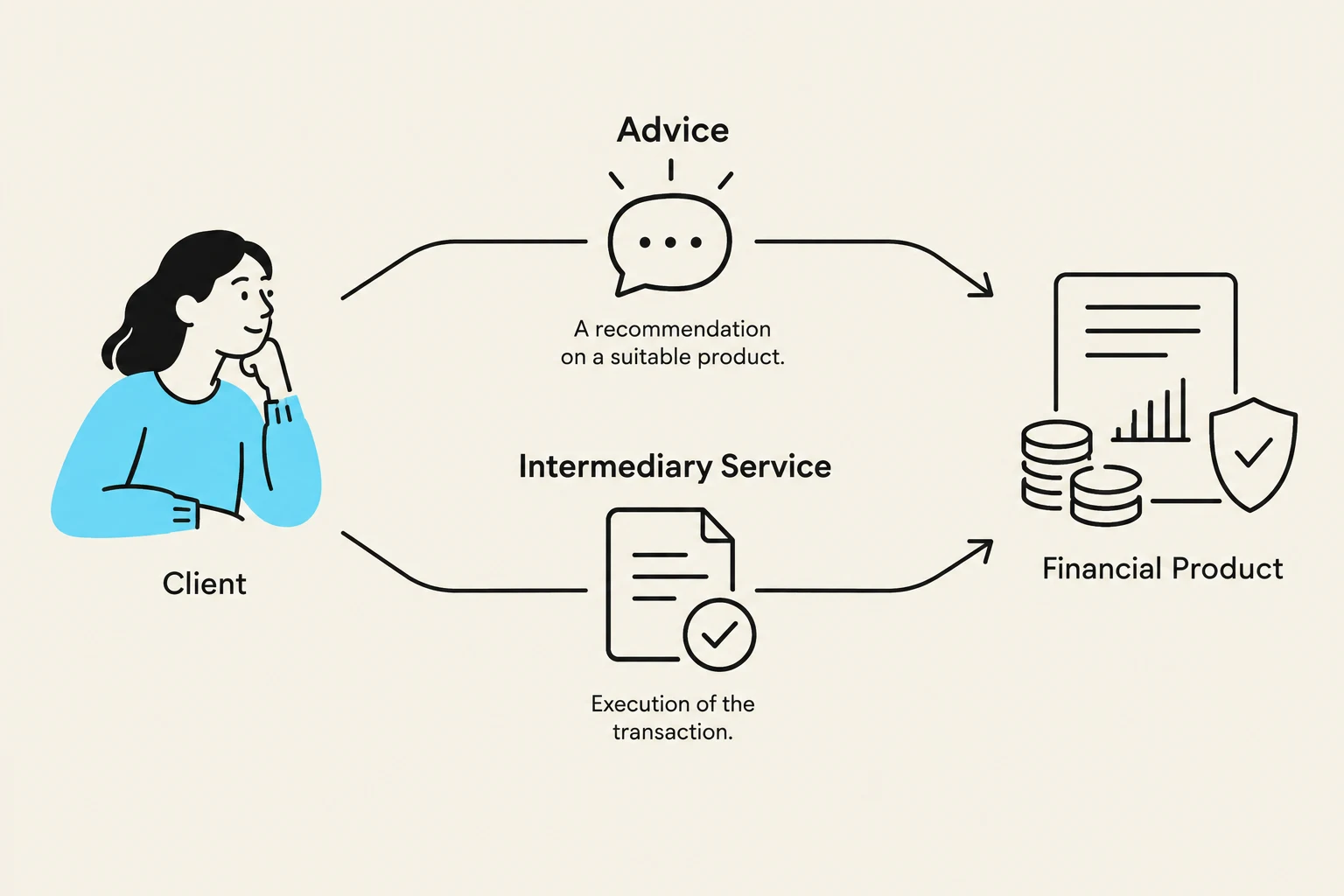
This diagram illustrates the process of a client receiving advice and intermediary services leading to a financial product.
An FSP is defined as any person (other than a Representative) who, as a regular feature of their business, furnishes advice and/or renders intermediary services.
Advice: Any recommendation, guidance, or proposal of a financial nature regarding a financial product. This includes automated advice provided via algorithms.
Intermediary Service: Any act other than advice that results in a client entering into a transaction regarding a financial product.
Understanding Financial Products
FSPs deal with various financial products, which are categorized to ensure that representatives have the correct level of competence. A recent development in the regulatory landscape is the distinction between Tier 1 and Tier 2 products:
Tier
Description
Examples
Tier 1
More complex products requiring higher competencies
Long-term deposits, certain life risk policies
Tier 2
Products with no or limited underwriting
Funeral insurance, certain short-term personal lines
Exam Tip: Remember that an FSP's license is specific to certain categories and subcategories. A Representative can only provide advice or services for the specific products for which the FSP is authorized.
The Transition: The COFI Bill
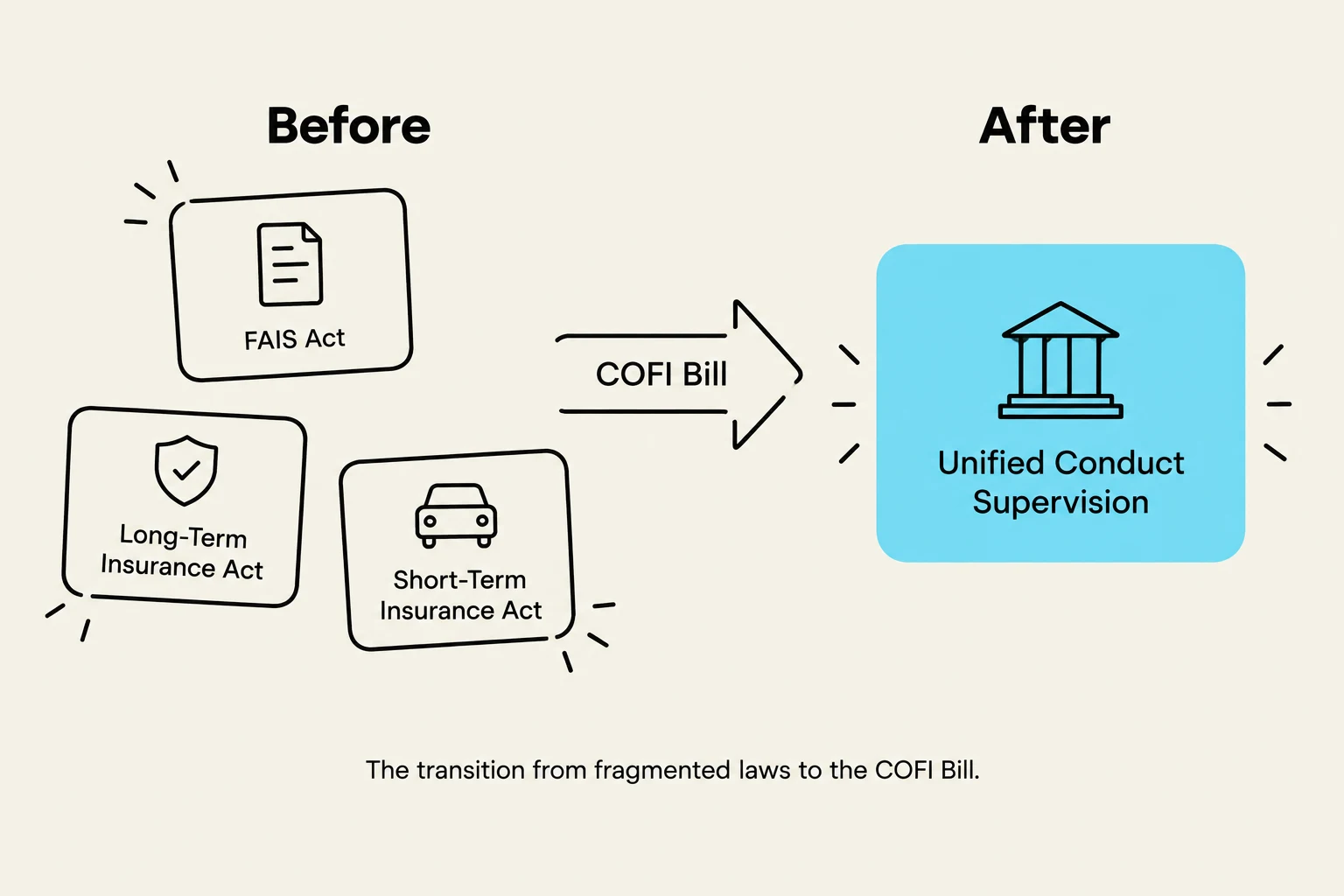
This diagram illustrates the transition from fragmented laws, such as the FAIS Act, Long-Term Insurance Act, and Short-Term Insurance Act, to a unified system under the COFI Bill, resulting in Unified Conduct Supervision.
The South African regulatory landscape is currently in a state of transition due to the Conduct of Financial Institutions (COFI) Bill.
Currently, market conduct is governed by a patchwork of different laws, such as the FAIS Act, the Long-Term Insurance Act, and the Short-Term Insurance Act. The COFI Bill aims to streamline this by:
Replacing several existing Acts (including the FAIS Act and the Insurance Acts) with a single, unified way to supervise market conduct.
Enabling conduct standards to back up legislation more effectively.
Amending other critical laws like the Pension Funds Act and the Medical Schemes Act to ensure consistency across the entire financial sector.
Compliance and Professional Standards
To maintain the integrity of the industry, the FSCA imposes strict "Fit and Proper" requirements on all Key Individuals and Representatives. This includes:
Qualifications: Meeting specific educational standards recognized by the Authority.
Regulatory Examinations (RE): Passing exams to prove knowledge of the FAIS Act, FICA, and the General Code of Conduct.
Continuous Professional Development (CPD): An ongoing requirement to complete a minimum number of training hours each cycle (e.g., 6, 12, or 18 hours depending on the number of Classes of Business handled).
Calculation Example: Pro-rated CPD Hours
If a Representative is authorized for a period of less than 12 months in a CPD cycle, their required hours are calculated using the following formula:
Z=(12X)⋅Y
Where:
X = Total annual required CPD hours.
Y = Number of months authorized during the cycle.
Z = Required pro-rated CPD hours.
Summary Table: Regulatory Oversight
Feature
Financial Sector Conduct Authority (FSCA)
Prudential Authority (PA)
Primary Focus
Market Conduct (How they behave)
Prudential (Financial health)
Main Goal
Fair treatment of customers
Financial stability and soundness
Key Legislation
FSRA, FAIS Act, COFI Bill
FSRA
Target Entities
All FSPs, Insurers, etc.
Banks and Insurers
Keep reading for free.
Create an account to finish this reading and make it part of your study routine.