Solving Systems of Linear Equations: Elimination and Substitution Methods
This guide explains how to solve systems of linear equations using the elimination and substitution methods, with step-by-step examples and explanations of geometric interpretations.
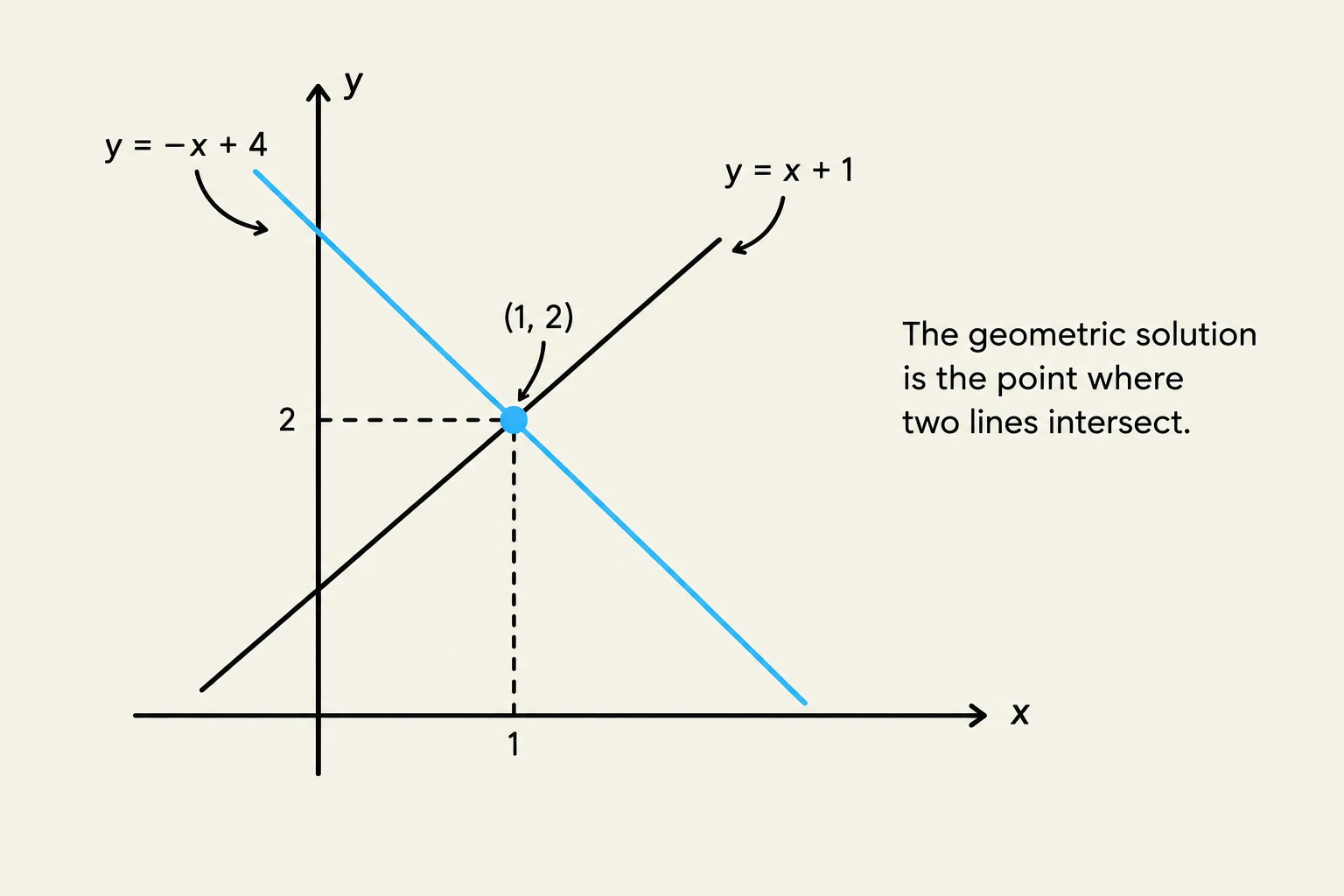
In mathematics, we often encounter situations where we need to find the values of two or more unknown variables at the same time. This is the core purpose of simultaneous equations. When we are dealing with two linear equations, we are essentially looking for the specific set of values (x,y) that makes both equations true simultaneously. Geometrically, if you were to graph these two lines on a coordinate plane, the solution is the point of intersection where the two lines meet.
This graph illustrates the intersection of two linear equations, y = -x + 4 and y = x + 1, at the point (1, 2), representing the geometric solution.
There are several algebraic strategies to solve these systems, but the two most common are the elimination method and the substitution method. This article will guide you through the mechanics of these methods using step-by-step examples.
The Elimination Method
This illustration demonstrates how multiplying an equation by a constant scales its coefficients, a technique used for aligning coefficients in systems of equations for elimination.
The elimination method is often the most efficient way to solve a system when the equations are written in standard form (e.g., $ax + by = c$). The goal is to manipulate the equations so that when you add or subtract them, one of the variables "disappears" or is eliminated.
1. Simple Addition to Cancel Variables
The easiest case for elimination occurs when the coefficients of one variable are already opposites (for example, +y and −y). In this scenario, you can simply add the two equations together to eliminate that variable.
Example 1: Direct Elimination
Consider the following system:
x+yx−y=−3=−1
Step 1: Add the equations
By adding the left sides and the right sides together, the y terms cancel out:
(x+x)+(y−y)2x=−3+(−1)=−4
Step 2: Solve for the first variable
Divide both sides by 2:
x=−2
Step 3: Substitute back to find the second variable
Now that we know x=−2, we substitute this value back into one of the original equations (let's use Equation 1) to find y:
−2+yyy=−3=−3+2=−1
Final Solution: The solution is (−2,−1).
2. Aligning Coefficients via Multiplication
Often, the variables will not cancel out immediately. In these cases, you must use coefficient manipulation by multiplying one or both equations by specific constants.
Example 2: Multiplying one equation
If the coefficients are not opposites, you can multiply one equation by a number to make them match.
3x+yx−2y=11(Eq. 1)=6(Eq. 2)
To eliminate y, we notice that Equation 2 has −2y. If we multiply Equation 1 by 2, it will have +2y:
(3x+y=11)×2⟹6x+2y=22(Eq. 1a)
Now, add Equation 1a to Equation 2:
(6x+x)+(2y−2y)7xx=22+6=28=4
Finally, substitute x=4 back into the original Equation 1:
3(4)+y12+yy=11=11=−1
Final Solution: The solution is (4,−1).
Example 3: Multiplying both equations
In more complex systems, you may need to multiply both equations by different constants to find a common coefficient.
2x−3y3x+2y=1(Eq. 1)=8(Eq. 2)
To eliminate y, we look for the least common multiple of the y coefficients (3 and 2), which is 6. We multiply Equation 1 by 2 and Equation 2 by 3:
Exam Tip: The Check Step
Always verify your final answer by substituting both x and y back into the other original equation you didn't use for the final substitution. If both sides of the equation remain equal, your solution is correct!
The Substitution Method
This illustration demonstrates the process of substituting an expression to solve a system of linear equations, thereby reducing the number of variables.
While the elimination method is powerful for standard forms, the substitution method is often preferred when one of the equations is already solved for a single variable (e.g., $y = mx + c$).
In this method, you "isolate" one variable in one equation and then "substitute" that expression into the second equation. This effectively turns a system of two equations with two variables into a single equation with only one variable, which is much easier to solve.
Summary of Steps for Solving Systems
To master solving systems of linear equations, follow this general workflow:
Analyze the coefficients: Decide if it is easier to use elimination or substitution.
Manipulate (if using elimination): Multiply equations by constants to align coefficients.
Eliminate: Add or subtract the equations to remove one variable.
Solve: Find the value of the remaining variable.
Substitute back: Plug that value into an original equation to find the second variable.
State the solution: Write your answer as a coordinate pair (x,y).
Keep reading for free.
Create an account to finish this reading and make it part of your study routine.