In the study of aqueous chemistry, one of the most visually striking phenomena is the sudden appearance of a cloudy solid when two clear liquids are mixed. This process is known as a precipitation reaction. To understand why these solids form, we must look at the behavior of ions in solution and apply a set of systematic guidelines known as solubility rules.
Understanding Electrolytes and Solubility
Before predicting precipitates, it is essential to distinguish between how substances behave when they dissolve in water. A solute that produces ions in a solution is called an electrolyte.
There are three main categories of substances in aqueous solutions:
Strong Electrolytes: These substances dissociate nearly 100% into ions. Examples include strong acids like HCl and soluble ionic compounds like NaCl.
Weak Electrolytes: These only partially dissociate into ions, existing in an equilibrium between the unionized molecule and its ions.
Nonelectrolytes: These substances dissolve in water but do not produce ions, meaning they cannot conduct electricity (e.g., sugar or ethanol).
It is a common mistake to confuse "solubility" with "electrolyte strength." For instance, BaSO4 is considered a strong electrolyte because the tiny amount that does dissolve dissociates completely into Ba2+ and SO42− ions, even though the substance is mostly insoluble.
Solubility Rules for Soluble Compounds
To predict if a reaction will produce a solid, we first identify which combinations of ions are likely to remain dissolved in the water. These are the soluble compounds. While no list of rules is perfect, the following guidelines are highly reliable:
Group I Elements and Ammonium: All salts containing Li+, Na+, K+, Cs+, Rb+, or NH4+ are soluble.
Nitrates: Salts containing the nitrate ion (NO3−) are generally soluble.
Halides: Salts containing Cl−, Br−, or I− are generally soluble, except when paired with Ag+, Pb2+, or Hg22+.
Sulfates: Most sulfate salts (SO42−) are soluble, with key exceptions: CaSO4, BaSO4, PbSO4, Ag2SO4, and SrSO4.
Hydroxides: Group I hydroxides are soluble. Group II hydroxides (such as Ca(OH)2, Sr(OH)2, and Ba(OH)2) are only slightly soluble, while hydroxides of transition metals and Al3+ are insoluble.
Identifying Insoluble Compounds
An insoluble compound is a substance that does not dissolve significantly in water. When two aqueous solutions react and produce an insoluble product, that product is called a precipitate.
If your predicted product falls into one of these categories, it will likely form a precipitate:
Silver Salts: Most silver salts are insoluble, though AgNO3 and Ag(C2H3O2) are notable soluble exceptions.
Sulfides: Transition metal sulfides (e.g., CdS, FeS, ZnS) and sulfides of arsenic, antimony, bismuth, and lead are highly insoluble.
Carbonates, Chromates, and Phosphates: These are frequently insoluble. Examples include CaCO3, PbCrO4, and Ag3PO4.
Fluorides: Many fluorides, such as BaF2 and MgF2, are frequently insoluble.
Exam Tip: Conflict Resolution
Sometimes, two rules will seem to contradict each other. For example, "Halides are soluble" and "Silver salts are insoluble." If you are asked about AgBr, the rule regarding silver takes precedence. Therefore, AgBr is insoluble and will form a precipitate.
Precipitation Reactions and Net Ionic Equations
A precipitation reaction occurs when a soluble cation combines with a soluble anion to form an insoluble solid. To accurately describe what is happening at the molecular level, chemists use net ionic equations.
Step-by-Step Example
Consider the reaction between potassium chloride (KCl) and silver nitrate (AgNO3):
Molecular Equation:KCl(aq)+AgNO3(aq)→KNO3(aq)+AgCl(s)
By applying solubility rules, we see that KNO3 is soluble (contains Group I and Nitrate), but AgCl is insoluble (Silver halide).
Total Ionic Equation:
We break all soluble strong electrolytes into their constituent ions:
K+(aq)+Cl−(aq)+Ag+(aq)+NO3−(aq)→K+(aq)+NO3−(aq)+AgCl(s)
Net Ionic Equation:
We remove the spectator ions—ions that appear unchanged on both sides of the equation (K+ and NO3− in this case). The remaining species show the actual chemical change:
Ag+(aq)+Cl−(aq)→AgCl(s)
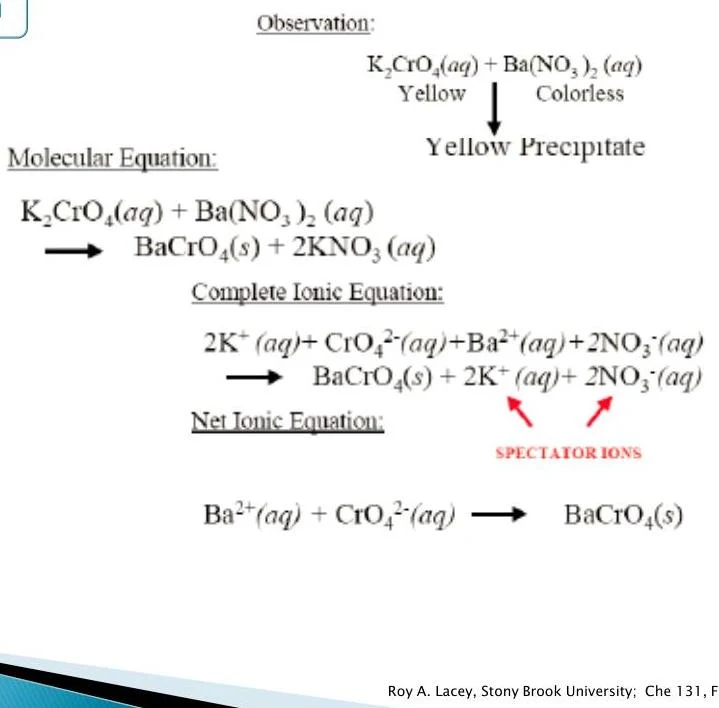
This illustration shows the molecular, complete ionic, and net ionic equations for the reaction between potassium chromate and barium nitrate, resulting in the formation of a yellow precipitate of barium chromate.
Summary Checklist for Predicting Precipitates
When presented with a reaction, follow this workflow:
Identify all possible products by swapping the cations and anions of the reactants.
Apply the solubility rules to each potential product.
If any product is identified as insoluble, a precipitate will form.
Write the net ionic equation by focusing only on the ions that form the precipitate.
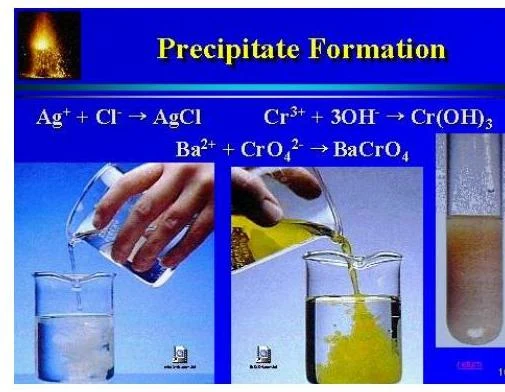
Precipitate Formation
Keep reading for free.
Create an account to finish this reading and make it part of your study routine.