Learn how to predict the formation of precipitates in aqueous solutions using solubility guidelines. This guide covers electrolytes, soluble and insoluble compounds, and the process of writing net ionic equations.
In aqueous chemistry, when two solutions containing dissolved ions are mixed, a chemical change often occurs. One of the most common changes is the formation of a solid from two clear liquids. This solid is known as a precipitate. To predict whether such a reaction will occur, chemists rely on a set of established solubility guidelines that help distinguish between soluble salts and insoluble compounds.
Understanding Solubility and Electrolytes
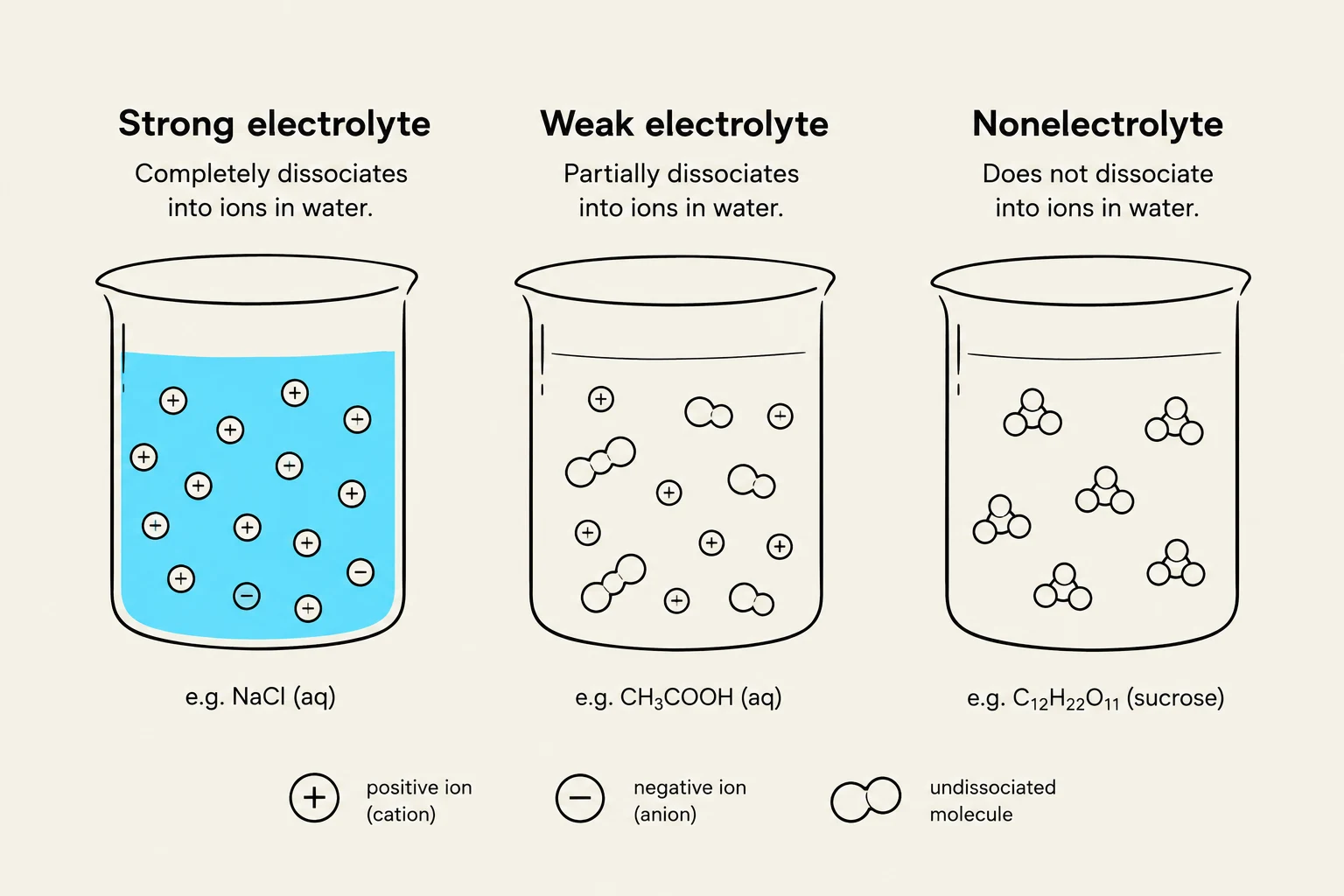
Before predicting precipitates, it is essential to understand what happens when a substance dissolves in water. A substance is considered soluble if it dissolves in a solvent. However, solubility is distinct from the concept of an electrolyte. An electrolyte is a solute that produces ions in solution, allowing the liquid to conduct electricity.
Strong Electrolytes: These substances nearly 100% dissociate into ions (e.g., NaCl or HNO3).
Weak Electrolytes: These only partially dissociate into ions (e.g., acetic acid).
Non-electrolytes: These dissolve in water but do not form ions, meaning no electrical conduction occurs (e.g., sugar).
Crucial Distinction: Do not confuse solubility with electrolyte strength. For example, BaSO4 is very slightly soluble, but the tiny amount that does dissolve dissociates completely into ions, making it a strong electrolyte.
Diagram illustrating the dissociation of strong electrolytes, weak electrolytes, and nonelectrolytes in water, with examples of NaCl, CH3COOH, and sucrose.
Solubility Guidelines: Predicting Soluble Salts
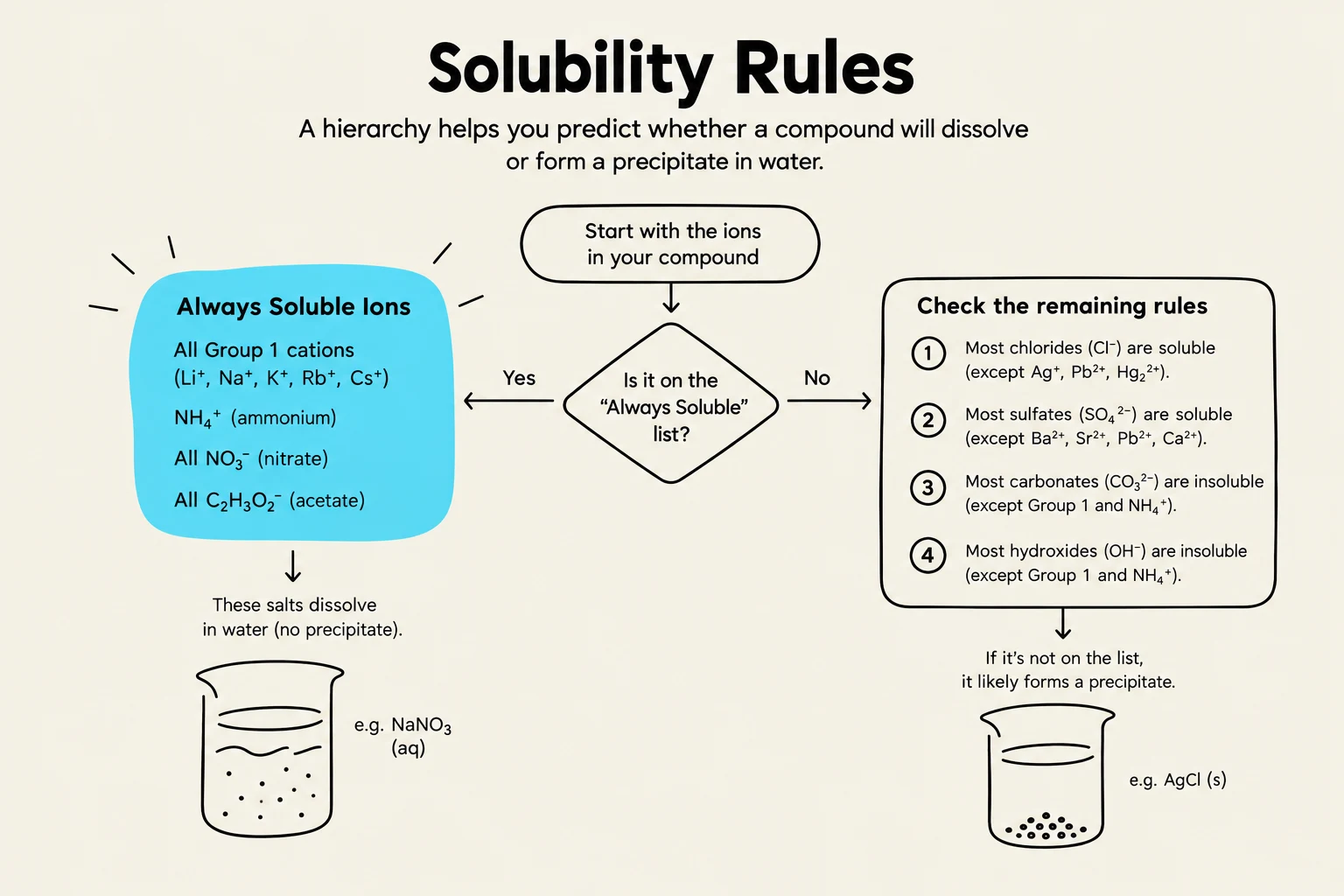
To predict if a compound will stay dissolved or crash out of solution as a solid, we follow specific rules. While no rule is absolute, these guidelines are highly reliable for most chemical predictions.
The "Always Soluble" Rules
Certain ions are almost always found in soluble compounds. If you see these in a formula, you can generally assume the compound will be soluble:
Group I Elements and Ammonium: Salts containing Li+, Na+, K+, Cs+, Rb+, or NH4+ are soluble.
Nitrate Ion: Any salt containing the nitrate ion (NO3−) is generally soluble.
The "Generally Soluble" Rules (With Exceptions)
Some ions are usually soluble, but they have specific "enemies" that force them to form precipitates:
3. Halide Salts: Salts containing Cl−, Br−, or I− are generally soluble.
* The Exception: These halides are insoluble when paired with silver (Ag+), lead (Pb2+), or mercury (Hg22+). For example, AgCl is insoluble.
4. Sulfate Salts: Most sulfate salts (SO42−) are soluble.
* The Exception:CaSO4, BaSO4, PbSO4, Ag2SO4, and SrSO4 are notable exceptions that are insoluble or only slightly soluble.
5. Hydroxide Salts: Hydroxide (OH−) salts of Group I elements are soluble, but most other hydroxides are only slightly soluble.
* The Exception: Hydroxides of Group II elements (like Ca, Sr, and Ba) are slightly soluble, while hydroxides of transition metals and Al3+ are typically insoluble.
This flowchart illustrates the solubility rules for ionic compounds in water, helping to predict whether a compound will dissolve or form a precipitate.
Identifying Insoluble Compounds
When the guidelines above are applied, we can identify compounds that are likely to form solids. The following groups are frequently insoluble:
Silver Salts: Most silver salts are insoluble, with the common exceptions being silver nitrate (AgNO3) and silver acetate (Ag(C2H3O2)).
Transition Metal Sulfides: Most sulfides of transition metals (such as CdS, FeS, ZnS, and Ag2S) are highly insoluble.
Carbonates: Carbonates are frequently insoluble, including Group II carbonates like CaCO3 and BaCO3.
Chromates and Phosphates: Chromates (e.g., PbCrO4) and phosphates (e.g., Ag3PO4) are frequently insoluble.
Fluorides: Many fluorides, such as BaF2 and PbF2, are frequently insoluble.
Precipitation Reactions and Net Ionic Equations
A precipitation reaction occurs when two aqueous solutions react to form an insoluble solid. To determine if a precipitate will form, you must examine all potential products of the reaction. If even one product is insoluble according to the guidelines, a precipitate will form.
Worked Example: Predicting a Precipitate
Consider the reaction between silver nitrate and sodium sulfide:
$3AgNO_{3}(aq) + Na_{2}S(aq) \rightarrow Ag_{2}S(s) + 2NaNO_{3}(aq)$
Analyze NaNO3: Nitrates are generally soluble, so this remains in solution.
Analyze Ag2S: Sulfides of transition metals/silver are highly insoluble. Therefore, Ag2S will form a precipitate.
The Net Ionic Equation
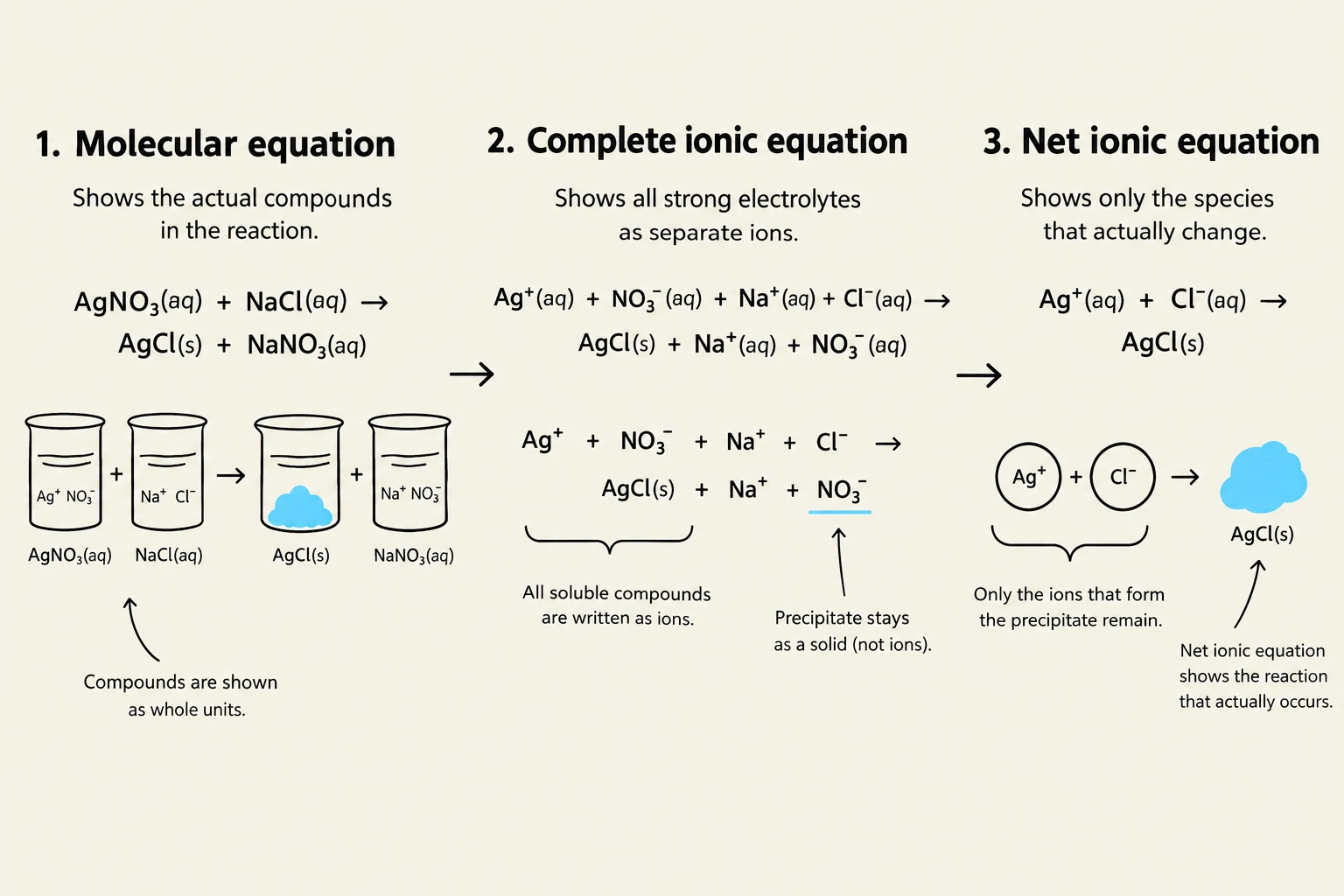
While a "molecular equation" shows the complete formulas, a net ionic equation focuses only on the species actually participating in the chemical change. It removes "spectator ions"—ions that remain dissolved in the solution unchanged.
Exam Tip: When writing a net ionic equation, only include the ions that combine to form the solid precipitate. All other ions are spectators and should be omitted.
This illustration explains the process of forming a molecular equation, a complete ionic equation, and a net ionic equation, using the reaction between silver nitrate and sodium chloride as an example. It visually depicts the transformation of compounds into ions and the formation of a precipitate.
Example Problem:
Will a precipitate form when 0.1 M aqueous solutions of AgNO3 and NaCl are mixed? If so, provide the net ionic equation.
Predict products:AgNO3+NaCl→AgCl+NaNO3
Check solubility:NaNO3 is soluble (nitrate rule). AgCl is insoluble (halide exception rule).
Identify spectators:Na+ and NO3− are spectator ions.
Write Net Ionic Equation:Ag+(aq)+Cl−(aq)→AgCl(s)
Keep reading for free.
Create an account to finish this reading and make it part of your study routine.