Solidification and Nucleation Mechanisms in Metals
Explores the fundamental processes of solidification in metals, focusing on homogenous and heterogeneous nucleation, Gibbs free energy, critical radius, and the resulting grain structures. Discusses industrial implications for material properties.
When metals are processed for industrial use, they are often melted and then cast into molds to create specific shapes. This transition from a liquid state to a solid state is known as solidification. Understanding how this process occurs at the atomic level is crucial for engineers, as the way crystals form determines the final grain structure and mechanical properties of the metal.
The Thermodynamics of Solidification
To understand why a liquid turns into a solid, we must look at the Gibbs free energy (G). In thermodynamics, the Gibbs free energy represents the energy available to do work, and it varies with temperature. At a specific temperature, the phase with the lowest Gibbs free energy is the most stable.
When a metal is cooled below its melting temperature (Tm), the solid phase becomes more stable than the liquid phase. This temperature difference (Tm−T) is referred to as undercooling or supercooling. During this process, the metal releases the latent heat of fusion as it transitions from liquid to solid.
The transformation involves two competing energy changes:
Volume free energy (ΔGV): This is the energy released by the liquid-to-solid transformation. Because the solid is more stable below Tm, this value is negative, meaning it favors solidification.
Surface energy (ΔGS): Forming a new solid particle creates a new solid-liquid interface. Creating this surface requires an input of energy, which acts as a barrier to solidification.
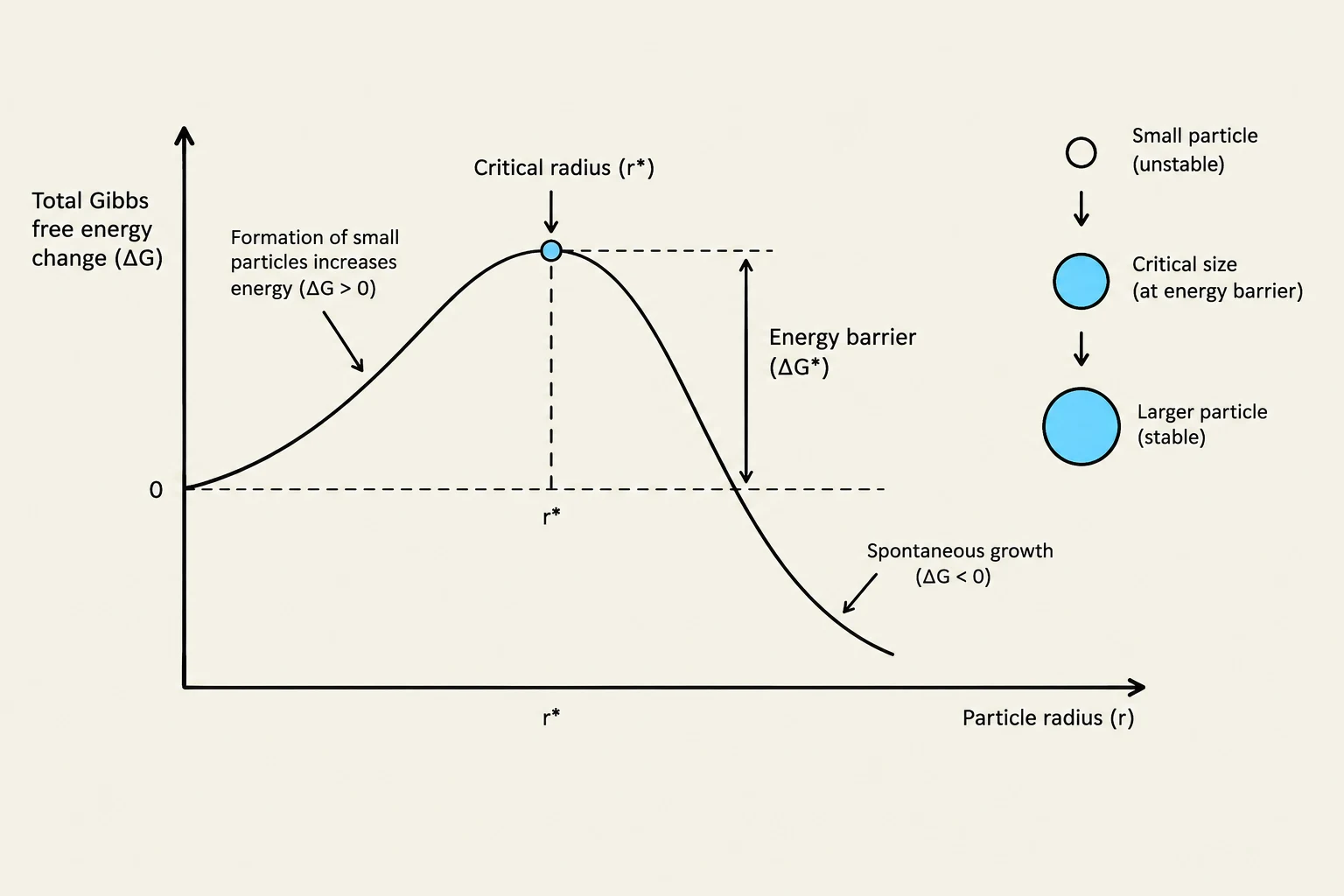
This graph illustrates the relationship between the total Gibbs free energy change (ΔG) and particle radius (r). It shows that the formation of small particles increases energy, reaching a critical radius (r*) with an associated energy barrier (ΔG*). Beyond this critical point, spontaneous growth occurs as the free energy change becomes negative (ΔG < 0), leading to larger, stable particles.
Homogenous Nucleation
In homogenous nucleation, the metal atoms themselves provide the material to form new nuclei. As the molten metal is significantly undercooled, atoms begin to bond together to form small clusters.
Embryos vs. Stable Nuclei
Not every cluster of atoms survives. A small cluster of atoms is called an embryo. Because of the high surface-area-to-volume ratio in very small clusters, the energy required to maintain the surface often outweighs the energy gained from the volume change. Consequently, many embryos are unstable and dissolve back into the liquid.
If an embryo grows large enough to reach a specific size, known as the critical radius (r\*), it becomes a stable nucleus. Once a nucleus is stable, it will continue to grow into a crystal grain. As these grains grow, they eventually meet one another, forming grain boundaries.
The total free energy change (ΔGT) for a spherical nucleus of radius r is expressed as:
ΔGT=34πr3ΔGV+4πr2γ
Where γ is the specific surface energy.
Exam Tip: Remember that for very small radii, the surface energy term (r2) dominates, making ΔGT positive. As r increases, the volume term (r3) dominates, making ΔGT negative. The point where the slope is zero is the critical radius r\*.
The relationship between the critical radius and undercooling (ΔT) is given by:
r∗=ΔHfΔT2γTm
Where ΔHf is the latent heat of fusion. This means that greater undercooling results in a smaller critical radius, making it easier for stable nuclei to form.
Heterogeneous Nucleation
In real-world industrial applications, solidification rarely happens through pure homogenous nucleation. Instead, heterogeneous nucleation occurs. This happens when the molten metal solidifies on the surfaces of its container or on insoluble impurities within the melt.
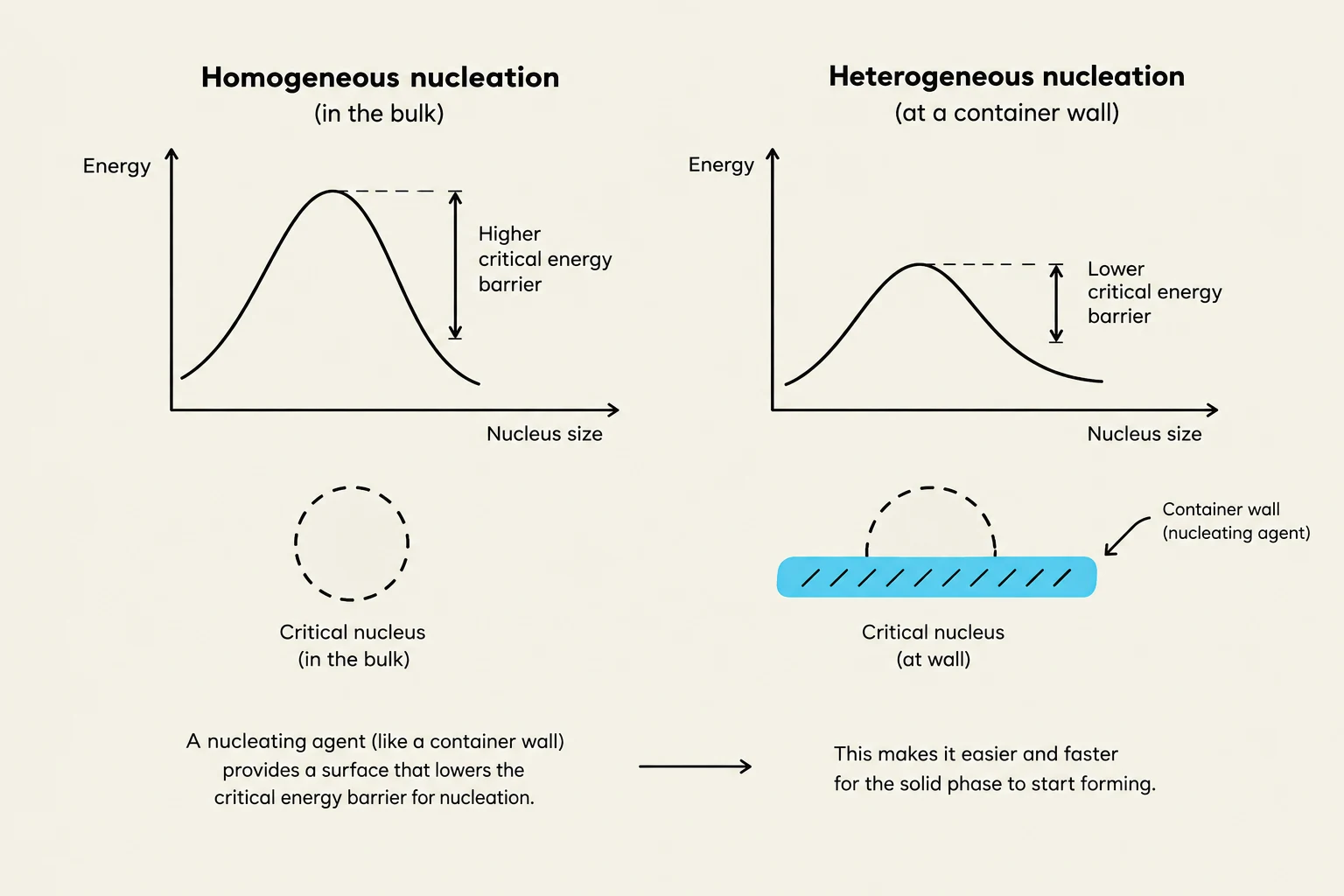
These surfaces act as nucleating agents. They provide a "head start" by reducing the amount of new surface area that needs to be created, thereby lowering the total energy barrier. Because the energy requirement is lower, heterogeneous nucleation requires much less undercooling than homogenous nucleation.
This diagram illustrates homogeneous and heterogeneous nucleation, showing how a nucleating agent like a container wall lowers the critical energy barrier for solid phase formation.
Grain Structure and Industrial Implications
The mechanism of nucleation directly dictates the resulting microstructure of the metal:
Equiaxed Grains: These are smaller crystals that grow equally in all directions. They typically form at sites with a high concentration of nuclei, such as near a cold mold wall.
Columnar Grains: These are long, thin, and coarse crystals that grow predominantly in one direction. They form in areas of slow cooling and steep temperature gradients, often away from the mold walls.
In industry, controlling grain size is vital. Smaller grains result in more grain boundaries, which increase a metal's resistance to slip and make the metal stronger at room temperature. To achieve a fine grain size in aluminum alloys, manufacturers often add "grain refiners" like Titanium, Boron, or Zirconium.
Conversely, some high-tech applications, such as gas turbine blades or silicon wafers for computer chips, require single crystals. In these cases, the growth rate is kept extremely slow to ensure the entire component grows as one continuous crystal lattice without grain boundaries.
Keep reading for free.
Create an account to finish this reading and make it part of your study routine.