A comprehensive guide to the fundamental principles of solar photovoltaic (PV) systems, covering electrical concepts, system components, design factors, and safety standards.
Preparing for the NABCEP Associate exam requires a firm grasp of both theoretical electrical principles and the practical application of solar technology. This guide serves as a comprehensive review of the core concepts—ranging from Ohm's Law to system design and safety—that form the foundation of professional solar photovoltaics (PV) practice.
Electrical Fundamentals
To design and troubleshoot solar systems, you must first master the relationship between voltage, current, and resistance. A common way to visualize these concepts is through a hydraulic analogy: voltage is analogous to water pressure, while current is analogous to the flow of water.
Ohm’s Law and Power Calculations
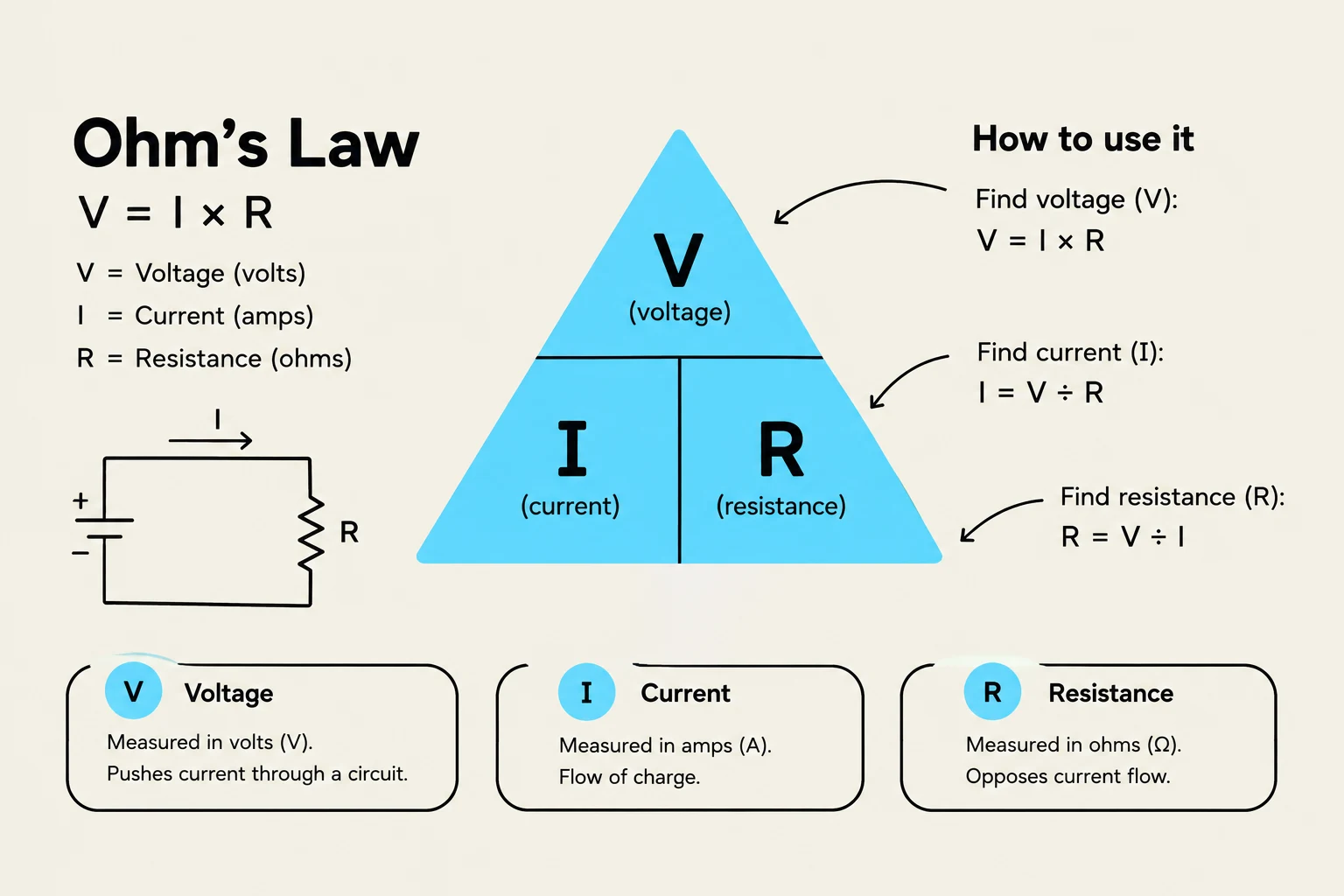
Ohm’s Law defines the fundamental relationship between voltage (V), current (I), and resistance (R) using the formula:
V=I⋅R
In a PV system, voltage and current are directly proportional. Furthermore, power (P) is the product of voltage and current:
P=V⋅I
Power is measured in Watts (W), while energy (E) is the product of power and time (t):
E=P⋅t
Energy is typically measured in Watt-hours (Wh) or kilowatt-hours (kWh).
Exam Tip: Do not confuse power and energy. Power is a rate (like speed), whereas energy is the total amount consumed over time (like distance).
Ampacity and Voltage Drop
When selecting conductors, you must consider ampacity, which is the maximum current-carrying ability of a wire. If a wire is too small for the current, it will heat up and potentially melt its insulation. Additionally, designers must account for voltage drop, which is the loss of voltage as electricity travels through a conductor.
Ohm's Law illustrates the relationship between voltage, current, and resistance in an electrical circuit. It states that voltage (V) is equal to current (I) multiplied by resistance (R). The diagram shows how to calculate each variable if the other two are known, and provides definitions for voltage, current, and resistance.
PV System Components and Configuration
A solar PV system is composed of various modules, inverters, and controllers, all configured to maximize energy harvest.
Module Connections: Series vs. Parallel
How you connect solar modules determines the electrical characteristics of your PV source circuit (string):
Series Connections: Connecting the positive terminal of one module to the negative of the next increases the total voltage, while the current remains the same as a single module.
Parallel Connections: Connecting modules in parallel increases the total current, while the voltage remains the same as a single module.
Inverters and MPPT
The inverter is a critical component that converts Direct Current (DC) from the modules into Alternating Current (AC) for use in buildings or the grid.
Microinverters: These are connected directly at the module level.
MPPT (Maximum Power Point Tracking): This technology, found in many inverters and charge controllers, constantly adjusts the electrical operating point to extract the maximum possible power from the PV array.
Bypass Diodes
To mitigate the negative effects of shading, modules are equipped with bypass diodes located in the junction box. These diodes allow current to flow around shaded cell groups, preventing a single shaded cell from significantly reducing the power output of the entire module.
Diagram illustrating how bypass diodes in a PV module divert current around shaded cells to prevent power loss.
Design and Environmental Factors
Solar design is heavily influenced by the environment, particularly temperature and the position of the sun.
Temperature Effects on Voltage
Temperature has a significant impact on PV performance. As the temperature of a module decreases, the Open Circuit Voltage (Voc) increases. This is a critical safety consideration: designers must use the temperature coefficient of the module to calculate the maximum possible voltage at the lowest expected design temperature to ensure the voltage does not exceed the inverter's limits. Conversely, on hot days, designers use the Maximum Power Voltage (Vmp) to ensure the system maintains minimum operating voltage.
Orientation: Azimuth and Tilt
To maximize annual production, the orientation of the array is vital.
Tilt Angle: In temperate latitudes, a tilt of approximately 30∘ is often ideal for annual production. To maximize winter production when the sun is lower in the sky, a steeper tilt (Latitude +15∘) is recommended.
Azimuth: This refers to the compass direction the panels face.
Irradiance and Insolation
Understanding solar resource measurements is essential for sizing systems:
Irradiance: The instantaneous power per unit area, typically measured in W/m2.
Insolation (Irradiation): The total energy received per unit area over a specific period.
Safety and Standards
Safety is the most important aspect of any solar installation.
OSHA and Fall Protection
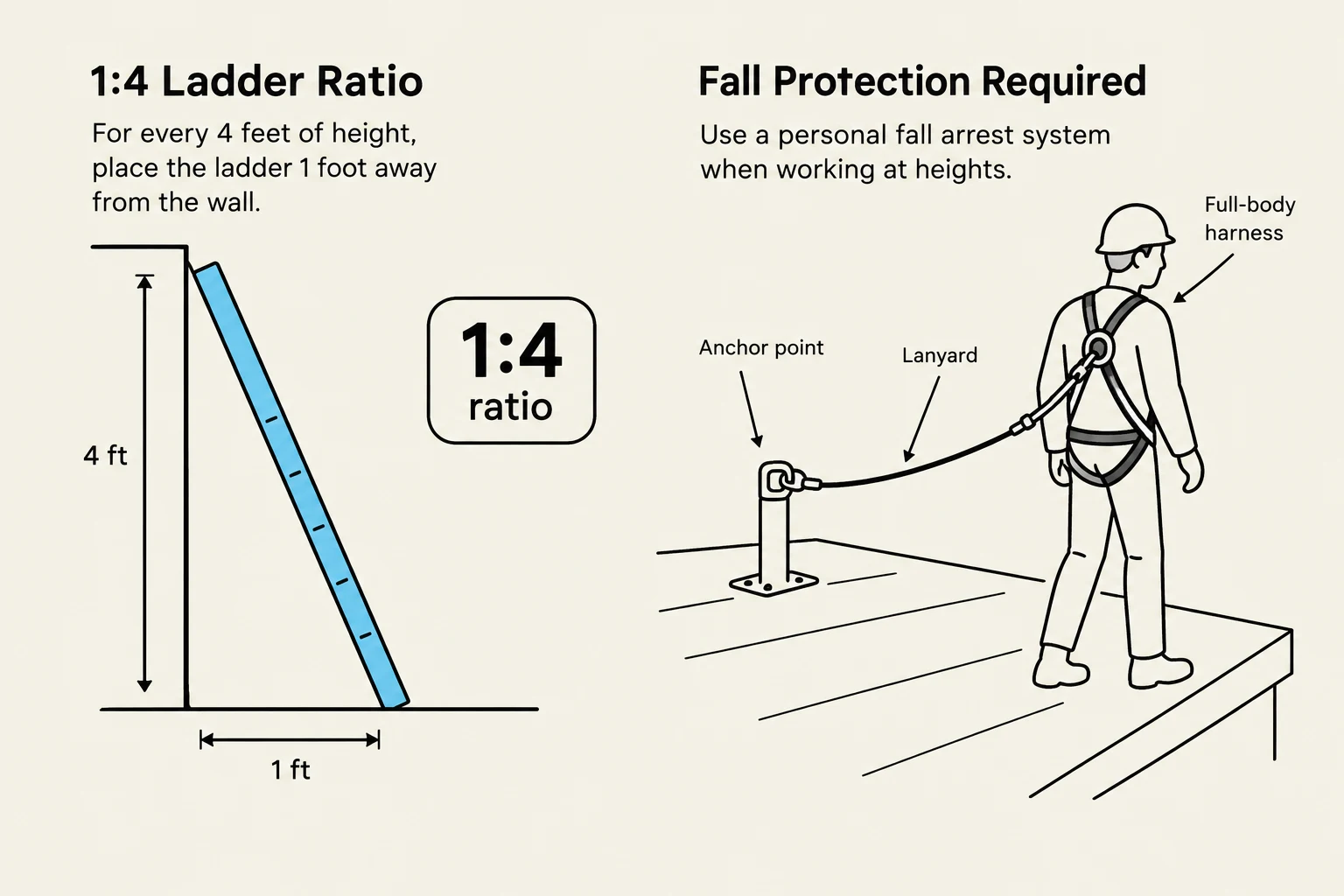
The Occupational Safety and Health Administration (OSHA) governs workplace safety. In the solar industry, fall protection is the most critical type of Personal Protective Equipment (PPE).
Height Requirement: Fall protection is required at heights of 6 feet or more.
Ladder Safety: When using a ladder, maintain a 1:4 ratio (for every 4 feet of height, the base should be 1 foot away from the wall). Always maintain three points of contact.
Electrical Safety
Working with DC electricity carries risks of arcing and arc flashes. An arc is a plasma discharge that can cause fires. An arc flash is an explosion caused by a massive release of energy during an arc.
Safety Note: Always use a Lockout-Tagout (LOTO) kit when performing maintenance to ensure the system cannot be accidentally energized while you are working.
Diagrams illustrating the 1:4 ladder ratio for safe ladder placement and the components of a fall protection system including a full-body harness, lanyard, and anchor point.
By mastering these fundamentals—from the math of Ohm's Law to the physics of temperature coefficients and the rigors of OSHA safety standards—you will be well-prepared to tackle the technical challenges of the NABCEP Associate exam and a career in solar energy.
Keep reading for free.
Create an account to finish this reading and make it part of your study routine.