Sociological Perspectives on Social Problems, Power, and Social Capital
Explores how social problems are defined and constructed, the influence of power and media, and the concepts of social capital, social boundaries, rituals, and imagined communities. Includes a case study on sports.
How do we decide what is "wrong" with society? Is a shopping spree a personal choice, an environmental disaster, or a tool used by the ruling class to maintain control? In sociology, these are not just personal questions; they are structural ones. This article explores how social problems are constructed, how power dictates these definitions, and how social capital and rituals shape our sense of belonging and identity.
Defining Social Problems: The Power of Construction
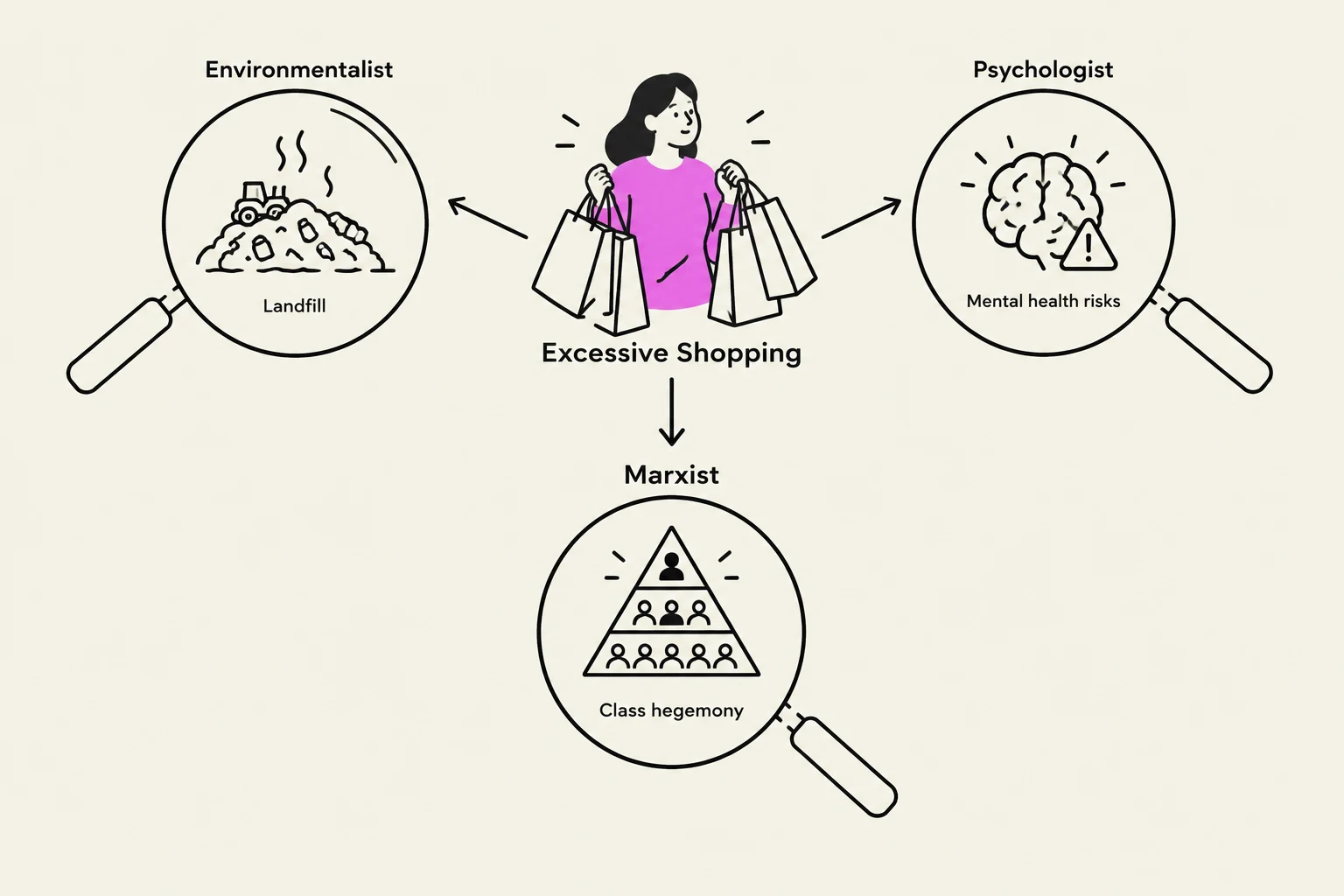
This diagram illustrates the multifaceted perspectives on excessive shopping, including environmental impacts (landfill), psychological consequences (mental health risks), and Marxist analysis (class hegemony).
A social problem is defined as a situation or behavioral pattern that is socially identified as pathological, meaning it is viewed as something that requires regulation, treatment, or improvement.
Crucially, what constitutes a "problem" is not an objective truth waiting to be discovered; rather, it is socially constructed. This means that different sociological lenses will view the same behavior in vastly different ways. For example, consider the act of shopping:
An Environmentalist might view excessive shopping as a social problem due to resource depletion and waste.
A Psychologist might view shopping as a social problem if it manifests as a pathological behavioral pattern (such as compulsive buying).
A Marxist Sociologist might interpret shopping not as a problem to be fixed, but as a mechanism through which hegemony—the dominance of one social class over others—is achieved.
Exam Tip: When analyzing a social issue, always ask: Who is defining this as a problem, and what political or economic interests do they serve?
Power and the Media
The definition of a social problem is inextricably linked to power. Powerful groups often exert significant influence over mass media, which allows them to dictate which issues are labeled as "problematic" and which are ignored.
By controlling the narrative, these groups can also influence the "solutions" presented to state actors. If a group can frame a problem in a specific way, they can ensure that the resulting laws or regulations benefit their own interests while appearing to be "viable and reasonable" to the public.
Social Capital: Bonds and Boundaries
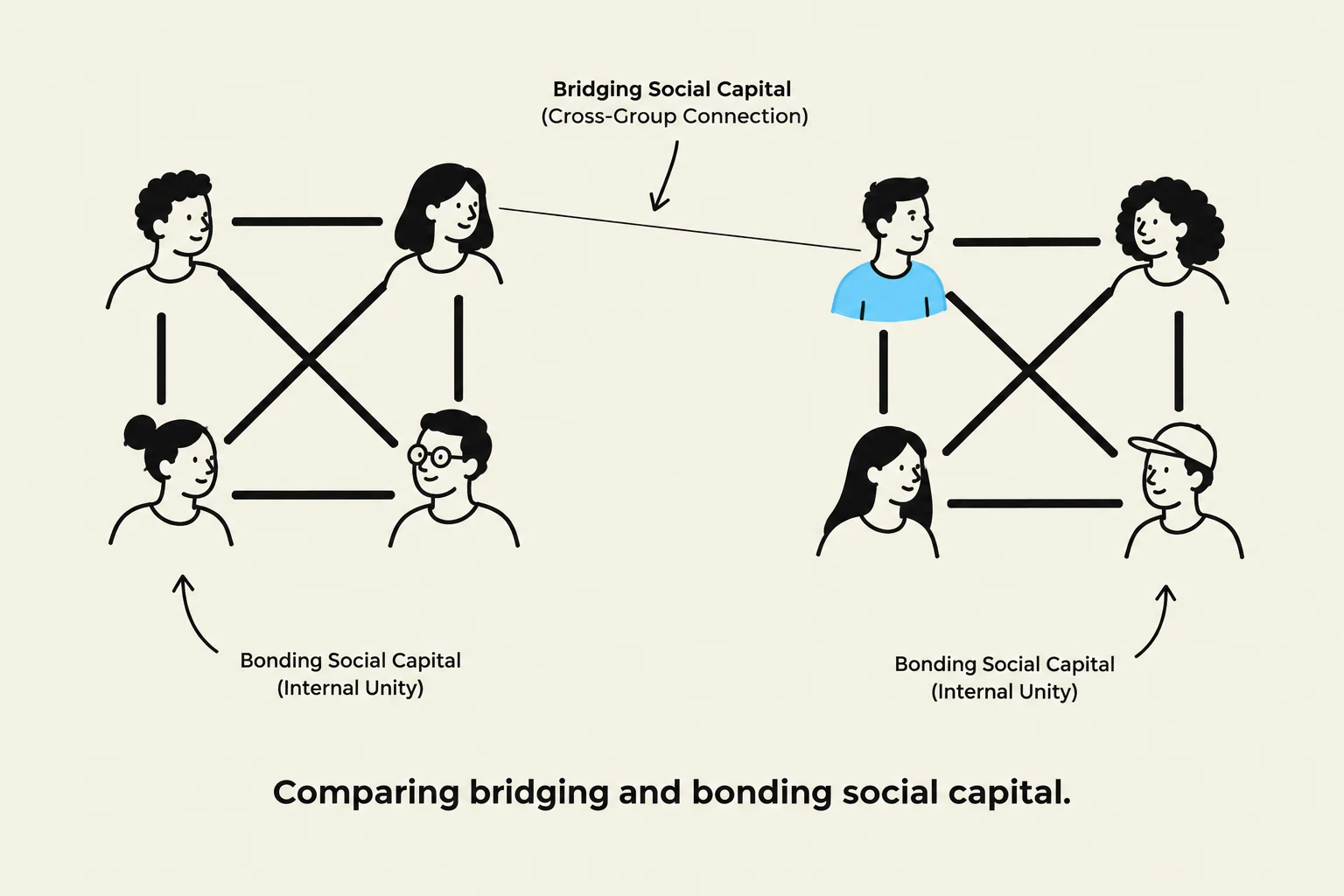
This diagram illustrates the concepts of bridging and bonding social capital, differentiating between internal unity within a group and cross-group connections.
Sociologists are not only interested in how people come together, but also in how they are kept apart. This brings us to the concept of social capital, which refers to the resources available to individuals through the maintenance and enhancement of social relationships and bonds.
To understand how social capital functions, we must look at three key dimensions:
1. Social Boundaries and Location
Sociologists examine social location—the position an individual occupies within a social structure—to understand their access to resources. Central to this is the creation of social boundaries, which are the distinctions made between "insiders" and "outsiders".
2. Bridging Social Capital
Bridging social capital involves fostering connections among individuals who are socially distant. This type of capital is essential for social cohesion across different groups, helping to prevent fragmentation.
3. Bonding Social Capital
Bonding social capital refers to the mechanisms that allow people who are already socially tied to reinforce their sense of identity and group belonging. While this strengthens internal group unity, it can also reinforce the boundaries that separate "us" from "them."
Rituals and the Imagined Community
This diagram illustrates the cyclical relationship between shared rituals, imagined communities, and individual identity, showing how rituals foster a sense of belonging which in turn reinforces individual identity.
How do large groups of people, who may never meet, feel a sense of unity? This is achieved through ritual. In a sociological sense, a ritual is a cultural practice that serves to affirm group membership or shared values.
Through these rituals, individuals participate in an imagined community. Even if you do not know every other member of your group, the shared rituals create an intense sense of belonging (or, conversely, a sense of intense disdain for those outside the group).
Case Study: Sports as a Social Arena
Sports provide a perfect microcosm for observing these sociological concepts in action. Participation in and consumption of sports (buying tickets, apparel, or watching on TV) acts as a powerful tool for social interaction and identity formation.
Social Mobility vs. Inequality
Sports can serve as a vehicle for social mobility, offering individuals a pathway to move up the social hierarchy. However, sports are not a neutral playing field; they often reflect and reinforce existing inequalities related to:
Social Class
Race
Gender
Essentialism
In-Groups and Out-Groups
Through the lens of sports, we see the tension between bonding and bridging. Sports can foster an intense sense of "in-group" belonging, but they can also serve as sites for social division, creating sharp "out-group" distinctions between rival fans or different social strata.
Keep reading for free.
Create an account to finish this reading and make it part of your study routine.